
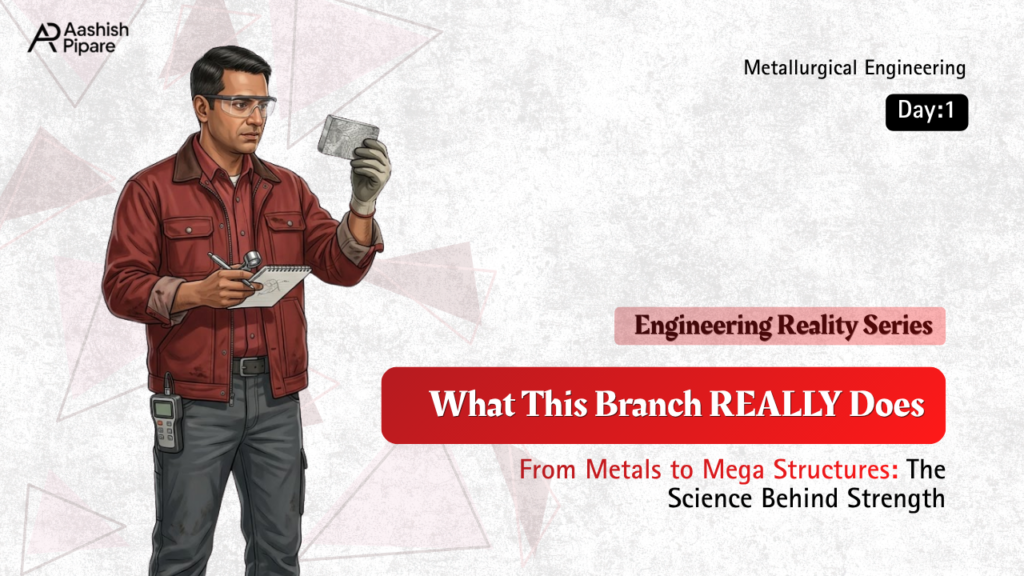
🔹What is the core problem domain this branch solves?
Metallurgical Engineering fundamentally deals with understanding, controlling, and improving the behavior of metals and materials under different physical, chemical, and mechanical conditions. The core problem it addresses is how to convert naturally occurring raw materials (ores) into useful, reliable, and high-performance engineering materials. In nature, metals are rarely found in pure form; they exist as ores mixed with impurities. Therefore, metallurgical engineers develop processes such as extraction, refining, and alloying to transform these ores into usable metals.
For example, iron ore extracted from mines cannot be used directly. It undergoes processes like beneficiation, smelting in blast furnaces, and refining to produce steel. This steel is then further processed to achieve desired properties such as strength, hardness, ductility, and toughness. Metallurgical engineers carefully control temperature, pressure, and chemical composition to achieve these results.
Another major problem this field solves is material failure analysis. When a bridge collapses, a machine part breaks, or a pipeline leaks, metallurgical engineers investigate the root cause. This may involve studying fatigue, corrosion, creep, or improper material selection. For instance, a cracked railway track may fail due to repeated cyclic loading, which can be prevented by improving material design.
The branch also focuses on material selection, ensuring that the right material is used for the right application. For example, aircraft require lightweight yet strong alloys, while marine structures require corrosion-resistant materials. Sustainability is another key concern, where engineers work on recycling metals and reducing energy consumption during production.
Overall, Metallurgical Engineering solves the critical challenge of transforming raw materials into safe, efficient, and durable products that support modern infrastructure and technology.
🔹What are the primary outputs of this field?
The primary outputs of Metallurgical Engineering are metals, alloys, and advanced engineered materials that serve as the backbone of modern industries. These outputs are not just raw metals but carefully designed materials with specific properties tailored for different applications.
Basic metals such as iron, aluminum, copper, and zinc are produced through extraction and refining processes. However, pure metals are often not sufficient for engineering applications, so they are combined to form alloys. For example, steel is an alloy of iron and carbon, which provides improved strength and durability compared to pure iron. Stainless steel, which contains chromium, offers excellent corrosion resistance and is widely used in kitchens, medical instruments, and construction.
In advanced industries, metallurgical engineers develop high-performance alloys such as titanium alloys for aerospace applications. These materials are lightweight, strong, and capable of withstanding extreme temperatures. Similarly, nickel-based superalloys are used in jet engines and turbines due to their ability to perform under high thermal stress.
Another important output is processed forms of metals, such as sheets, rods, wires, and plates, which are used in manufacturing industries. For example, copper wires are essential for electrical transmission due to their excellent conductivity.
Metallurgical engineering also contributes to modern innovations like nanomaterials and smart materials. Shape memory alloys, for instance, can return to their original shape after deformation and are used in medical devices and robotics.
Additionally, the field produces materials for electronics, energy systems, and biomedical applications. These outputs directly influence product performance, safety, and efficiency. Without metallurgical engineering, modern industries like automotive, aerospace, and electronics would not exist in their current form.
🔹How is this branch different from closely related branches?
Metallurgical Engineering is unique because it focuses specifically on materials and their behavior, especially metals, rather than machines or processes alone. While it overlaps with other engineering branches, its core perspective is entirely different.
For instance, Mechanical Engineering focuses on designing machines and systems, but it depends on metallurgical engineering to provide suitable materials. A mechanical engineer may design a car engine, but a metallurgical engineer determines which alloy can withstand high temperatures, pressure, and wear inside that engine.
Similarly, Chemical Engineering deals with chemical processes and reactions, but metallurgical engineering applies these principles specifically to metal extraction and refining. For example, chemical engineers may study reaction kinetics, while metallurgical engineers use those reactions to extract metals from ores in furnaces.
One of the most important distinguishing features is the study of microstructure. Metallurgical engineers analyze materials at the microscopic level using tools like microscopes and X-ray analysis. The arrangement of atoms and grains inside a material determines its properties such as strength and toughness. This level of detail is not the primary focus in most other engineering branches.
Metallurgical engineers also play a key role in quality control and failure prevention. They ensure that materials meet required standards and do not fail during operation. For example, if a bridge fails, metallurgical engineers analyze the material to identify defects or weaknesses.
Thus, Metallurgical Engineering acts as a bridge between science and engineering, connecting material science with practical industrial applications.
🔹What are the real-world applications of this field?
Metallurgical Engineering has vast real-world applications, making it one of the most essential branches of engineering. It plays a critical role in industries ranging from construction to advanced technology.
In the construction industry, metallurgy is used to produce strong and durable steel for buildings, bridges, and infrastructure. Without high-quality steel, modern skyscrapers and large structures would not be possible. In the automotive industry, metallurgical engineers develop lightweight and strong materials that improve fuel efficiency and safety.
In aerospace, high-performance alloys are used to manufacture aircraft and spacecraft components. These materials must withstand extreme temperatures, pressure, and stress. For example, turbine blades in jet engines are made from special alloys that can operate at very high temperatures.
The electronics industry relies on metallurgical engineering for conductive materials like copper and aluminum used in circuits and wiring. Medical applications include implants such as artificial joints and dental implants made from biocompatible materials like titanium.
The energy sector also depends heavily on metallurgy. Power plants use materials that can withstand high temperatures and pressures. Renewable energy systems, such as wind turbines and solar panels, also require specialized materials.
Even in daily life, metallurgical engineering is present in utensils, tools, and appliances. From kitchen knives to smartphones, metals play a crucial role.
Thus, the field impacts both large-scale industries and everyday life, making it indispensable in modern society.
🔹What industries heavily depend on this branch?
Metallurgical Engineering supports a wide range of industries that rely on materials for their operations. The steel industry is the most prominent, producing materials for construction, infrastructure, and manufacturing. Without metallurgy, large-scale construction would not be possible.
The mining industry depends on metallurgical processes to extract metals from ores efficiently. Engineers design processes to maximize yield and minimize waste. The automotive industry relies on metallurgy to produce lightweight, strong, and durable components for vehicles.
The aerospace industry uses advanced alloys for aircraft and spacecraft, where performance and safety are critical. The oil and gas industry requires corrosion-resistant materials for pipelines and drilling equipment, as they operate in harsh environments.
Power generation industries use metallurgical knowledge to design turbines, boilers, and heat-resistant components. The electronics industry depends on conductive and reliable materials for circuits and devices.
Defense organizations use metallurgy for weapons, armor, and protective equipment. Manufacturing industries require processed metals for producing machinery and consumer goods. Even the recycling industry relies on metallurgical processes to reuse metals efficiently.
Companies like Tata Steel and JSW Steel are examples of industries heavily dependent on metallurgy.
Thus, Metallurgical Engineering is a foundation industry, supporting both heavy industries and advanced technologies globally.