
Introduction
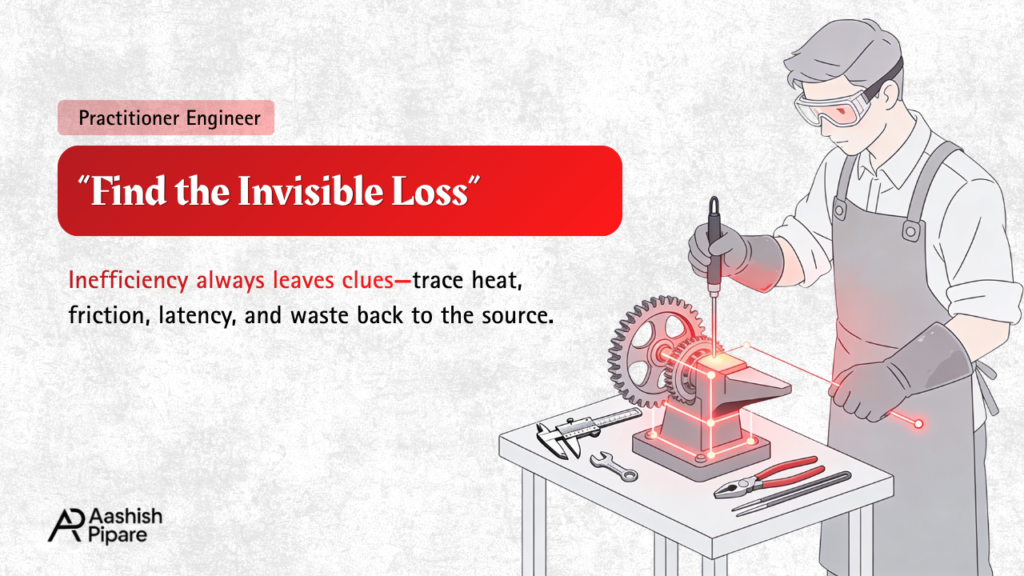
No system is perfectly efficient.
Where there is work, there is loss—and where there is loss, there is a story about design, assumptions, and missed understanding.
Every Loss Has a Cause
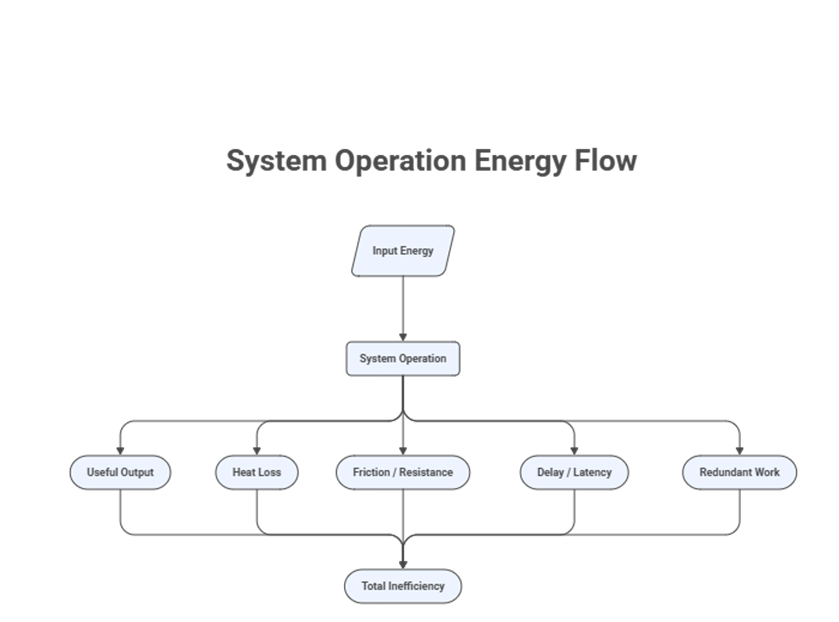
Energy does not disappear—it transforms. In engineering systems, wasted energy often shows up as heat, vibration, noise, delay, or unnecessary repetition.
These losses are not random. They originate from specific design choices, material limitations, or system interactions. Friction in mechanical systems, resistance in electrical circuits, latency in software, or redundant steps in processes—all are forms of energy being diverted away from useful output.
A practitioner engineer learns to see inefficiency not as a side effect, but as a signal of incomplete optimization.
What It Really Means to “Waste Energy”
Energy waste is not just about power consumption—it is about value not being realized.
A system may consume energy exactly as designed, yet still be inefficient if that energy does not contribute meaningfully to the intended outcome.
For example:
- A motor generating excess heat is converting electrical energy into thermal loss instead of motion
- A software system waiting on slow I/O is wasting computational potential
- A production process with repeated steps is consuming time and human effort unnecessarily
In each case, the system is functioning—but not respecting the energy it consumes.
Hidden Sources of Inefficiency
The most obvious losses are often addressed first, but deeper inefficiencies remain hidden in less visible layers of the system.
These include:
- Overdesign: components operating far below capacity but still consuming energy
- Mismatched interfaces: poor alignment between subsystems causing additional work
- Idle states: systems consuming energy while not performing useful tasks
- Redundant operations: repeating processes due to lack of coordination
These inefficiencies persist because they are normalized. They do not cause immediate failure, but they quietly degrade system performance over time.
Tracing Loss Back to Origin
A practitioner engineer does not stop at identifying loss—they trace it back to its source.
This requires asking deeper questions:
- Why is this heat being generated?
- Why is this delay occurring?
- Why is this step repeated?
Each “why” leads closer to the root cause, which is often not physical but conceptual—an assumption, a design shortcut, or a missing integration.
For example:
- Friction loss may trace back to poor material selection or lack of lubrication strategy
- Electrical loss may originate from inefficient circuit design or improper load matching
- Process inefficiency may come from unclear system boundaries or communication gaps
Understanding origin transforms inefficiency from a symptom into a solvable problem.
Why Efficiency Is a Design Responsibility
Efficiency is not an afterthought—it is a design principle.
Every unit of wasted energy has implications:
- Increased operational cost
- Reduced system lifespan
- Environmental impact through excess resource consumption
Efficiency reflects how seriously an engineer treats the resources of the system—whether electrical, mechanical, computational, or human.
A well-designed system does not just work—it works with intention, minimizing waste at every stage.
Observing Systems in Operation
True inefficiencies often reveal themselves only under real operating conditions.
Lab conditions and simulations may not expose:
- Load variations
- Environmental influences
- Human interaction patterns
A practitioner engineer observes systems in the field:
- listening for abnormal noise
- measuring temperature variations
- analyzing performance under stress
These observations provide clues about where energy is being lost and why.
Visual Representation
Practical Table
| Area of Observation | Why It Matters | Example |
| Heat generation | Indicates conversion of useful energy into loss | Overheating motor or processor |
| System delays | Shows wasted time and underutilized resources | Slow data processing due to inefficient algorithms |
| Mechanical resistance | Direct energy loss due to friction | Poor lubrication in moving parts |
| Idle energy consumption | Energy used without productive output | Machines running without load |
| Redundant processes | Repetition increases total energy usage | Duplicate steps in manufacturing workflow |
Key Takeaways
- Energy waste is always traceable—it has a specific origin
- Inefficiency is not just loss, but unrealized system potential
- Hidden inefficiencies often exist in normalized system behavior
- Root cause analysis is essential to reduce energy loss
- Efficiency reflects engineering responsibility toward resources
- Real-world observation is critical to identifying true inefficiencies
Conclusion
To ask where energy is being wasted is to look beyond function and into intention.
A system that works is not necessarily a system that respects its resources. Every inefficiency is a quiet signal that something in the design, interaction, or understanding is incomplete.
A practitioner engineer develops the habit of noticing these signals—of questioning not just whether a system operates, but how well it uses what it is given.
Because in the end, efficiency is not only about performance. It is about responsibility—to the system, to the user, and to the world that supplies the energy in the first place.