

Introduction
In engineering measurements and calculations, two words appear frequently: accuracy and precision. They are often used interchangeably in everyday conversation, but in engineering they represent two very different ideas. Understanding the difference is essential because confusing them can lead to serious design and measurement errors.
What Accuracy Really Means
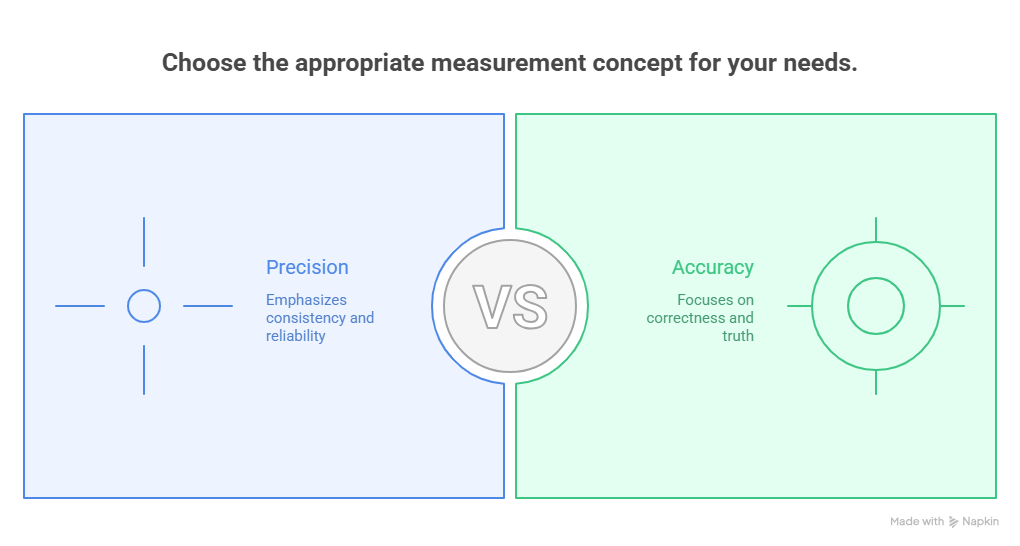
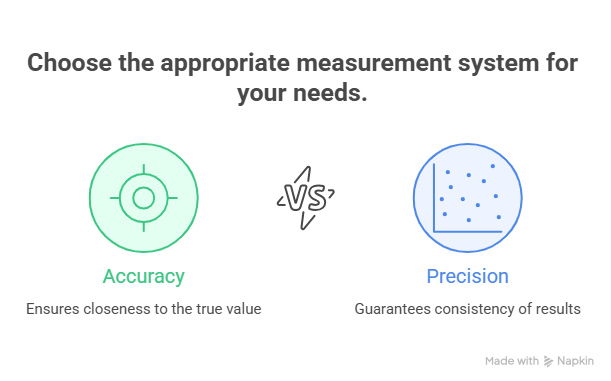
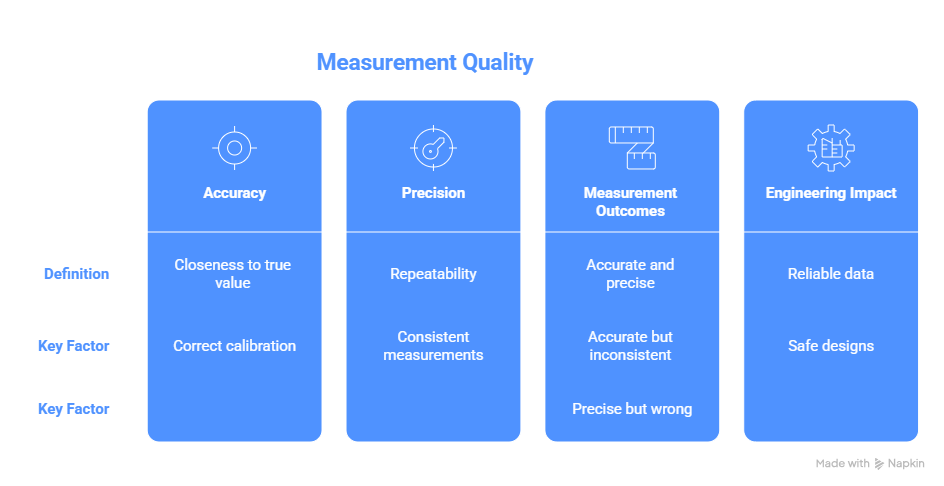
Accuracy refers to how close a measurement or result is to the true or correct value. When a measurement is accurate, it means the result is very close to the actual physical reality.
For example, imagine measuring the length of a metal rod that is exactly 100 millimeters long. If your measurement tool reads 99.9 mm or 100.1 mm, the measurement is highly accurate because it closely matches the real value.
Accuracy depends on factors such as:
- proper calibration of instruments
- correct measurement methods
- well-designed experiments or models
- minimizing systematic errors
In engineering, accuracy matters because designs are often based on measured data. If those measurements are inaccurate, the calculations built upon them may also be wrong. A bridge designed using incorrect load measurements or a circuit designed with inaccurate voltage readings could lead to unsafe or inefficient systems.
In short, accuracy ensures that engineering decisions are based on reality.
What Precision Really Means
Precision refers to how consistent repeated measurements are with each other, regardless of whether they are correct.
If you measure the same object several times and get nearly identical results every time, those measurements are considered precise.
For example, suppose you measure the same metal rod five times and obtain these results:
- 102.3 mm
- 102.4 mm
- 102.3 mm
- 102.4 mm
- 102.3 mm
These measurements are extremely consistent. They are therefore highly precise. However, they are not accurate because the true length of the rod is 100 mm.
Precision reflects the repeatability of a measurement process. A precise system produces the same results again and again, even if those results are incorrect.
In engineering, precision is important because it allows engineers to detect patterns, compare measurements, and analyze changes over time.
Why Engineers Need Both
For engineering systems to function reliably, measurements must be both accurate and precise.
Accuracy ensures that measurements reflect reality. Precision ensures that measurements are consistent enough to be trusted.
If a measurement system is accurate but not precise, the results may fluctuate wildly each time a measurement is taken. This inconsistency makes it difficult to analyze or control the system.
If a system is precise but not accurate, it may consistently produce incorrect values. This situation is especially dangerous because the consistency can create a false sense of confidence.
The ideal measurement system produces results that are close to the true value and repeatable across multiple measurements.
The Four Possible Measurement Scenarios
Understanding accuracy and precision becomes easier when considering four common situations.
| Scenario | Description |
| Accurate and Precise | Measurements are close to the true value and consistent |
| Accurate but Not Precise | Average value is correct, but measurements vary widely |
| Precise but Not Accurate | Measurements are consistent but consistently wrong |
| Neither Accurate nor Precise | Measurements are both inconsistent and incorrect |
The goal of engineering measurement systems is to achieve both accuracy and precision simultaneously.
Why Confusing Them Can Be Dangerous
Confusing accuracy with precision has led to many engineering problems.
A system may appear reliable because its measurements are very consistent. However, if the system is consistently measuring the wrong value due to calibration errors or incorrect assumptions, engineers may make decisions based on flawed data.
For example, if a sensor consistently reports a temperature that is five degrees lower than the actual temperature, the readings will appear precise but inaccurate. Over time, this error could cause overheating in machinery or failure in temperature-sensitive systems.
This type of mistake is dangerous because precision can create an illusion of correctness.
Engineers must therefore constantly verify both the consistency and correctness of their measurements.
Visual Representation
Expanded concept:
Practical Engineering Example
Consider a pressure sensor used in an industrial system.
If the sensor consistently reads 48 psi when the true pressure is 50 psi, the sensor is precise but inaccurate. Engineers relying on this sensor may believe the system is operating safely when it is actually approaching dangerous pressure levels.
If the sensor produces readings like 45 psi, 52 psi, 48 psi, and 55 psi, the readings may average near the correct value, but the system lacks precision. This variability makes it difficult to monitor and control the process reliably.
The ideal sensor would consistently report values close to 50 psi, providing both accurate and precise measurements.
Key Takeaways
- Accuracy measures how close a result is to the true value.
- Precision measures how consistent repeated results are.
- A measurement system can be precise but inaccurate.
- Reliable engineering systems require both accuracy and precision.
Mind Map
Conclusion
Accuracy and precision are fundamental concepts in engineering measurement, yet they are often misunderstood. Accuracy ensures that measurements reflect the true value of a quantity, while precision ensures that measurements remain consistent across repeated observations.
Confusing these two ideas can lead engineers to trust measurements that appear reliable but are fundamentally incorrect. For this reason, engineers must design measurement systems that are both accurate and precise.
Only when both qualities are present can measurements provide a trustworthy foundation for engineering decisions and safe system design.