
Introduction
At a senior level, decisions are rarely made with complete information.
The real skill lies not in waiting for certainty—but in acting responsibly under uncertainty.
The Myth of Complete Information
Engineering education often assumes that decisions are made with sufficient data, clear constraints, and defined outcomes. In reality, this condition almost never exists.
Projects move forward despite:
- incomplete requirements
- evolving constraints
- uncertain external conditions
Waiting for perfect data creates the illusion of control, but in practice, it leads to delay. And delay is not neutral—it carries cost, risk, and lost opportunity.
A senior engineer understands that uncertainty is not an exception—it is the operating environment.
Structuring the Unknown
When data is insufficient, the first step is not to guess—it is to structure the uncertainty.
This involves separating information into three categories:
- What is known: verified facts, measured data, confirmed constraints
- What can be bounded: ranges, limits, or scenarios within which the system will operate
- What must be assumed: gaps that require temporary decisions
This structure transforms uncertainty from something vague into something manageable. It allows decisions to be made consciously, rather than implicitly.
Instead of asking, “Do I have enough data?”, the question becomes:
“Do I understand the shape of what I don’t know?”
The Role of Assumptions
Assumptions are unavoidable when data is incomplete. The risk is not in making assumptions—it is in making them unconsciously.
A senior engineer:
- makes assumptions explicit
- documents them clearly
- understands their potential impact
Each assumption is effectively a placeholder for missing knowledge. By identifying them, the engineer creates visibility into future risks.
This also makes it easier to revisit decisions when new information becomes available.
Acting Without Paralysis
Indecision often feels safe, but it is rarely harmless.
Not deciding:
- delays progress
- increases uncertainty over time
- may create larger downstream risks
Paralysis is itself a decision—a decision to accept all consequences of inaction.
In dynamic systems, this is often the worst option because:
- opportunities close
- constraints tighten
- system conditions change further
A senior engineer recognizes that timely action, even with imperfect information, is often better than delayed perfection.
Monitor and Adapt
Making a decision under uncertainty is only the first step. What follows is equally important.
Every decision should include:
- a mechanism to observe outcomes
- checkpoints to evaluate correctness
- flexibility to adjust when needed
This transforms decision-making into a continuous loop:
Decide → Observe → Learn → Adjust
Instead of aiming to be right immediately, the focus shifts to becoming right over time.
Engineering Thinking: Managing Risk, Not Eliminating It
With incomplete data, risk cannot be removed—it can only be managed.
This requires balancing:
- speed vs accuracy
- confidence vs adaptability
- short-term action vs long-term impact
The goal is not certainty, but controlled exposure to uncertainty.
A well-made decision under uncertainty is not defined by its outcome alone, but by:
- how well the uncertainty was understood
- how visible the assumptions were
- how quickly the system could respond to change
Visual Representation
Practical Table
| Factor / Question | Why It Matters | Example |
| What do I know for certain? | Establishes a stable foundation for decision-making | Confirmed load capacity in a system |
| What can I bound or estimate? | Reduces uncertainty into manageable ranges | Expected variation in demand |
| What assumptions am I making? | Makes hidden risks visible | Assuming consistent user behavior |
| What is the cost of waiting? | Evaluates impact of delayed decisions | Project delays increasing cost |
| How will I monitor outcomes? | Enables correction after decision is made | Performance tracking after deployment |
Key Takeaways
- Complete information is rare in real engineering decisions
- Structuring uncertainty makes decision-making more reliable
- Assumptions should be explicit and revisitable
- Delaying decisions often creates greater risk than acting
- Effective decisions include monitoring and adaptability
- Engineering judgment is about managing uncertainty, not avoiding it
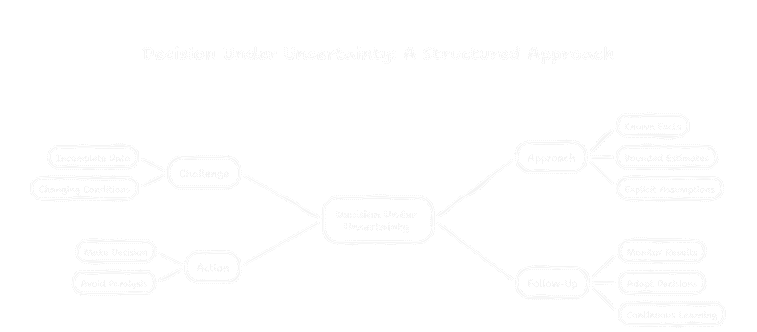
Mind Map
Conclusion
At a senior level, decision-making is not about waiting for clarity—it is about creating clarity within uncertainty.
The absence of complete data does not remove responsibility. It increases it.
A developing engineer seeks correct answers.
A senior engineer builds a process that allows decisions to be made, tested, and refined—even when the answers are not fully known.
Because in the end, progress is not made by those who wait for certainty,
but by those who can move forward while understanding its limits.