
Introduction
At a senior level, the challenge is no longer just building systems that work today.
It is building systems that continue to work—even when the future behaves differently than expected.
The Illusion of Perfect Design
Engineering often begins with the goal of optimization—designing something that fits current requirements as efficiently as possible.
But perfect optimization assumes stability. It assumes:
- requirements will not change
- usage patterns will remain consistent
- external conditions will stay within expected bounds
In reality, none of this hold over time.
A system designed to be “perfect” for today is often fragile tomorrow. It performs exceptionally well under known conditions, but struggles when those conditions shift.
A senior engineer recognizes that perfection is often the enemy of longevity.
Why Adaptability Outlasts Accuracy
The future introduces variables that cannot be fully modeled—new technologies, unexpected usage, environmental changes, and human behavior shifts.
Since prediction has limits, design must shift from accuracy to adaptability.
An adaptable system does not attempt to predict every scenario. Instead, it ensures that:
- changes can be absorbed
- modifications can be made without breaking the system
- growth does not require complete redesign
This is why a bridge that can be widened survives longer than one that was perfectly sized for initial traffic.
The goal is not to eliminate uncertainty—but to remain functional despite it.
The Three Pillars of Future-Ready Design
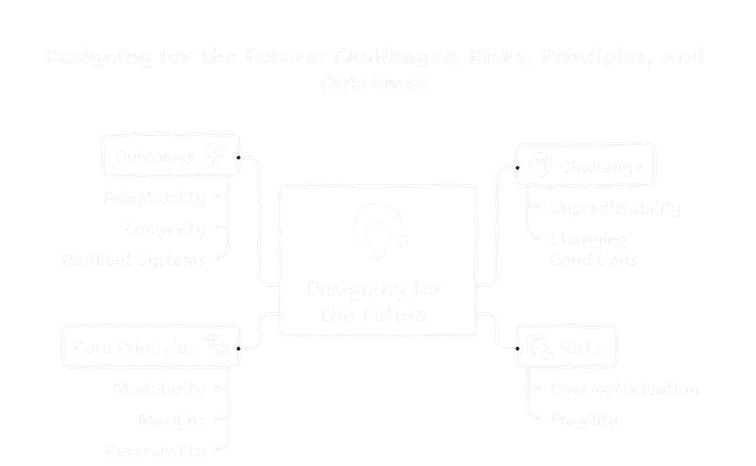
Modularity
Modularity allows systems to be broken into independent components. Each part can evolve without forcing a complete system redesign.
This creates flexibility:
- components can be upgraded individually
- failures can be isolated
- new functionality can be added without disruption
Without modularity, even small changes can ripple through the entire system.
Margins
Margins are intentional buffers—extra capacity, tolerance, or safety beyond current requirements.
They account for:
- unexpected loads
- performance variations
- future expansion
Margins may seem inefficient in the short term, but they prevent systems from reaching failure limits too quickly.
A system without margins operates close to its limits. A system with margins operates with breathing space.
Reversibility
Reversibility ensures that decisions are not permanent.
In many systems, the cost of change is not the change itself—but the inability to undo previous decisions.
Reversible design allows:
- experimentation without catastrophic risk
- correction of wrong assumptions
- gradual evolution instead of forced replacement
A senior engineer designs not just for correctness—but for the ability to recover from being wrong.
Engineering Thinking: Designing Under Uncertainty
At this level, engineering becomes a balance between:
- efficiency vs flexibility
- cost vs resilience
- optimization vs adaptability
There is no perfect point. Every system must trade short-term performance for long-term survivability.
The key shift is in mindset:
Instead of asking, “Is this the best design?”
The question becomes, “How easily can this design change when needed?”
This reframes engineering from static problem-solving to dynamic system stewardship.
Real-World Implications
Systems that fail in the future rarely fail because they were poorly designed. They fail because they were designed for a world that no longer exists.
Examples include:
- infrastructure that cannot handle increased demand
- software systems that cannot scale with users
- processes that break under new operational realities
In contrast, systems built with adaptability:
- evolve gradually
- extend their lifespan
- reduce the need for costly redesigns
The difference is not intelligence—it is foresight about uncertainty.
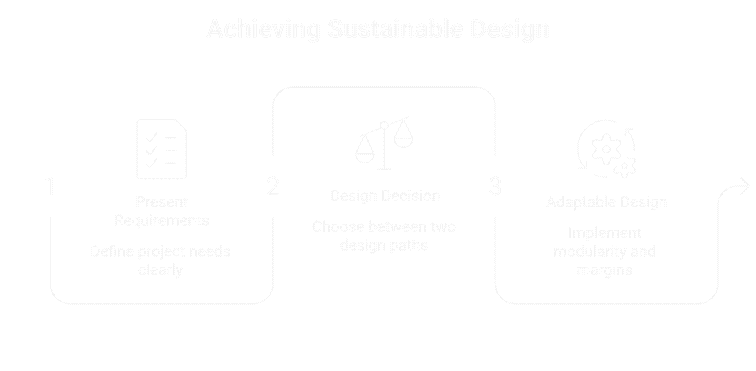
Visual Representation
Practical Table
| Factor / Question | Why It Matters | Example |
| Can this system be expanded? | Ensures future growth without redesign | Designing extra capacity in infrastructure |
| Are components independent? | Reduces impact of changes and failures | Modular software architecture |
| What happens if assumptions change? | Tests system resilience under uncertainty | Load increase beyond expected limits |
| Can decisions be reversed? | Allows correction of mistakes without major disruption | Rollback mechanisms in system design |
| Is there buffer capacity? | Prevents immediate failure under stress or unexpected conditions | Safety margins in structural design |
Key Takeaways
- Designing for perfection today often leads to fragility tomorrow
- Adaptability is more valuable than precise optimization
- Modularity allows systems to evolve without full redesign
- Margins provide safety against uncertainty and variability
- Reversibility enables recovery from incorrect decisions
- Future-ready systems are defined by their ability to change
Mind Map
Conclusion
At a senior level, engineering is no longer about getting the design exactly right—it is about ensuring the design remains viable when reality changes.
The future cannot be fully predicted, but it can be prepared for. Not through perfect planning, but through flexible thinking.
The strongest systems are not those that resist change,
but those that are built with the expectation that change will come.
Because in the end, good engineering does not attempt to control the future— it ensures that when the future arrives, the system is still ready to respond.