
Introduction
At a senior level, engineering insight comes not just from depth—but from connection.
The ability to see patterns across different domains is what separates expertise from mastery.
Systems Are Different in Form, Similar in Behavior
On the surface, systems from different fields appear unrelated. A bridge, an electronic amplifier, and a biological population seem to belong to entirely separate domains.
Yet beneath this surface, they often follow the same fundamental principles:
- feedback loops
- dynamic response over time
- stability and instability conditions
- sensitivity to external inputs
The materials, scale, and context may differ—but the behavior patterns repeat.
A senior engineer learns to look past form and recognize that systems are defined more by their behavior than by their domain.
The Power of Underlying Mathematics
Many systems, regardless of field, are governed by similar mathematical structures.
For example:
- oscillations in a bridge due to resonance
- signal amplification and feedback in electronics
- growth and decay patterns in population models
All of these can be described using similar differential equations and stability analysis concepts.
This means that insights from one field can directly apply to another—if the underlying structure is recognized.
The value is not in memorizing equations, but in understanding what kind of system you are dealing with.
Why This Matters at Senior Level
At an early stage, engineers rely heavily on domain-specific knowledge. They solve problems using established methods within their field.
At a senior level, the approach changes:
- unfamiliar problems become solvable through analogy
- solutions can be transferred across domains
- innovation accelerates through pattern recognition
Instead of asking, “Have I seen this exact problem before?”, the question becomes:
“What does this problem behave like?”
This shift reduces dependence on experience limited to one field and expands problem-solving capability.
Engineering Thinking: Pattern Recognition Across Domains
Cross-domain thinking requires abstraction—the ability to strip away surface details and focus on core structure.
This involves identifying:
- feedback mechanisms (positive or negative)
- energy or information flow
- time-dependent behavior
- points of instability or amplification
Once these patterns are recognized, solutions from one domain can inform another.
For example:
- controlling oscillations in mechanical systems can inform signal stability in electronics
- understanding biological feedback can improve system control design
This is not coincidence—it is shared system logic expressed in different forms.
The Risk of Domain Isolation
One of the limitations of specialization is that it can restrict perspective.
When engineers think only within their field:
- similar solutions may be reinvented unnecessarily
- known patterns may go unrecognized
- opportunities for innovation may be missed
Cross-domain blindness leads to slower progress.
In contrast, engineers who recognize patterns across domains:
- solve problems faster
- apply proven concepts in new ways
- identify deeper system behavior
The difference lies in seeing beyond boundaries.
Real-World Implications
In complex real-world systems, problems rarely belong to a single discipline.
Modern engineering challenges often involve:
- mechanical systems interacting with electronics
- software controlling physical processes
- human behavior influencing system performance
In such environments, the ability to transfer understanding across domains becomes critical.
A senior engineer who sees patterns across fields can:
- anticipate system behavior more accurately
- design more robust solutions
- reduce reliance on trial-and-error
Because the system is no longer “new”—it is a familiar pattern in a different context.
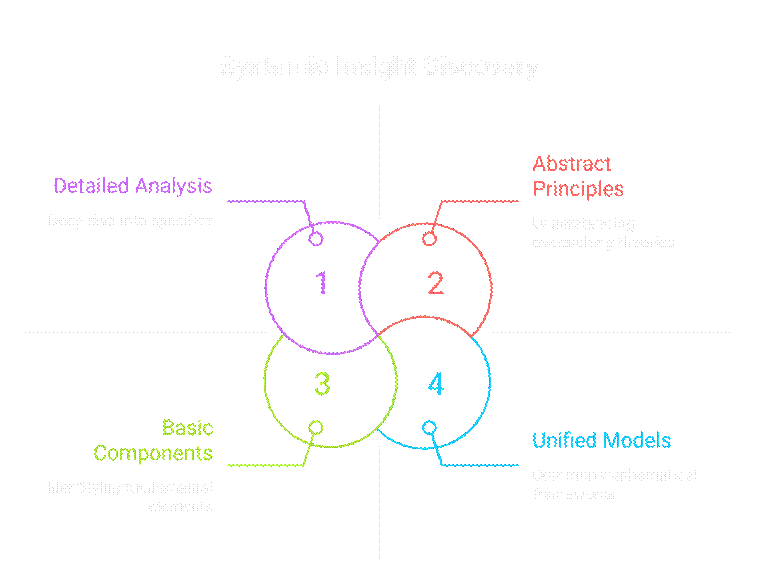
Visual Representation
Practical Table
| Factor / Question | Why It Matters | Example |
| What kind of system is this? | Identifies underlying behavior pattern | Oscillatory vs stable systems |
| Is there a feedback loop present? | Determines system response and stability | Amplifier gain feedback vs population growth feedback |
| Does the system exhibit oscillation? | Indicates resonance or cyclical behavior | Bridge vibration under periodic load |
| What controls stability? | Helps prevent failure or runaway conditions | Damping in mechanical vs control in electronics |
| Where have I seen similar behavior? | Enables cross-domain problem solving | Applying control theory to biological systems |
Key Takeaways
- Systems across different fields often share the same underlying behavior
- Mathematical models reveal common structures across domains
- Cross-domain pattern recognition accelerates problem-solving
- Senior engineers focus on behavior, not just domain details
- Abstraction is key to identifying transferable insights
- Innovation often comes from applying known patterns in new contexts
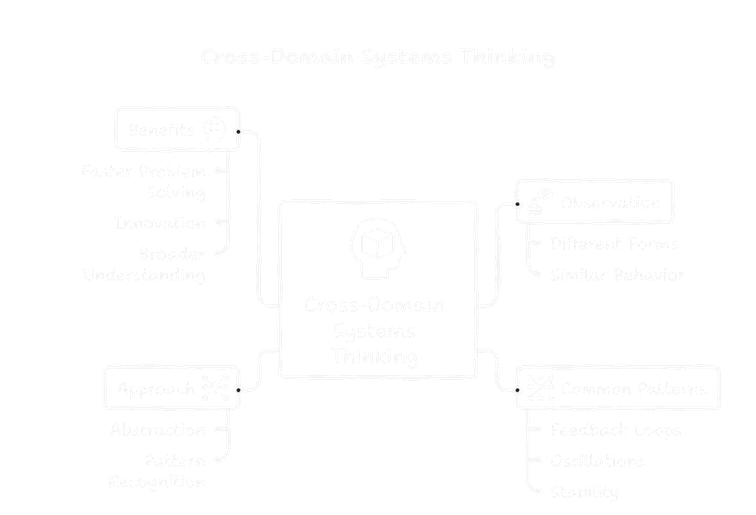
Mind Map
Conclusion
At a senior level, engineering is no longer confined to a single domain. It becomes a discipline of recognizing patterns that repeat across different systems.
The surface may change—materials, scale, context—but the underlying behavior often remains the same.
A developing engineer learns solutions within a field.
A master engineer learns to see that fields themselves are connected.
Because the most powerful insight is not knowing more details—
it is recognizing that different problems are often expressions of the same idea.