
Introduction
At a senior level, optimization is not just about improving a system.
It is about knowing when improvement stops creating real value.
The Trap of Endless Optimization
Optimization feels productive. Each refinement improves performance, reduces cost, or enhances efficiency. But without a clear objective, optimization becomes directionless.
There is always something more that can be improved:
- slightly better performance
- marginal cost reduction
- minor efficiency gains
Without a stopping point, this becomes an infinite loop. Time and resources get consumed without proportional benefit.
A senior engineer recognizes that optimization is only meaningful when it is bounded by purpose.
Defining What “Better” Means
Optimization cannot exist without a clear definition of success.
Before improving a system, the engineer must ask:
- What metric defines improvement?
- What trade-offs are acceptable?
- What constraints matter most?
“Better” could mean:
- faster response time
- lower cost
- higher reliability
- improved user experience
But these often conflict. Increasing performance may increase cost. Improving reliability may reduce flexibility.
Without clarity, optimization efforts can move in the wrong direction.
A well-defined objective transforms optimization from trial-and-error into focused decision-making.
The Concept of “Good Enough”
At some point, additional improvement yields minimal value compared to the effort required.
This is the point of diminishing returns.
Reaching “good enough” does not mean settling for poor quality. It means:
- the system meets its required purpose
- further improvements do not justify their cost
- risk of over-engineering is increasing
A senior engineer defines this threshold explicitly.
Instead of asking, “Can this be better?”, the question becomes:
“Is further improvement worth the cost, time, and complexity?”
Diminishing Returns in Practice
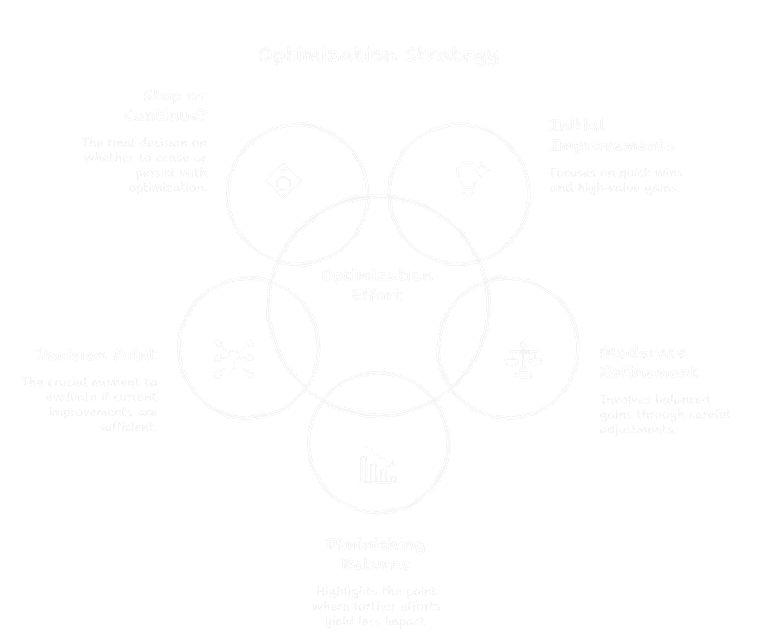
Optimization often follows a curve:
- early improvements deliver large gains
- later improvements deliver smaller and smaller benefits
As effort increases, the return per unit effort decreases.
At this stage:
- small gains require disproportionate time
- system complexity may increase
- maintenance burden may rise
Continuing beyond this point can harm the system more than it helps it.
Recognizing this curve is critical to making balanced decisions.
EngineeringThinking: Optimization as a Trade-Off
Optimization is not about maximizing a single variable. It is about balancing multiple competing factors:
- performance vs cost
- efficiency vs flexibility
- precision vs maintainability
Every optimization pushes the system in one direction while pulling it away from another.
A senior engineer does not optimize blindly. They:
- understand trade-offs clearly
- align optimization with system goals
- stop when the system reaches its intended balance
This requires discipline—knowing that not every improvement is worth pursuing.
The Risk of Over-Optimization
Over-optimization introduces its own problems:
- increased system complexity
- reduced robustness
- difficulty in maintenance
- limited adaptability
A highly optimized system may perform extremely well under specific conditions, but fail when those conditions change.
In contrast, slightly less optimized systems often:
- remain more flexible
- adapt better to uncertainty
- require less effort to maintain
The goal is not maximum optimization—it is sustainable optimization.
Real-World Implications
In real engineering environments, time and resources are limited.
Spending excessive effort on optimization can:
- delay project delivery
- increase costs without proportional benefit
- reduce focus on higher-impact problems
Senior engineers prioritize:
- solving the right problems
- delivering value within constraints
- maintaining system simplicity
They understand that finishing at the right time is as important as improving the system.
Visual Representation
Practical Table
| Factor / Question | Why It Matters | Example |
| What defines “better”? | Aligns optimization with clear objectives | Reducing response time below a target threshold |
| Is the system meeting requirements? | Determines if further improvement is necessary | System already performing within acceptable limits |
| What is the cost of further gains? | Evaluates effort vs benefit | Large development effort for minimal performance increase |
| Are trade-offs increasing? | Identifies negative side effects of optimization | Higher complexity for marginal efficiency gains |
| Is the system still maintainable? | Ensures long-term sustainability | Over-tuned systems becoming harder to manage |
Key Takeaways
- Optimization without a clear objective leads to endless iteration
- Defining what “better” means is essential before optimizing
- “Good enough” is a deliberate and important decision point
- Diminishing returns indicate when to stop refining
- Over-optimization can harm system flexibility and maintainability
- Senior engineers balance improvement with practicality
Mind Map
Conclusion
At a senior level, optimization is not about pushing a system to its limits—it is about knowing where those limits should be.
The pursuit of improvement must be guided by purpose, not by possibility. Without a clear stopping point, optimization becomes a cycle that consumes time without creating proportional value.
A developing engineer focuses on making things better.
A senior engineer understands when better is no longer meaningful.
Because in the end, engineering is not about achieving perfection—
it is about delivering value at the right point, and knowing when to stop.