
Introduction
At a senior level, engineering problems do not exist in isolation.
They are shaped as much by people, incentives, and institutions as by physics and design.
The Myth of Purely Technical Problems
Engineering is often framed as a purely technical discipline—solve the equations, optimize the design, and implement the best solution.
In reality, the “best” technical solution is not always the one that gets built.
Projects exist within environments shaped by:
- organizational priorities
- regulatory frameworks
- stakeholder interests
- budget constraints
These forces define what is possible, acceptable, and fundable.
A senior engineer understands that the real design space is larger than the technical one.
The Forces That Actually Shape Outcomes
Several non-technical forces quietly influence engineering decisions:
Procurement Processes
What gets selected is often determined by procurement rules—vendor relationships, cost structures, and compliance requirements. A technically superior solution may lose if it does not fit procurement criteria.
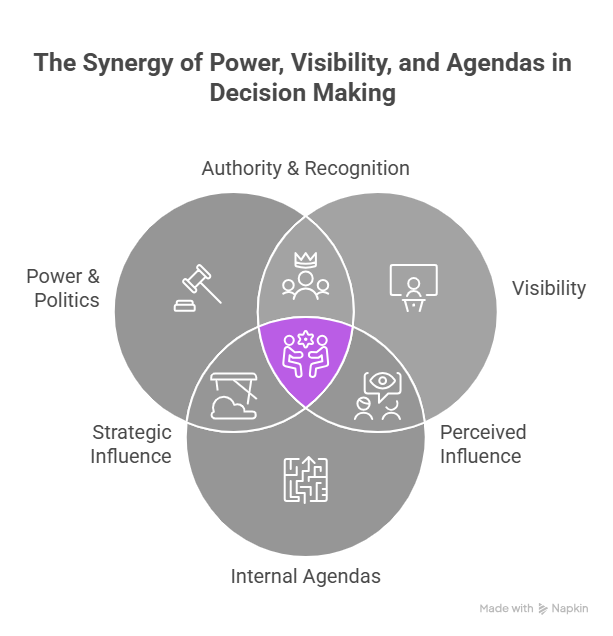
Politics and Power Structures
Decisions may reflect influence rather than optimization. Stakeholders with authority shape direction, sometimes prioritizing visibility, control, or short-term outcomes.
Organizational Inertia
Existing systems resist change. Legacy infrastructure, established workflows, and cultural habits create friction against new approaches.
Incentives and Metrics
Teams optimize for what they are measured on. If success metrics are misaligned, engineering decisions will follow those incentives—even if they conflict with long-term system quality.
These forces are not exceptions—they are part of the system itself.
Why This Matters at Senior Level
At early stages, engineers focus on correctness—ensuring the solution works.
At a senior level, success depends on whether the solution:
- gets approved
- gets funded
- gets implemented
- survives over time
A technically perfect design that is never adopted has zero impact.
This shifts the question from:
“What is the best solution?”
to:
“What solution will actually work within this environment?”
Engineering Thinking: Designing Within Reality
Understanding political and social forces does not mean compromising technical integrity. It means designing with awareness of constraints beyond engineering.
This involves:
- identifying key stakeholders and their priorities
- understanding decision-making processes
- aligning technical proposals with organizational goals
- anticipating resistance and planning around it
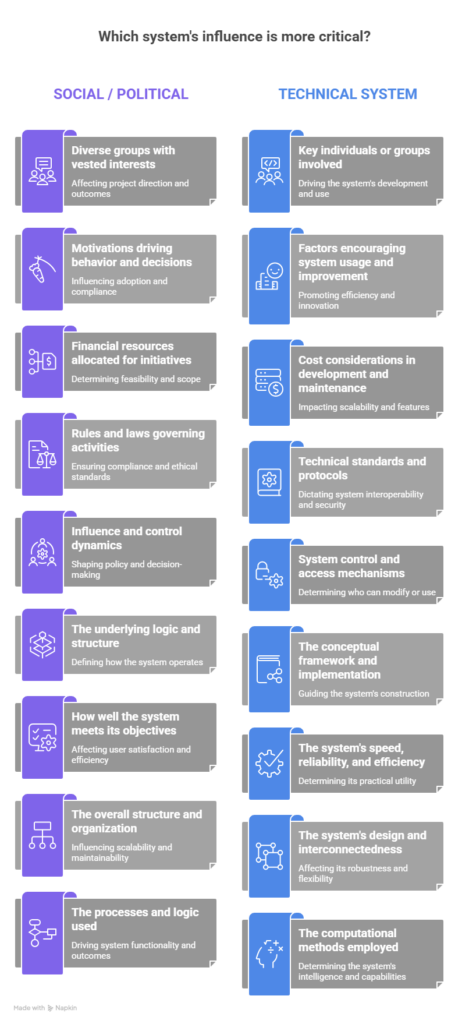
A senior engineer operates at two levels simultaneously:
- technical system design
- system of people and decisions
Ignoring either one reduces effectiveness.
Navigating Trade-Offs Without Losing Integrity
There will be situations where:
- the ideal solution is not feasible
- compromises are required
- trade-offs are unavoidable
The challenge is to balance:
- technical quality
- practical feasibility
This does not mean lowering standards. It means finding solutions that:
- meet essential requirements
- align with constraints
- create a path for future improvement
Sometimes the best strategy is incremental progress rather than immediate perfection.
Real-World Implications
In practice, many engineering failures are not technical—they are organizational.
Examples include:
- projects delayed due to approval processes
- systems rejected due to stakeholder misalignment
- solutions underperforming due to poor adoption
Conversely, successful systems often:
- align with incentives
- fit within existing processes
- gain stakeholder support early
The difference is not just design quality—it is context awareness.
Visual Representation
Practical Table
| Factor / Question | Why It Matters | Example |
| Who are the key stakeholders? | Identifies decision-makers and influencers | Management, regulators, clients |
| What are the incentives? | Determines how decisions will be evaluated | Cost reduction vs long-term reliability |
| What constraints exist beyond technical? | Reveals non-engineering limitations | Budget approvals, compliance requirements |
| Where might resistance come from? | Helps anticipate barriers to implementation | Teams resistant to changing existing systems |
| What solution will actually get built? | Aligns design with real-world feasibility | Choosing practical over theoretically optimal designs |
Key Takeaways
- Engineering problems are shaped by social and political forces, not just technical ones
- The best technical solution is not always the one implemented
- Procurement, incentives, and organizational inertia influence outcomes
- Senior engineers design within both technical and human systems
- Success depends on alignment, not just correctness
- Understanding context is essential for real-world impact
Mind Map
Conclusion
At a senior level, engineering is no longer just about solving technical problems—it is about ensuring that solutions exist within the reality of human systems.
The forces of politics, incentives, and organization are not obstacles to engineering. They are part of the system that must be understood and navigated.
A developing engineer builds correct solutions.
A senior engineer ensures those solutions actually come to life.
Because in the end, the value of engineering is not defined by what could be built—
but by what is built, adopted, and sustained.