
Introduction
Engineering decisions do not end at functionality.
They continue into society, behavior, and time.
Every Artifact Is a Moral Decision
An engineered system is never neutral. The moment it is introduced into the world, it begins to influence how people act, how resources are distributed, and how risks are experienced.
Even something that appears purely technical—a piece of software, a mechanical design, an infrastructure system—quietly embeds choices:
- what is prioritized
- what is ignored
- who is served
- who is exposed to risk
These choices are not always visible, but they are always present.
A Master Engineer understands that to build is to decide, and every decision carries ethical weight.
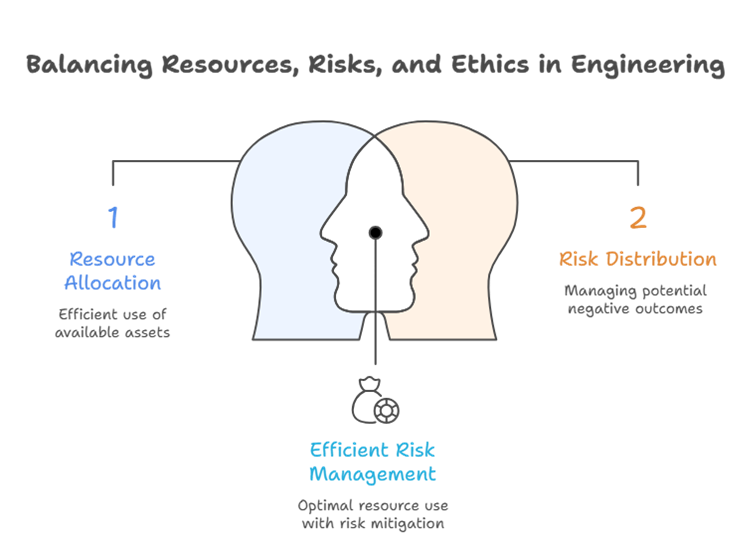
Allocation of Resources and Power
Every system directs resources—time, energy, attention, capital—toward certain outcomes.
When you design a system, you are deciding:
- where efficiency is maximized
- where effort is reduced
- where access is granted or limited
This allocation creates structure. It benefits some users more than others. It simplifies certain actions while making others harder.
Over time, these design choices shape ecosystems:
- industries adapt around systems
- users become dependent on them
- alternatives disappear
The ethical weight lies in the fact that these outcomes are not accidental. They are the result of design decisions.
Distribution of Risk
No system is without failure. The critical question is not whether failure occurs—but who bears the consequences when it does.
Engineering decisions determine:
- which parts of the system are protected
- which users are exposed to failure
- how failure propagates
For example:
- a cost-optimized design may reduce safety margins
- a high-efficiency system may reduce redundancy
- an automated process may remove human oversight
Each of these decisions shifts risk somewhere else.
A Master Engineer asks:
“If this system fails, who pays the price?”
Because ethical responsibility is often defined not by success—but by failure.
Shaping Human Behavior
Systems do not just serve users—they influence them.
Design choices affect:
- how people interact with technology
- how decisions are made
- how attention is directed
Over time, systems create habits. Habits become norms. Norms reshape culture.
For example:
- automation can reduce human skill and awareness
- optimization can encourage speed over reflection
- convenience can reduce resilience and independence
These effects are gradual and often invisible. But they are powerful.
The ethical weight of engineering includes this ability to shape behavior without explicit awareness.
Endurance Beyond the Engineer
One of the most overlooked aspects of engineering is persistence.
Systems outlast their creators. Once deployed, they continue to operate, influence, and evolve long after the original design context is gone.
This creates a fundamental challenge:
- assumptions become outdated
- environments change
- unintended uses emerge
Yet the system remains.
This means that engineering decisions are not temporary. They become part of a long-term structure that others must live with.
A Master Engineer designs with the understanding that
they are creating something that will exist beyond their control.
The Failure of Ignoring Ethics
Ignoring ethical considerations does not remove them—it simply shifts them into hidden consequences.
When ethics is excluded:
- risks are transferred silently
- biases remain unchallenged
- harmful impacts emerge later, often at scale
At that point, correction becomes difficult, expensive, or impossible.
The engineer who focuses only on technical success may achieve short-term results, but fails in the broader responsibility of the profession.
Because engineering is not just about making systems work.
It is about ensuring that their impact is understood and justified.
Visual Representation
Practical Table
| Factor / Question | Why It Matters | Example |
| Who benefits from this system? | Determines distribution of value | Technology improving access for one group but excluding another |
| Who bears the risk? | Reveals ethical responsibility in failure | Cost-cutting reducing safety margins |
| What behaviors are influenced? | Systems shape user habits and decisions | Automation reducing manual oversight |
| How long will this system persist? | Long-term impact increases ethical weight | Infrastructure lasting decades |
| What assumptions are embedded? | Hidden assumptions can become future risks | Designing for ideal conditions only |
Key Takeaways
- Every engineered system is a moral act, not just a technical one
- Design decisions allocate resources and distribute risk
- Systems shape human behavior over time
- Ethical responsibility extends beyond system deployment
- Ignoring ethics leads to hidden and often larger consequences
- Master Engineers integrate ethical awareness into every decision
Mind Map
Conclusion
To engineer is to shape reality. Not just physically, but socially and behaviorally.
Every system introduced into the world carries influence—over people, over resources, over risk. These influences accumulate, often quietly, until they define how systems and societies function.
The ethical weight of engineering is not an additional consideration.
It is the core of the discipline.
A Master Engineer does not separate technical success from ethical responsibility.
They understand that every design decision is also a moral decision.
Because in the end, the true measure of engineering is not what was built—
but what it does to the world after it is built.