

Introduction
Units often feel like simple labels attached to numbers.
But in reality, they are what give numbers meaning, context, and trust.
A Number Without a Unit Is Incomplete
For a budding engineer, it is easy to focus on calculations and results. But a number alone is meaningless unless it is tied to a unit.
Consider this:
- “50” could mean 50 meters, 50 seconds, or 50 kilograms
Without a unit, the number cannot be interpreted or used.
A unit tells you:
- what is being measured
- how it relates to the physical world
- how it can be compared or applied
In this sense, units are not optional—they are part of the value itself.
Units as a Shared Language
Units act as a common language that allows engineers, scientists, and systems to communicate clearly across time and space.
When you use standard units:
- your work can be understood by others
- your results can be verified
- your designs can be replicated
An engineer in one country can understand and use calculations made decades ago because the units remain consistent.
For a budding engineer, this means your work is not isolated—it becomes part of a larger system of knowledge.
Units make that connection possible.
Why Units Prevent Failure
Many engineering failures are not due to complex mistakes, but simple misunderstandings—especially involving units.
If units are inconsistent or misinterpreted:
- calculations become incorrect
- systems behave unexpectedly
- designs fail
A famous type of failure occurs when different unit systems are mixed (for example, metric and imperial). Even correct formulas can produce wrong results if units are not aligned.
Units act as a built-in check. When used correctly, they help verify whether calculations make sense.
Units and Physical Reality
Units are not arbitrary—they are tied directly to physical quantities.
They represent measurable aspects of reality:
- meters for length
- seconds for time
- kilograms for mass
When you write a value with units, you are connecting mathematics to the real world.
For a budding engineer, this is critical. Engineering is not just abstract calculation—it is applied to physical systems.
Units ensure that what you calculate can actually exist and function in reality.
Thinking Through Units
Experienced engineers do not treat units as an afterthought—they use them as a thinking tool.
Units can help you:
- understand relationships between variables
- check if equations are correct
- identify errors early
For example: If a calculation for velocity does not result in meters per second, something is wrong—even if the number seems reasonable.
This practice is called dimensional thinking, and it strengthens engineering judgment.
When Units Are Ignored
Ignoring units is one of the fastest ways to introduce errors.
Without units:
- numbers lose context
- comparisons become meaningless
- mistakes go unnoticed
A design may look correct on paper but fail in reality because the scale, magnitude, or relationship between values was misunderstood.
For a budding engineer, discipline with units is not a small detail—it is a fundamental habit.
Visual Representation
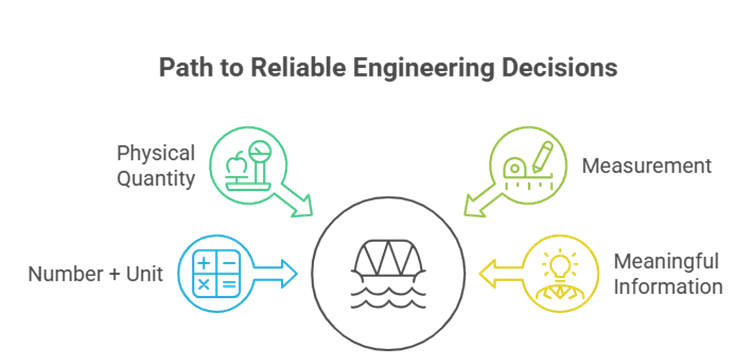
Practical Table
| Aspect / Question | Why It Matters | Example |
| What does this number measure? | Defines meaning of the value | 100 meters vs 100 seconds |
| Are units consistent? | Prevents calculation errors | Mixing km and m in distance calculations |
| Do units match the formula? | Validates correctness of equations | Velocity = distance/time → m/s |
| Can others understand this? | Enables communication across teams and time | Standard SI units in reports |
| Does it reflect reality? | Ensures calculations apply to real-world systems | Load in Newtons for structural design |
Key Takeaways
- A number without a unit has no clear meaning
- Units provide context and connect calculations to reality
- They act as a universal language across engineering disciplines
- Incorrect or inconsistent units can lead to failure
- Units help verify calculations and detect errors
- A budding engineer must treat units as part of the value, not an add-on
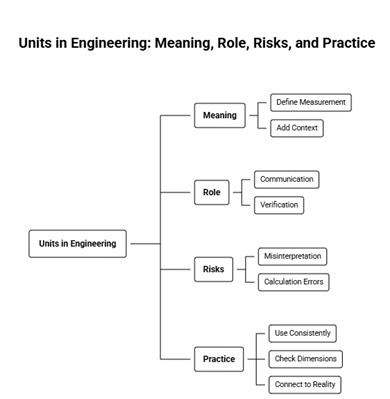
Mind Map
Conclusion
A unit is far more than a label—it is a bridge between numbers and reality.
It allows engineers to communicate clearly, think accurately, and build reliably. Without units, calculations lose meaning, and systems lose reliability.
For a budding engineer, respecting units is not about following rules—it is about maintaining clarity and precision in thought.
Because in engineering, it is not just what you calculate that matters— it is whether that calculation can be understood, trusted, and used by others, even long after you are gone.