
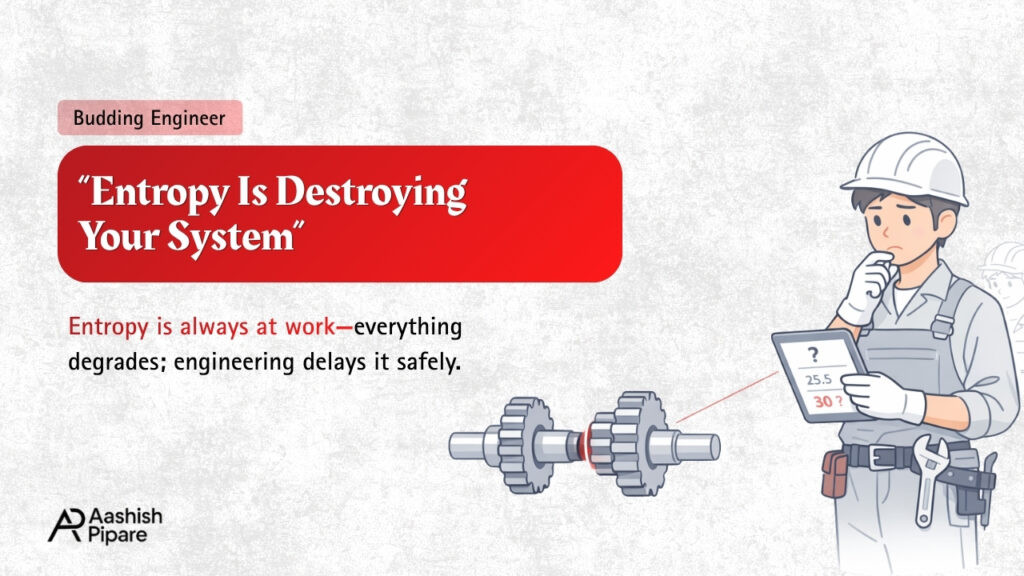
No system stays as it is.
Even when nothing seems to change, something is quietly degrading.
Entropy Is Always Increasing
For a budding engineer, entropy may feel like a distant thermodynamics concept. But in reality, it is active in every system, at every moment.
Entropy is the natural tendency of systems to move toward disorder, energy dispersion, and reduced usefulness.
This means:
- heat spreads out
- materials wear down
- signals lose clarity
- organized structures slowly degrade
Even a perfectly designed system begins to change the moment it starts operating.
The key realization is this: stability is temporary—change is constant.
What Entropy Looks Like in Real Systems
Entropy does not appear dramatically at first. It shows up in small, gradual ways.
In mechanical systems:
- friction causes wear
- lubrication degrades
- alignment shifts
In electrical systems:
- resistance generates heat
- components age
- signals weaken
In structures:
- materials fatigue
- micro-cracks form
- environmental exposure causes damage
For a budding engineer, recognizing these early signs is essential. Entropy is not an event—it is a continuous process.
Why Systems Naturally Degrade
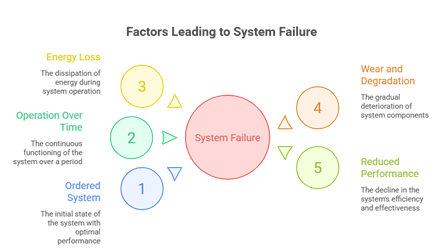
All systems are built using energy and order. But maintaining that order requires continuous input.
Without intervention:
- energy dissipates
- structure weakens
- performance declines
This is not due to poor design—it is a fundamental property of the physical world.
Even the best-engineered systems cannot eliminate entropy. They can only manage its effects.
The Role of the Engineer
If entropy cannot be stopped, what is the role of engineering?
It is to:
- slow down degradation
- control how systems fail
- extend useful life
- ensure safety during decline
For a budding engineer, this is a mindset shift. You are not designing something that will last forever—you are designing something that will age predictably and safely.
This includes:
- choosing materials that resist wear
- designing for maintenance and replacement
- accounting for environmental exposure
- planning for end-of-life conditions
Engineering is not about permanence—it is about graceful decay.
Hidden Risks of Ignoring Entropy
Ignoring entropy leads to systems that appear reliable but fail unexpectedly.
Common risks include:
- assuming performance will remain constant
- neglecting maintenance needs
- underestimating long-term effects
When entropy is ignored, degradation accumulates silently until failure occurs.
For a budding engineer, the danger is not entropy itself—it is unawareness of it.
Designing Against Disorder
Good engineering does not fight entropy directly—it works around it.
This involves:
- adding safety margins
- designing redundant systems
- enabling easy inspection and repair
- monitoring system performance over time
These strategies do not eliminate entropy, but they reduce its impact and make systems more resilient.
Visual Representation
Practical Table
| Aspect / Question | Why It Matters | Example |
| Where is energy being lost? | Energy loss drives degradation | Heat generation in electrical systems |
| What components wear out? | Identifies weak points in system | Bearings in rotating machinery |
| How does performance change over time? | Tracks system health | Reduced efficiency in engines |
| What maintenance is required? | Slows down entropy effects | Regular lubrication or part replacement |
| What happens at failure? | Ensures safety even when system degrades | Designing fail-safe mechanisms |
Key Takeaways
- Entropy is always active—it never stops
- All systems degrade over time, even if designed perfectly
- Small changes accumulate into major failures
- Engineering cannot eliminate entropy, only manage it
- Designing for maintenance and failure is essential
- A budding engineer must think in terms of time, not just initial performance
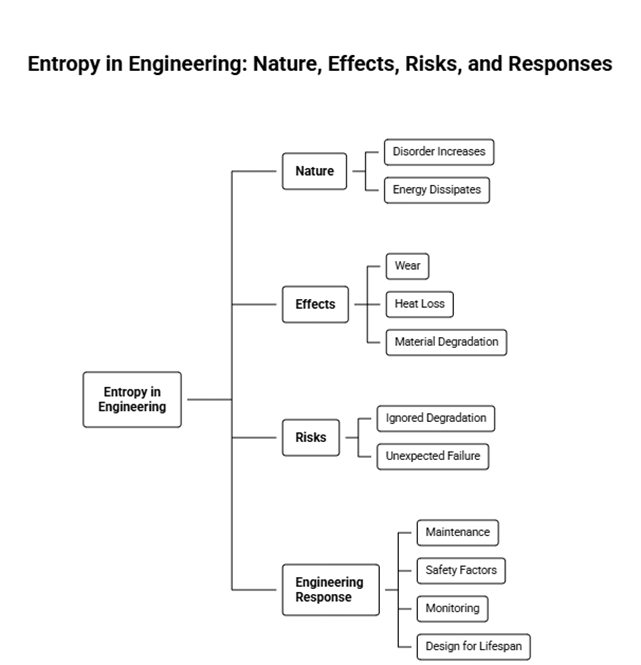
Mind Map
Conclusion
Entropy is not a problem to be solved—it is a reality to be respected.
Every system you design is already on a path of gradual decline. The question is not whether it will degrade, but how, how fast, and how safely.
For a budding engineer, this understanding changes the goal of design. It is no longer about creating something that lasts forever, but something that fails predictably, behaves responsibly, and remains useful for as long as possible.
Because true engineering is not about stopping disorder— it is about managing it with foresight and discipline.