
Introduction
Constraints are often seen as limitations that restrict creativity.
But in engineering, they are what give direction, clarity, and purpose to design.
What a Constraint Really Is
For a budding engineer, a constraint is not just a restriction—it is a defining boundary within which a system must exist.
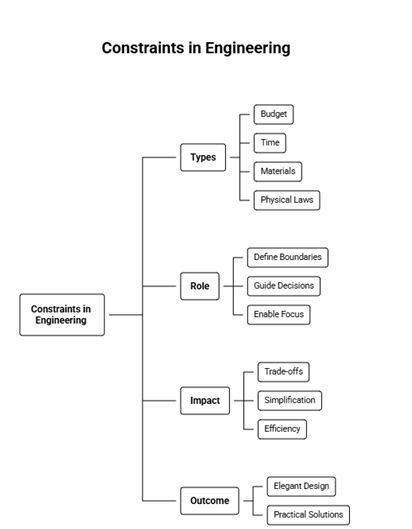
Constraints can take many forms:
- limited budget
- fixed materials
- time deadlines
- physical laws
- safety requirements
These are not optional conditions. They shape every decision you make.
Without constraints, there is no clear problem to solve. There is only an open space with infinite possibilities—and no direction.
A constraint transforms a vague idea into a real engineering problem.
Why Constraints Create Better Designs
At first, constraints may feel like obstacles. But in practice, they force clarity.
When resources are limited, you are pushed to:
- simplify designs
- prioritize what truly matters
- eliminate unnecessary complexity
This is where elegance emerges.
A design with no constraints often becomes overcomplicated, inefficient, or impractical. In contrast, a constrained design must be thoughtful.
For example:
- Limited power leads to energy-efficient systems
- Limited material leads to optimized structures
- Limited time leads to focused execution
Constraints do not reduce creativity—they focus it.
Constraints as a Direction, Not a Barrier
A common mistake for budding engineers is to see constraints as something to overcome or bypass.
In reality, constraints are signals. They tell you:
- what matters most
- what cannot be changed
- where effort should be focused
Instead of asking, “How do I avoid this constraint?”, a better question is:
“What is this constraint trying to guide me toward?”
A tight constraint often reveals the most efficient path forward.
The Relationship Between Constraint and Trade-offs
Every engineering decision involves trade-offs, and constraints define those trade-offs.
For example:
- A lower budget may reduce performance options
- A strict deadline may limit optimization
- Safety constraints may increase cost or weight
Constraints force you to balance competing priorities.
For a budding engineer, this is where real judgment develops—not in ideal conditions, but in constrained ones.
You begin to understand that:
- not everything can be maximized
- every gain comes with a cost
Constraints make these trade-offs visible.
When There Are No Constraints
It may seem that having fewer constraints is better. But in reality, the absence of constraints often leads to poor design.
Without constraints:
- decisions become unfocused
- complexity increases
- resources are wasted
A system without boundaries tends to grow unnecessarily, without improving its effectiveness.
Constraints provide structure. They prevent engineering from becoming uncontrolled exploration.
Learning to Work With Constraints
As a budding engineer, one of the most valuable skills is learning to work with constraints instead of resisting them.
This involves:
- clearly identifying all constraints early
- understanding which constraints are fixed and which are flexible
- using constraints to guide design choices
Over time, you begin to see constraints not as problems, but as design tools.
They help you ask better questions:
- What is essential here?
- What can be simplified?
- Where should effort be focused?
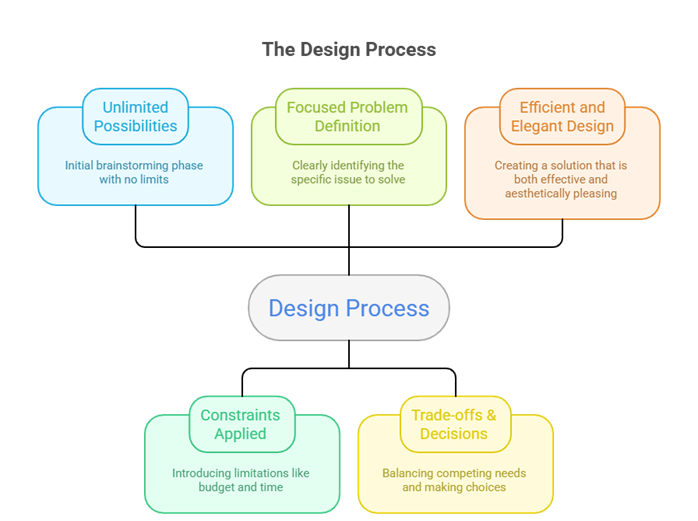
Visual Representation
Practical Table
| Constraint / Question | Why It Matters | Example |
| What limits exist? | Defines the boundaries of the solution | Budget limiting material choice |
| Which constraints are fixed? | Helps avoid unrealistic design decisions | Safety regulations that cannot be changed |
| Where is flexibility possible? | Identifies areas for optimization | Adjusting design dimensions within limits |
| What trade-offs are required? | Balances competing factors | Reducing weight vs maintaining strength |
| What can be simplified? | Prevents unnecessary complexity | Minimizing components in a system |
Key Takeaways
- Constraints are not obstacles—they define the problem
- Good design emerges from working within limits
- Constraints help focus creativity and decision-making
- Trade-offs are shaped by constraints
- Lack of constraints often leads to inefficiency
- A budding engineer must learn to use constraints as guidance
Mind Map
Conclusion
Constraints are not the enemy of engineering—they are its foundation.
They transform abstract ideas into real problems, force meaningful decisions, and guide engineers toward solutions that are practical and efficient.
For a budding engineer, the mindset shift is essential. Instead of resisting constraints, you begin to see them as direction.
Because the best designs are not created in freedom without limits— they are shaped carefully within them.