
Introduction
Science and engineering are often seen as similar, but they serve fundamentally different purposes.
One seeks to understand the world, while the other seeks to act within it.
Two Different Questions: Why vs What Now
At the heart of the difference lies the type of question each discipline asks.
Science is driven by curiosity. It asks, “Why does this happen?” It tries to uncover the principles that govern the universe—whether it is gravity, heat transfer, or chemical reactions.
Engineering, on the other hand, is driven by action. It asks, “Given what we know, what should we do now?” It focuses on using those principles to achieve a specific outcome.
For a budding engineer, this distinction is critical. You are not expected to discover new laws of nature—you are expected to use existing knowledge to make decisions under real constraints.
Discovery vs Application
Science builds understanding. Engineering builds solutions.
Scientists work to uncover truths that are universally valid. Their work is not always tied to immediate use. It expands knowledge, often without knowing where it will be applied.
Engineers take that knowledge and apply it in specific contexts. They deal with constraints—cost, time, safety, materials, and user needs.
For example:
- Science explains how electricity behaves
- Engineering uses that understanding to design power systems, circuits, and devices
As a budding engineer, your work begins where science leaves off. You inherit knowledge—but you must transform it into something useful.
Certainty vs Trade-offs
Science aims for clarity and certainty. It tries to isolate variables and understand systems under controlled conditions.
Engineering operates in uncertainty. Real-world systems are messy, interconnected, and constrained.
An engineer rarely asks, “What is perfectly correct?”
Instead, the question becomes, “What is good enough, safe enough, and practical under these conditions?”
This introduces trade-offs:
- efficiency vs cost
- performance vs reliability
- speed vs safety
For a budding engineer, learning to navigate trade-offs is more important than finding perfect answers.
The Role of Constraints
Science seeks truth without limits. Engineering works within limits.
A scientific discovery does not need to consider cost or manufacturability. But an engineering solution must work within:
- budget
- available materials
- time constraints
- operational conditions
This is where engineering becomes deeply practical.
A design that is theoretically perfect but impossible to build is not engineering—it is incomplete thinking.
Value Creation and Responsibility
Science expands knowledge. Engineering transforms that knowledge into impact.
Engineering is directly tied to human outcomes:
- improving safety
- increasing efficiency
- reducing effort
- enabling new capabilities
As a budding engineer, your work will affect real people and real systems. This brings responsibility.
A scientific error may remain in theory.
An engineering error can lead to failure, cost, or harm.
This is why engineering demands not just intelligence, but judgment.
Where They Meet
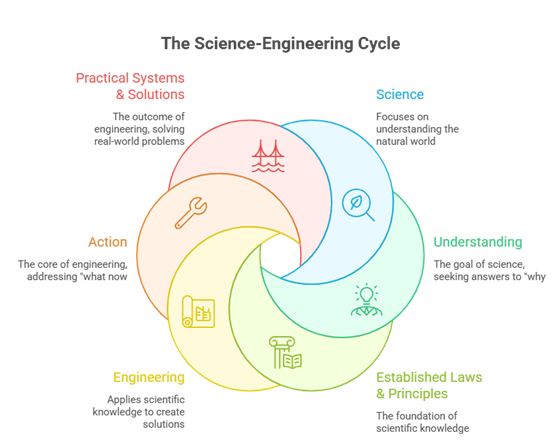
Science and engineering are not separate—they are deeply connected.
Science provides the foundation. Engineering builds upon it.
Without science, engineering has no reliable base.
Without engineering, science remains unused potential.
For a budding engineer, it is important to respect both:
- understand the science deeply
- but focus on applying it effectively
Visual Representation
Practical Table
| Aspect / Question | Why It Matters | Example |
| What is being asked? | Defines purpose of work | Science: Why does heat transfer? Engineering: How to cool a system? |
| What is the goal? | Clarifies direction | Science seeks truth; engineering seeks usable solutions |
| Are there constraints? | Determines feasibility | Budget limits affecting material choice |
| What is the acceptable outcome? | Engineering requires “good enough” decisions | Designing a bridge with safety factors, not perfection |
| Who is impacted? | Engineering directly affects users and systems | Product usability and safety considerations |
Key Takeaways
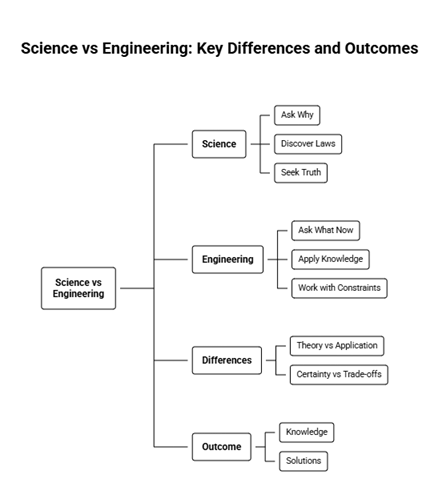
- Science asks why; engineering asks what to do next
- Science discovers laws; engineering applies them
- Engineering operates under constraints and trade-offs
- Perfect solutions are less important than practical ones
- Engineering creates direct impact on real systems and people
- A budding engineer must focus on decision-making, not just understanding
Mind Map
Conclusion
Science and engineering are two sides of the same pursuit—understanding and shaping the world.
Science reveals how reality works.
Engineering decides what to do with that knowledge.
For a budding engineer, this distinction is essential. Your role is not just to understand the world, but to act within it—carefully, responsibly, and intelligently.
Because in the end, progress does not come only from knowing why things happen—
it comes from deciding what to do next, and doing it well.