
Introduction
Failure is often seen as a mistake or breakdown.
But in engineering, failure is not random—it is the result of something not fully understood.
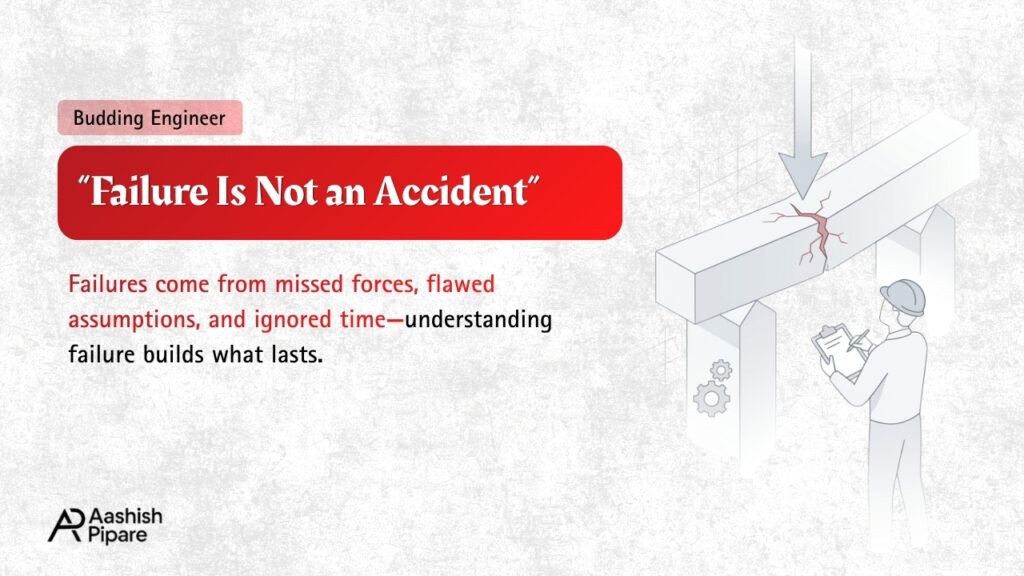
Failure Is Not an Accident
For a budding engineer, it is important to understand that systems do not fail suddenly without reason. Every failure has a history.
A structure does not collapse in a moment—it weakens over time.
A machine does not stop instantly—it degrades before it breaks.
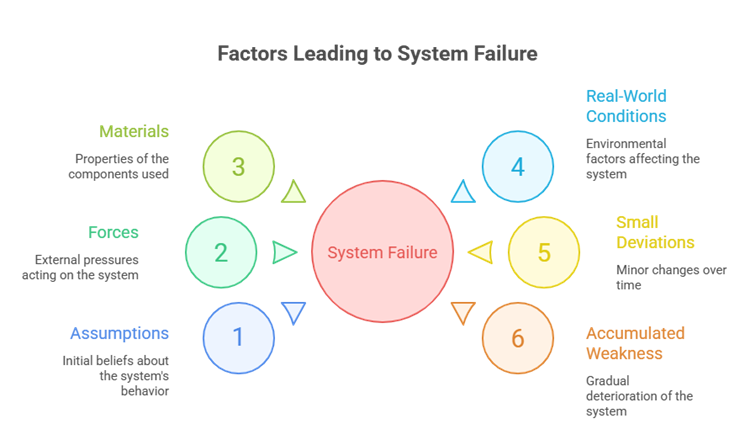
Failure is usually the final step in a chain of small, unnoticed factors:
- forces that were underestimated
- conditions that were not considered
- interactions that were not fully understood
What appears as a sudden failure is often the end of a long, invisible process.
Underestimated Forces
One of the most common reasons things fail is that the forces acting on the system were not fully accounted for.
In controlled environments, systems behave predictably. But in the real world, forces vary:
- loads fluctuate
- vibrations occur
- environmental conditions change
If these forces are underestimated, the system operates closer to its limits than intended. Over time, even small miscalculations can lead to failure.
As a budding engineer, you must always ask:
“What forces might exist beyond what I have calculated?”
Misunderstood Materials
Materials do not behave ideally in real conditions.
They expand, contract, fatigue, corrode, and degrade over time. A material that performs well initially may weaken under repeated stress or environmental exposure.
For example:
- metal can fail due to fatigue under cyclic loading
- materials can corrode when exposed to moisture or chemicals
- temperature changes can alter strength and flexibility
Failure often occurs not because the material was wrong—but because its long-term behavior was not fully understood.
Forgotten Assumptions
Every design is built on assumptions. The danger is that these assumptions are often forgotten once the system is complete.
Common assumptions include:
- operating conditions will remain stable
- users will behave as expected
- loads will stay within limits
When reality deviates from these assumptions, the system is exposed to conditions it was never designed for.
For a budding engineer, one of the most critical habits is to identify and revisit assumptions continuously.
The Role of Time
Time is one of the most underestimated factors in engineering.
A system may perform perfectly at the beginning but fail later due to:
- wear and tear
- fatigue
- gradual misalignment
- accumulation of small stresses
Engineering is not just about whether something works—it is about how long it continues to work reliably.
Ignoring time leads to designs that succeed briefly but fail in the long run.
Failure as a Source of Understanding
Failure is not just an outcome—it is a source of knowledge.
Every failure reveals:
- what was misunderstood
- what was overlooked
- what assumptions were incorrect
For a budding engineer, studying failure is one of the fastest ways to improve judgment.
Instead of asking, “How do I avoid failure?”, a better question is:
“What can failure teach me about this system?”
Understanding failure is the foundation of building systems that last.
Visual Representation
Practical Table
| Factor / Question | Why It Matters | Example |
| What forces are acting? | Hidden or variable forces can exceed design limits | Unexpected vibration in rotating machinery |
| How do materials behave over time? | Long-term degradation leads to failure | Metal fatigue in bridges |
| What assumptions were made? | Incorrect assumptions expose systems to risk | Assuming constant load conditions |
| How does time affect the system? | Wear and fatigue accumulate gradually | Bearings wearing out over repeated use |
| What conditions were ignored? | Unaccounted environments can damage systems | Corrosion due to humidity |
Key Takeaways
- Failure is rarely sudden—it develops over time
- Underestimated forces are a major cause of breakdown
- Materials behave differently in real-world conditions
- Assumptions often become hidden risks
- Time plays a critical role in system reliability
- Understanding failure is essential to building durable systems
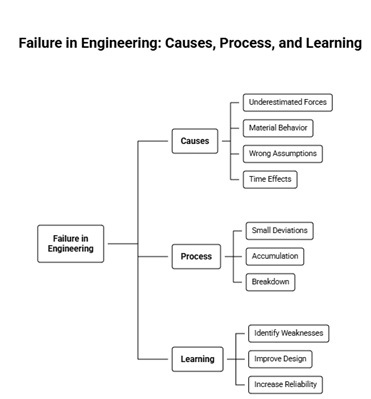
Mind Map
Conclusion
Failure is not the opposite of success in engineering—it is part of the same process.
Every failure is a signal that something was not fully understood. It reveals the limits of knowledge, the gaps in assumptions, and the realities of the physical world.
For a budding engineer, the goal is not to eliminate failure completely—that is impossible. The goal is to understand it deeply enough to reduce its likelihood and impact.
Because systems that last are not built by avoiding failure—
they are built by learning from it before it happens again.