
Introduction
Engineering often appears to be about tools, software, and calculations.
But the most powerful tool exists before all of them—it is the question you choose to ask.
The Power of a Well-Formed Question
For a budding engineer, it is easy to believe that answers define expertise. In reality, it is the quality of your questions that determines the outcome of your work.
A well-formed question does three things:
- defines the real problem
- sets the direction of thinking
- limits wasted effort
If the question is unclear or incomplete, even perfect calculations will lead to the wrong solution.
Engineering rarely fails because of lack of effort—it fails because the wrong question was solved correctly.
Before Equations, There Is Framing
Every equation, model, or simulation begins with a decision about what to include and what to ignore. That decision is shaped entirely by the question being asked.
For example:
- Asking “How do I make this stronger?” leads to different solutions than
- Asking “Why is this failing?”
Both are valid—but they lead to completely different paths.
For a budding engineer, learning to pause and refine the question is more valuable than rushing into analysis.
Because once the question is set, everything that follows becomes constrained by it.
Questions Reveal What Matters
A good question highlights priorities.
It forces clarity about:
- objectives
- constraints
- risks
- trade-offs
For instance:
- “What is the safest design?” prioritizes reliability
- “What is the most cost-effective solution?” prioritizes efficiency
Without a clear question, decisions become scattered and inconsistent.
A strong question acts like a filter—it removes irrelevant details and focuses attention on what truly matters.
Poor Questions Lead to Hidden Failures
When questions are poorly formed, problems remain hidden.
Common issues include:
- solving symptoms instead of root causes
- ignoring constraints
- overlooking critical variables
For example, asking “How do we fix this component?” may miss the deeper issue that the entire system design is flawed.
For a budding engineer, this is a key lesson: the depth of your question determines the depth of your understanding.
Questioning as a Habit
Experienced engineers do not accept problems as given—they reshape them through questioning.
They ask:
- What exactly is the problem?
- What assumptions are we making?
- What are we not considering?
- What does success actually look like?
This habit transforms engineering from reactive problem-solving into intentional thinking.
For a budding engineer, developing this habit early is one of the most valuable skills you can build.
The Relationship Between Questions and Solutions
Every solution is a direct response to a question.
If the question is narrow, the solution will be limited.
If the question is thoughtful, the solution will be meaningful.
This means:
- better questions → better direction → better outcomes
The quality of engineering work is not just in execution—it begins at the level of inquiry.
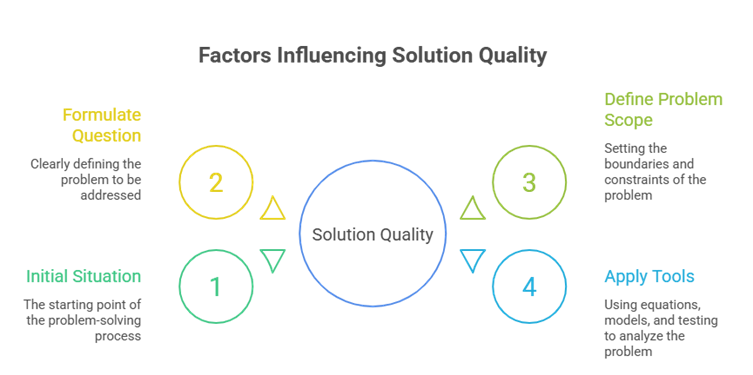
Visual Representation
Practical Table
| Question / Aspect | Why It Matters | Example |
| What is the real problem? | Prevents solving the wrong issue | Identifying root cause instead of symptoms |
| What are the constraints? | Defines boundaries of solution | Budget or material limitations |
| What assumptions exist? | Reveals hidden risks | Assuming constant operating conditions |
| What does success mean? | Clarifies objective | Performance vs safety priority |
| What is being ignored? | Identifies potential blind spots | Environmental factors not considered |
Key Takeaways
- The quality of a solution depends on the quality of the question
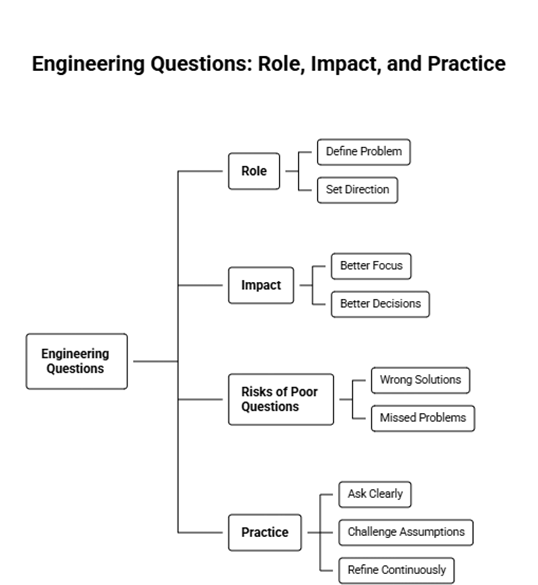
- A well-formed question defines direction and focus
- Poor questions lead to solving the wrong problems
- Questioning reveals assumptions, constraints, and priorities
- Engineering thinking begins before calculations
- A budding engineer must learn to refine questions continuously
Mind Map
Conclusion
The most powerful tool in engineering is not something you use—it is something you ask.
Before any calculation or design begins, the question determines what will be seen, what will be ignored, and what will be solved.
For a budding engineer, mastering questions is the beginning of mastering engineering itself.
Because in the end, engineering is not just about finding answers— it is about asking the kind of questions that make the right answers possible.