
Introduction
In engineering, beauty is often dismissed as aesthetic preference.
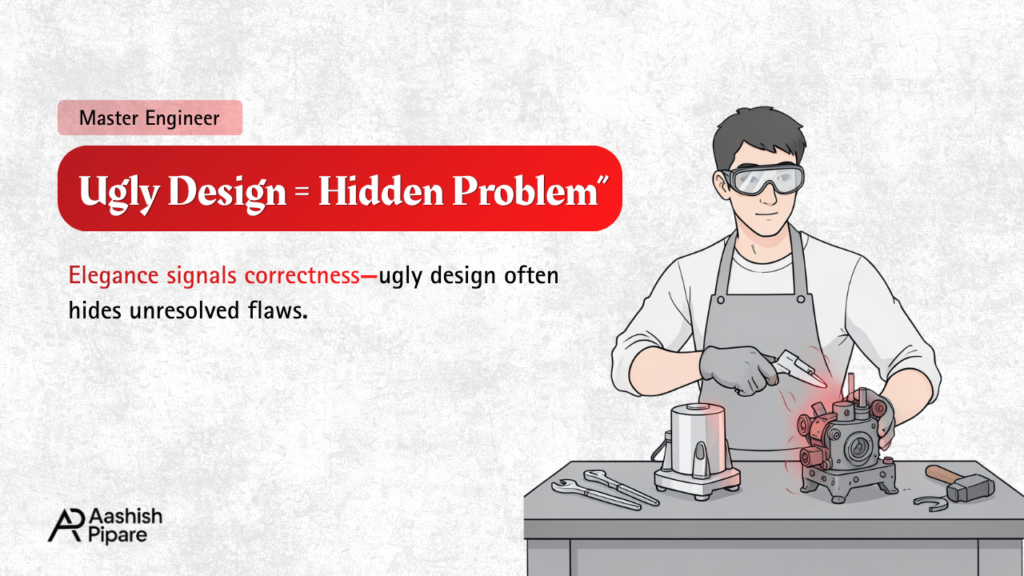
But true elegance is not decoration—it is a signal of correctness.
What Elegance Really Means
Elegance in engineering is not about simplicity for its own sake. It is about achieving clarity, efficiency, and coherence in a way that feels natural and inevitable.
An elegant design:
- solves the problem without unnecessary complexity
- aligns structure with purpose
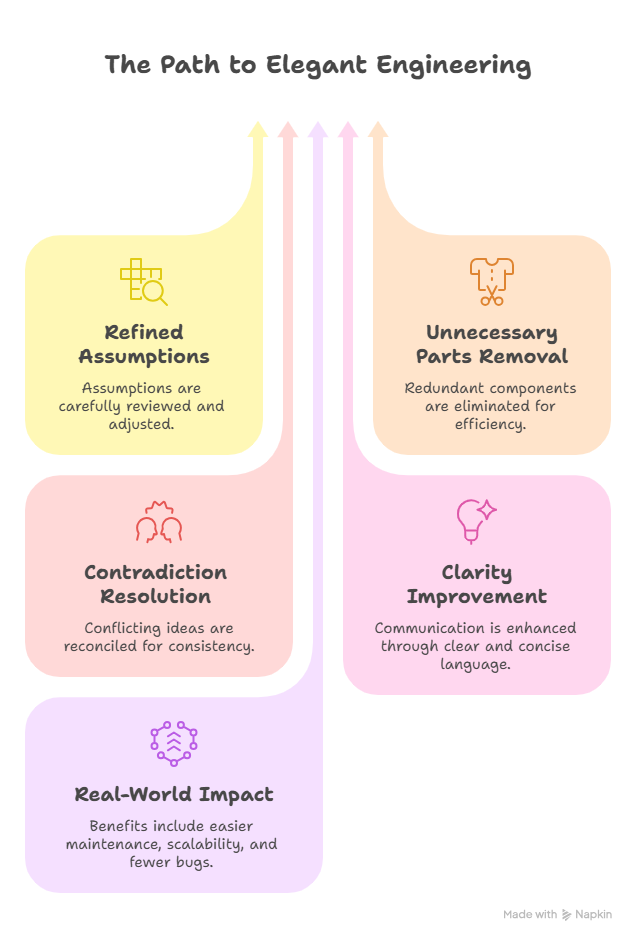
- removes contradictions and redundancies
It feels “right” not because it is visually appealing, but because it reflects a deep understanding of the system.
A Master Engineer recognizes that elegance is not added at the end—it emerges when the problem is truly understood.
Why Truth Tends Toward Elegance
When a system is correctly understood, the solution often becomes simpler, more direct, and more consistent.
This happens because:
- unnecessary assumptions are removed
- hidden constraints are resolved
- interactions are aligned rather than forced
In contrast, when understanding is incomplete, solutions tend to become:
- overcomplicated
- inconsistent
- filled with patches and workarounds
These are signs that the design is compensating for something not fully understood.
Elegance, therefore, is not just aesthetic—it is a byproduct of truth.
Ungainly Designs as Warning Signals
When a design feels awkward, overly complex, or difficult to reason about, it is rarely just a stylistic issue.
It often indicates:
- unresolved contradictions in requirements
- incomplete understanding of system behavior
- hidden dependencies that are not fully addressed
Engineers sometimes attempt to force solutions into place, layering fixes on top of each other. The result is a system that works—but lacks coherence.
A Master Engineer treats this discomfort as a diagnostic signal:
If it feels wrong, something is likely wrong.
The Difference Between Simplicity and Oversimplification
It is important to distinguish elegance from naive simplicity.
Oversimplification ignores constraints and reduces complexity artificially.
Elegance, on the other hand:
- acknowledges complexity
- organizes it effectively
- expresses it in the simplest possible form without losing truth
This requires discipline. Removing complexity without losing correctness is one of the hardest tasks in engineering.
True elegance is achieved not by ignoring difficulty, but by resolving it.
Engineering Thinking: Refinement Toward Clarity
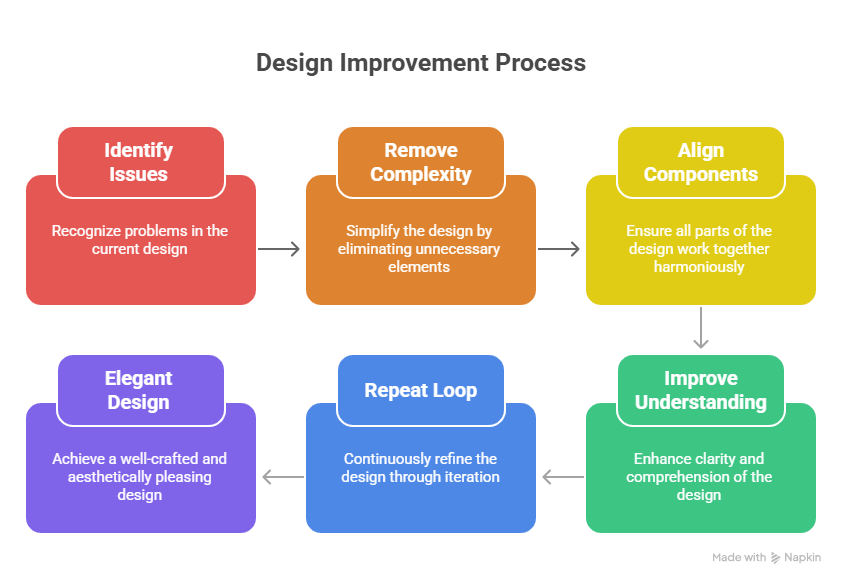
Elegance is often the result of iteration.
The process typically involves:
- identifying inconsistencies in the design
- refining assumptions
- removing unnecessary elements
- aligning components with system behavior
Each iteration brings the design closer to coherence.
This process requires patience. Initial solutions are rarely elegant. They reflect partial understanding. Over time, as understanding deepens, the design becomes clearer and more refined.
A Master Engineer does not rush to finalize solutions.
They refine until the design reaches a point where it becomes internally consistent and naturally structured.
Real-World Implications
In real systems, elegant designs tend to be:
- easier to maintain
- more robust under changing conditions
- simpler to extend or modify
Because they are built on clear principles, rather than layered fixes.
In contrast, inelegant systems:
- accumulate technical debt
- become harder to debug
- fail in unexpected ways
This is why elegance is not a luxury—it is a practical indicator of system quality.
Visual Repres
Practical Table
| Factor / Question | Why It Matters | Example |
| Does the design feel unnecessarily complex? | Complexity often hides unresolved issues | Multiple layers of fixes in software systems |
| Are there redundant components? | Redundancy may indicate lack of clarity | Duplicate logic across modules |
| Is the system easy to reason about? | Clarity reflects correctness | Clean, predictable system behavior |
| Are assumptions clearly aligned? | Misaligned assumptions create inconsistency | Conflicting design constraints |
| Can the design be simplified further without loss? | True elegance balances simplicity and correctness | Optimized mechanical structure with minimal parts |
Key Takeaways
- Elegance in engineering is a reflection of deep understanding
- Correct solutions tend to be more coherent and less complex
- Ungainly designs often signal unresolved problems
- Simplicity must not come at the cost of correctness
- Iteration and refinement are essential to achieving elegance
- Elegance improves maintainability, reliability, and clarity
Mind Map
Conclusion
In engineering, elegance is not an aesthetic luxury—it is a reflection of truth.
A design becomes elegant when it aligns perfectly with the realities of the system it represents. It contains no excess, no contradiction, no unnecessary complexity. It feels inevitable.
This is why elegance can be trusted as a signal.
Not because it is beautiful—but because it reveals that the engineer has reached a deeper level of understanding.
A Master Engineer does not pursue elegance directly.
They pursue truth—
and allow elegance to emerge as its natural consequence.