
Introduction
Engineering does not end when a system is built.
It ends when the system is understood well enough to be trusted and used correctly.
Communication Is Part of the Design
In practice, engineering is not isolated from people. Every system interacts with stakeholders—clients, managers, operators, and users—many of whom do not think in technical frameworks.
A design that cannot be clearly explained is not fully formed. It may function correctly, but it lacks accessibility. And in real-world systems, unexplained systems are often misused systems.
Communication is not a separate activity after engineering work—it is a continuation of it. The clarity of explanation reflects the clarity of thinking behind the design.
What It Really Means to Translate Technical Truth
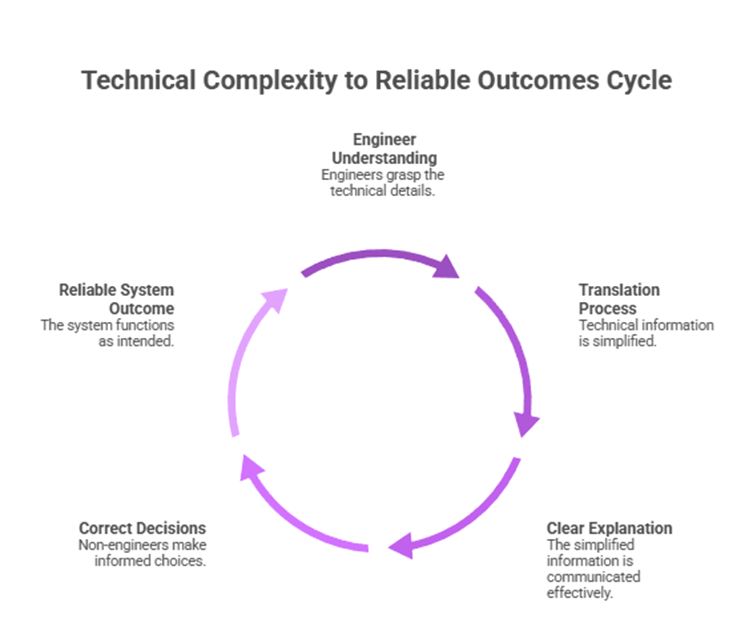
Communicating with non-engineers is not about simplifying until the truth is lost. It is about preserving accuracy while removing unnecessary complexity.
Technical truth often contains layers:
- underlying principles
- assumptions
- constraints
- risks
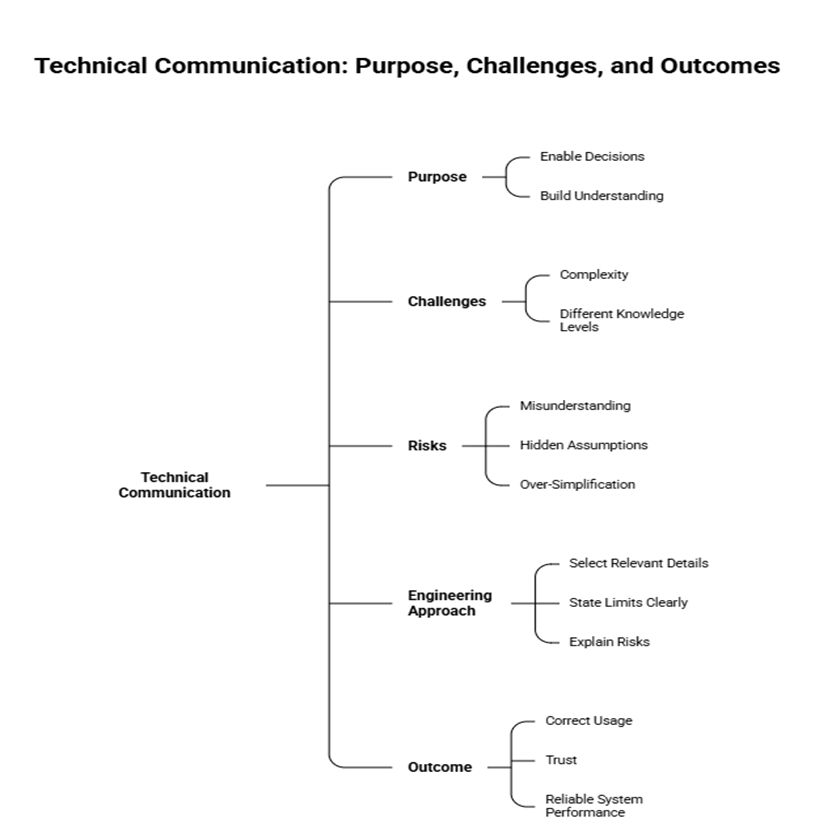
A practitioner engineer understands which layer is relevant to the listener.
For example, a structural engineer does not need to explain stress-strain equations to a client. But they must clearly communicate:
- what the structure can handle
- what its limits are
- what conditions may cause failure
Translation is not reduction—it is selection of what matters.
Why This Matters in Real Projects
In real-world projects, decisions are not made only by engineers. Budgets, timelines, safety approvals, and operational choices often depend on people who rely entirely on your explanation.
If communication fails:
- risks are underestimated
- wrong trade-offs are approved
- expectations become unrealistic
This creates a dangerous gap between what the system is and what people believe it is.
That gap is where failures originate—not from calculations, but from misunderstanding.
The Risk of Over-Simplification
While clarity is necessary, oversimplification introduces its own risks.
When engineers remove too much detail:
- uncertainty disappears from the explanation
- limitations are hidden
- systems appear more robust than they are
For example, saying “this system is safe” is incomplete.
A more accurate statement would be:
“This system is safe under these conditions, within these limits.”
The goal is not to make things sound simple—it is to make them correctly understandable.
Engineering Thinking Behind Good Communication
Effective technical communication requires the same thinking used in design:
- identifying key variables
- understanding constraints
- evaluating consequences
Instead of asking, “How do I explain everything?”, a practitioner engineer asks:
“What does this person need to understand to make a correct decision?”
This shifts communication from information delivery to decision support.
Good engineers design systems.
Strong practitioners design understanding.
Real-World Implications
In the field, poor communication leads to predictable outcomes:
- operators misuse systems because instructions were unclear
- clients push systems beyond safe limits
- teams misalign due to different interpretations
On the other hand, clear communication creates:
- correct usage
- realistic expectations
- faster decision-making
- trust between stakeholders
In many cases, a well-explained system performs better than a technically superior but poorly communicated one.
Visual Representation
Practical Table
| Situation / Question | Why It Matters | Example |
| What does the listener need to decide? | Focuses communication on relevance | Client deciding budget vs safety trade-off |
| What assumptions should be stated? | Prevents hidden misunderstandings | Explaining operating conditions of a machine |
| What are the limits of the system? | Defines safe usage boundaries | Load limits in structural design |
| What risks must be understood? | Ensures informed decision-making | Failure scenarios in extreme conditions |
| What can be simplified safely? | Removes noise without losing meaning | Avoiding deep equations while keeping core concept intact |
Key Takeaways
- Communication is not separate from engineering—it is part of the design
- If a system cannot be explained clearly, it is not fully understood
- Translation means preserving truth while removing unnecessary complexity
- Oversimplification can hide risks and create false confidence
- The goal of communication is to support correct decisions
- Clear understanding reduces real-world system failure
Conclusion
Engineering truth has no value if it remains locked in technical language.
A practitioner engineer recognizes that systems do not exist in isolation—they exist in human environments where decisions depend on understanding. The ability to communicate clearly is not an additional skill layered on top of engineering; it is a reflection of how well the system itself has been thought through.
If a design cannot be understood, it cannot be trusted.
And if it cannot be trusted, it is not complete.
Because in the end, engineering is not only about making systems work— it is about making them understandable enough to work correctly in the real world.