
Introduction
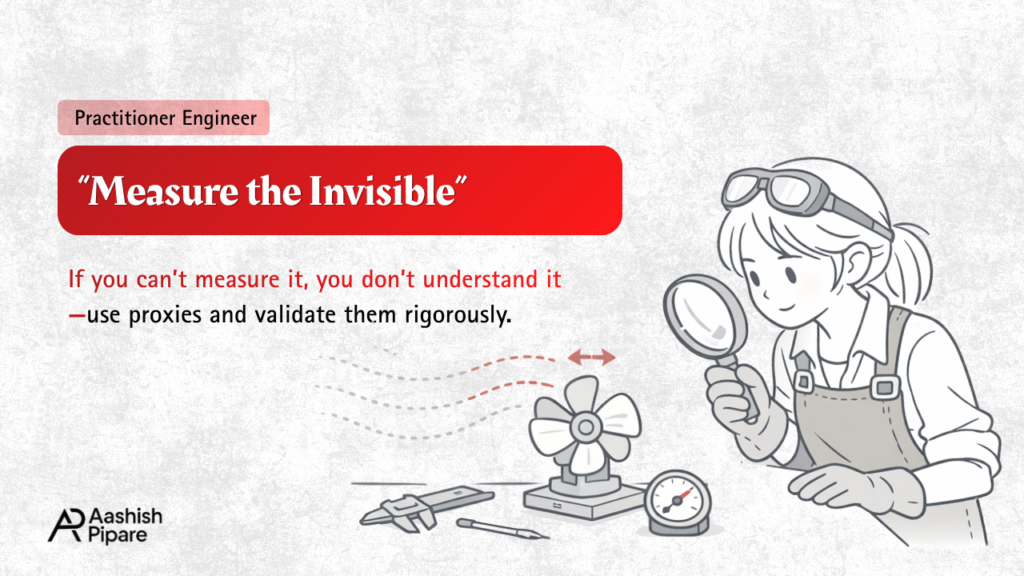
Not everything in engineering is visible, measurable, or directly accessible.
Yet decisions still have to be made.
The challenge is not just testing the system—but understanding what lies beyond direct observation.
The Limits of Direct Measurement
In real-world systems, many critical variables cannot be measured directly. These may include internal stresses, microscopic behavior, long-term degradation, or system states that exist only under specific conditions.
An early-stage engineer often assumes that what matters can be directly measured. A practitioner engineer learns otherwise.
There are always layers of the system that remain hidden:
- internal states of materials
- transient behaviors during operation
- interactions between components at scale
The absence of direct measurement does not remove the need for understanding. It simply forces the engineer to approach the problem differently.
The Role of Instrumentation
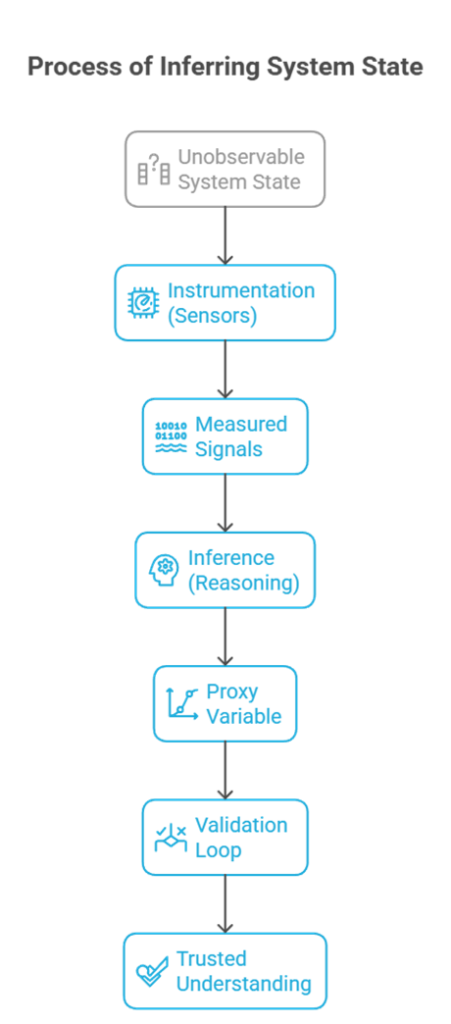
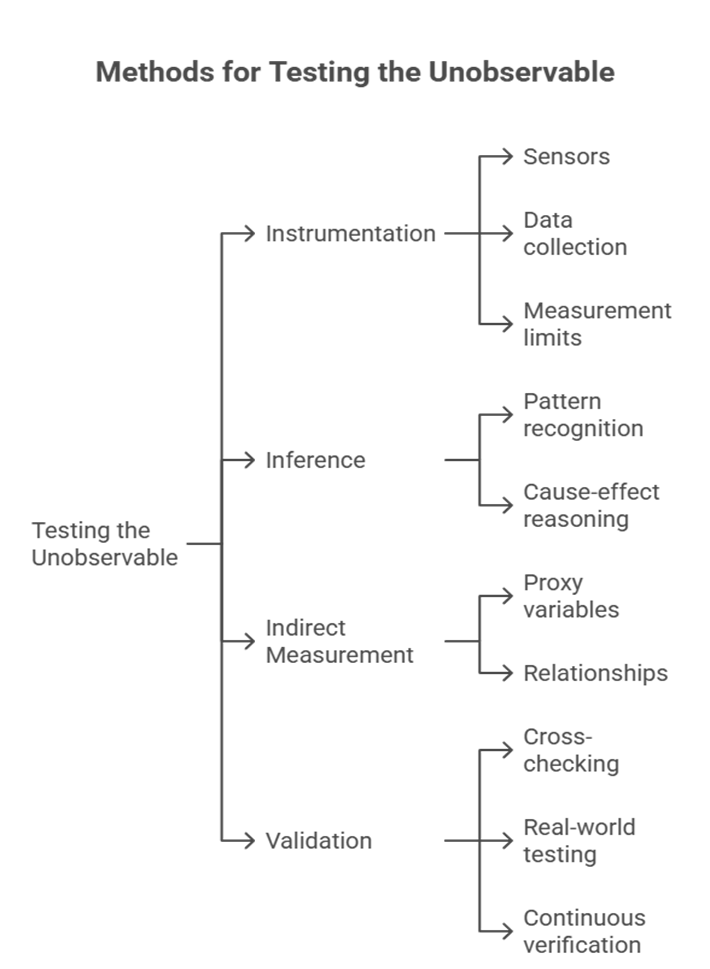
Instrumentation is the first step toward making the invisible visible.
Sensors, probes, and monitoring systems allow engineers to capture signals that represent deeper system behavior. However, instrumentation is not neutral—it shapes what you see and what you miss.
Every instrument has:
- limitations in accuracy
- response time constraints
- placement sensitivity
For example, measuring temperature at one point in a system does not guarantee an understanding of the entire thermal profile. The reading is real—but incomplete.
A practitioner engineer does not just install instruments. They question:
- What exactly is this measuring?
- What is it not capturing?
Inference: Thinking Beyond the Signal
When direct observation is not possible, engineers rely on inference—drawing conclusions from available data.
Inference is not guesswork. It is structured reasoning based on physics, system behavior, and relationships between variables.
For instance:
- Vibration patterns may indicate internal imbalance
- Power consumption may reveal system inefficiencies
- Output variations may reflect upstream instability
However, inference introduces uncertainty. The same signal can sometimes be explained by multiple causes.
This is where engineering judgment becomes critical. The goal is not to eliminate uncertainty—but to reduce ambiguity through reasoning and validation.
Indirect Measurement and the Use of Proxies
Indirect measurement relies on proxies—variables that can be measured and are strongly related to the variable of interest.
A proxy is useful only if:
- It has a consistent relationship with the hidden variable
- That relationship is validated under real conditions
For example:
- Using surface temperature as a proxy for internal heat generation
- Using pressure drop as a proxy for flow resistance
- Using noise levels as a proxy for mechanical wear
The danger lies in assuming the proxy is always reliable. In reality, relationships change with:
- operating conditions
- system aging
- environmental factors
A practitioner engineer treats every proxy as a hypothesis, not a truth.
Validating the Proxy Ruthlessly
The most critical step is validation.
If you rely on indirect measurement, you must continuously test whether your proxy still reflects reality. This is where many systems fail—not because the proxy was wrong initially, but because it stopped being valid over time.
Validation methods include:
- cross-checking with alternative measurements
- testing under extreme conditions
- comparing predicted vs actual outcomes
For example, if vibration is used as a proxy for machine health, it must be validated against actual inspection results periodically.
Without validation, a proxy becomes a false sense of understanding.
Real-World Implications
In real systems, invisible failures rarely occur without indirect signals. The issue is not absence of data—but misinterpretation of it.
Consider:
- A system that passes all visible checks but fails under load
- A machine that operates normally but degrades internally
- A process that appears stable but drifts slowly over time
These are not failures of measurement tools—they are failures of measurement strategy.
A practitioner engineer builds systems that:
- capture meaningful signals
- relate those signals to hidden states
- continuously verify those relationships
Because in practice, you rarely measure what you truly care about. You measure what you can—and interpret the rest.
Visual Representation
Practical Table
| Factor / Question | Why It Matters | Example |
| What cannot be directly measured? | Defines the gap in understanding | Internal stress in a structure |
| What signals can I capture? | Determines available data for inference | Vibration, temperature, pressure |
| Is the proxy reliable? | Ensures the relationship reflects actual system behavior | Using noise as an indicator of wear |
| How is the proxy validated? | Prevents false confidence | Comparing sensor data with physical inspection |
| What conditions may break the link? | Identifies when proxy relationships may fail | Environmental changes affecting sensor accuracy |
Key Takeaways
- Not all important variables in engineering can be directly measured
- Instrumentation provides signals, not complete understanding
- Inference connects data to hidden system behavior
- Proxies are useful but must be treated as assumptions
- Continuous validation is essential to maintain trust in indirect measurements
- Misinterpreting signals is often more dangerous than having no data
Conclusion
Engineering does not always offer direct visibility. Many of the most critical aspects of a system remain hidden, accessible only through signals, relationships, and interpretation.
A developing engineer focuses on measuring what is available.
A practitioner engineer focuses on understanding what is not directly visible.
This requires more than tools—it requires disciplined thinking. Instrumentation provides data, inference provides meaning, and validation provides trust.
Because in the end, you are not judged by what you can measure— but by how accurately you understand what you cannot see.