
Introduction
Design happens in controlled environments.
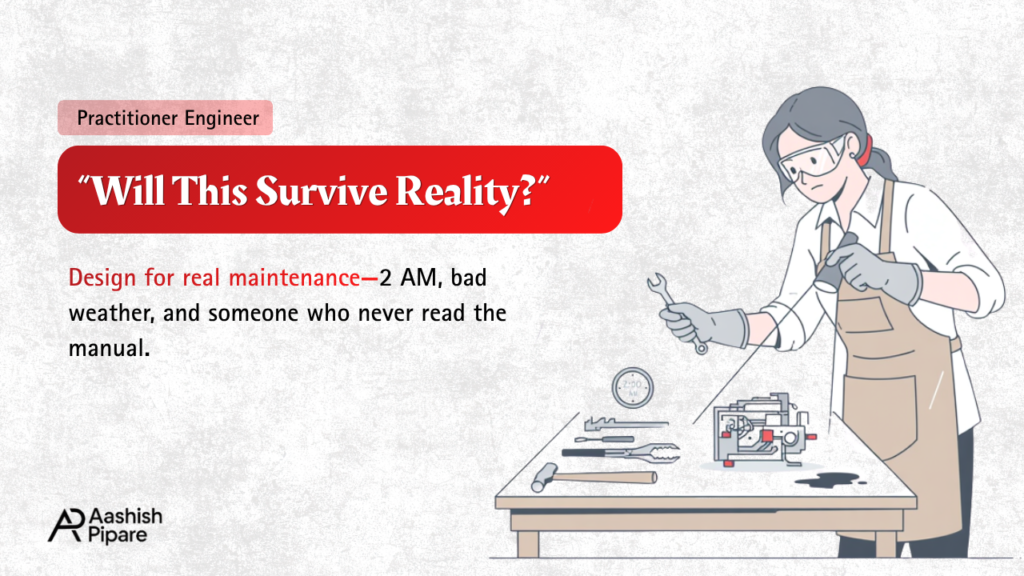
Maintenance happens in uncontrolled reality—where time, weather, and human limitations redefine your system.
The Reality Gap Between Design and Maintenance
In design, systems are clean, accessible, and fully understood. Every component is visible on drawings. Every assumption feels valid. The environment is predictable.
But maintenance does not happen in that world.
It happens in imperfect conditions:
- low visibility
- time pressure
- incomplete information
- physical discomfort
A technician in the field is not interacting with your design intent—they are interacting with your design decisions under stress.
The gap between these two worlds is where many systems fail—not because they are poorly designed, but because they are poorly maintainable.
What Maintenance Actually Feels Like
Maintenance is rarely planned the way designers imagine.
It often looks like:
- troubleshooting without full system context
- working in awkward physical positions
- dealing with stuck, worn, or degraded components
- interpreting unclear or missing documentation
At 2 AM, in the rain, the system is no longer a schematic—it is a physical reality.
The person maintaining it may:
- not be the original operator
- not have read the manual
- not fully understand the system logic
And yet, they must make decisions quickly.
A good design does not assume ideal behavior.
It respects human limitation under pressure.
Why This Matters More Than Design Perfection
A system is not successful because it works once.
It is successful because it continues to work over time.
Maintenance defines long-term reliability.
If maintenance is:
- difficult → errors increase
- unclear → wrong fixes are applied
- physically demanding → shortcuts are taken
Then even a perfectly designed system will degrade quickly.
In practice, systems fail not at the point of design—but at the point of repair, adjustment, and recovery.
Hidden Risks in Ignoring Maintenance Reality
When maintenance is not considered deeply, several risks emerge:
- Critical components are placed in hard-to-reach locations
- Tools required are not standard or easily available
- Disassembly requires unnecessary complexity
- Small errors during maintenance create large system failures
These are not technical flaws—they are usability failures in real conditions.
The most dangerous part is that these issues are invisible during design reviews.
They only appear when the system is under stress.
Engineering Thinking: Designing for the Worst Night
A practitioner engineer shifts perspective:
Instead of asking: “Does this system work?”
They ask: “Can this system be maintained by a tired human, in bad conditions, without full context?”
This changes decisions:
- accessibility becomes as important as performance
- simplicity becomes more valuable than optimization
- clarity becomes critical
Designing for maintenance means imagining:
- limited lighting
- wet or unsafe conditions
- reduced attention and cognitive load
Because that is where real engineering is tested.
Real-World Implications
Systems that are easy to maintain:
- recover faster from failure
- have lower operational cost
- build trust with operators
Systems that ignore maintenance:
- accumulate small errors over time
- require expert intervention frequently
- become unreliable despite strong design
In industry, maintainability is not a secondary feature—it is a core performance metric.
Visual Representation
Practical Table
Situation / Factor Why It Matters Example
Accessibility of components Difficult access increases repair time and errors Valve placed behind multiple assemblies
Clarity of system layout Confusing layout slows diagnosis Similar-looking components with no labeling
Tool requirements Non-standard tools delay maintenance Special wrench required not available on-site
Human conditions Fatigue and stress reduce decision quality Night shift emergency repair
Environmental exposure Weather and surroundings affect work capability Outdoor equipment during rain
Key Takeaways
- Maintenance happens in conditions far worse than design assumptions
- Systems are tested not during operation, but during failure and repair
- Human limitations are a central design constraint, not an afterthought
- Accessibility and simplicity directly impact system reliability
- Poor maintainability turns small issues into system failures
Conclusion
Engineering does not end when the system starts working.
It continues every time the system needs to be touched, opened, adjusted, or repaired.
Maintenance is where design meets reality—without preparation, without ideal conditions, and often without full understanding.
A practitioner engineer does not design for the best-case scenario.
They design for the worst moment—the night, the rain, the fatigue, and the uncertainty.
Because in the end, a system is not judged by how well it performs in ideal conditions,
but by how well it survives when everything around it is working against it.