
Introduction
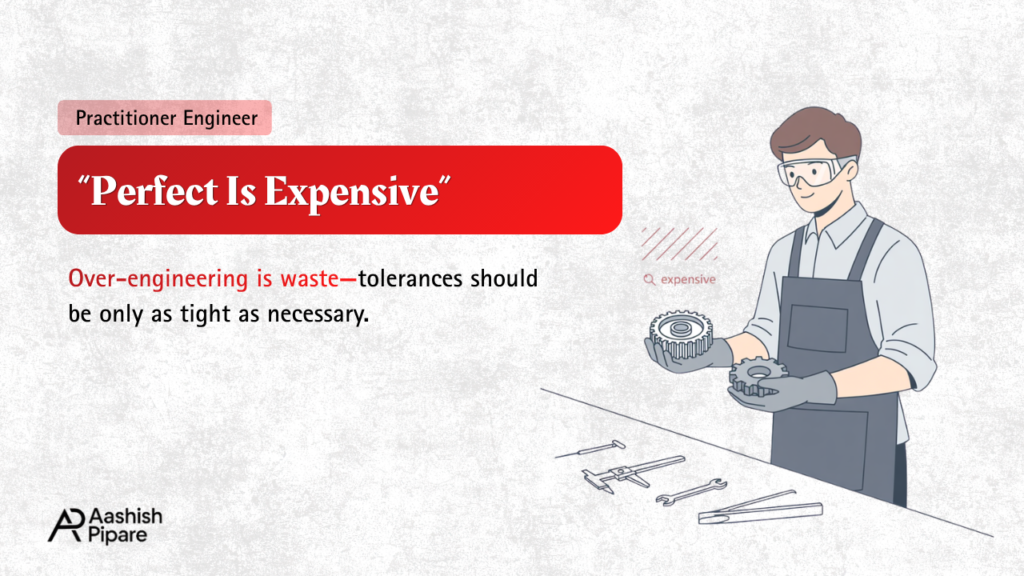
In engineering practice, perfection is rarely the goal.
The real challenge is knowing when further improvement stops adding value and starts creating waste.
The Illusion of Perfection
Early in an engineer’s journey, there is a strong instinct to refine everything—to make designs tighter, stronger, faster, and more precise than required. It feels responsible. It feels professional.
But in real systems, perfection is not free. Every additional layer of precision, every tighter tolerance, every extra safety margin comes with a cost—time, material, complexity, and often reduced flexibility.
A system does not fail because it wasn’t perfect. It fails when it does not meet its actual operating requirements. Anything beyond that is not always improvement—it can be unnecessary burden.
Understanding this distinction is where engineering maturity begins.
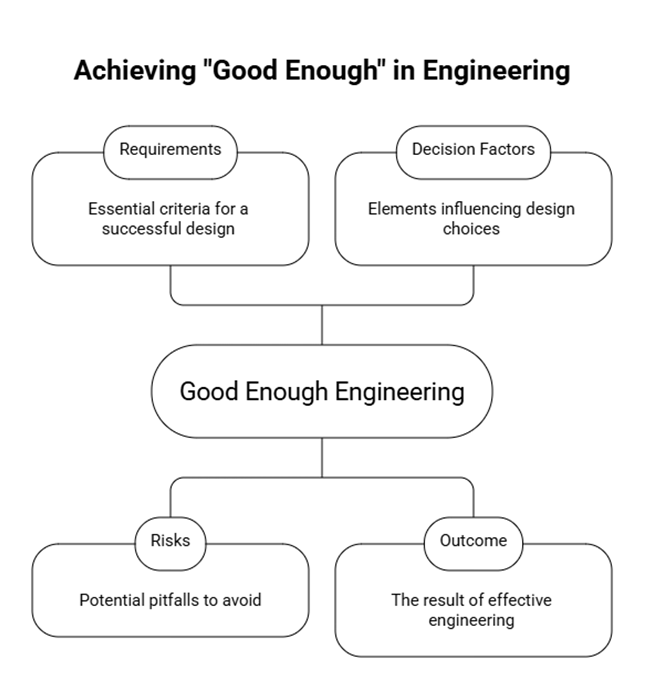
What “Good Enough” Really Means
“Good enough” is not about compromise or carelessness. It is about alignment.
A design is good enough when:
- it meets all functional requirements
- it operates safely under expected conditions
- it remains reliable over its intended life
- it fits within cost, time, and resource constraints
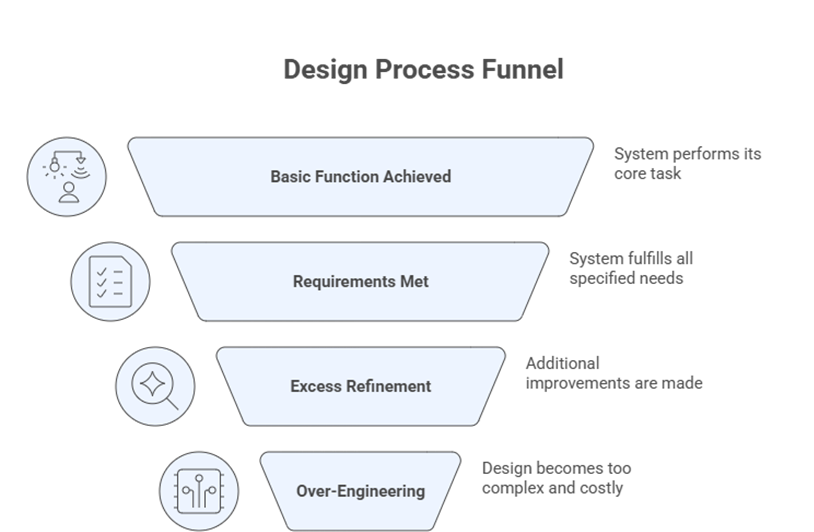
Beyond this point, additional refinement often produces diminishing returns.
For example, reducing tolerance from ±0.5 mm to ±0.1 mm may improve precision—but if the system performance does not depend on that level of accuracy, the tighter tolerance only increases manufacturing difficulty and cost without meaningful benefit.
Good engineering is not about maximizing performance in isolation. It is about optimizing the entire system.
The Cost of Over-Engineering
Over-engineering is one of the most common inefficiencies in real-world projects. It often comes from good intentions—wanting to build something robust or future-proof.
However, unnecessary precision introduces hidden costs:
- increased manufacturing complexity
- higher material usage
- longer production time
- more difficult maintenance
- reduced adaptability
In some cases, over-engineered systems become harder to operate because they are too rigid or too optimized for a narrow condition.
The paradox is that trying to make a system “better” can actually make it less practical.
Engineering Thinking: Optimize, Don’t Maximize
A practitioner engineer does not aim for the highest possible specification. Instead, they aim for the most appropriate specification.
This requires asking:
- What is the actual requirement?
- What level of precision is truly needed?
- What happens if this is slightly less accurate?
- What is the cost of making it more precise?
These questions shift thinking from maximization to optimization.
Optimization balances:
- performance
- cost
- reliability
- manufacturability
It recognizes that every improvement has a trade-off.
Designing with Appropriate Tolerances
Tolerances define how much variation a system can handle. Setting them correctly is a key part of engineering judgment.
If tolerances are too tight:
- production becomes expensive and slow
- rejection rates increase
- assembly becomes difficult
If tolerances are too loose:
- system performance may degrade
- reliability may be affected
The goal is not to minimize tolerance—it is to right-size it.
Experienced engineers deliberately choose tolerances that are:
- as loose as possible for manufacturability
- as tight as necessary for function and safety
This balance is what makes a design practical.
Knowing When to Stop
One of the hardest decisions in engineering is deciding when to stop improving a design.
There is always something that can be refined further. But each iteration must justify itself.
A practical rule:
If the improvement does not significantly enhance system performance, safety, or reliability—but increases cost or complexity—it is no longer valuable.
At this point, continuing to refine is not engineering—it is perfectionism.
And in real systems, perfectionism is a form of inefficiency.
Visual Representation
Practical Table
| Factor / Question | Why It Matters | Example |
| What is the actual requirement? | Prevents unnecessary improvements | Designing for 10 kN load instead of overdesigning for 50 kN |
| Does extra precision add value? | Avoids waste in manufacturing | Tight machining where rough tolerance is sufficient |
| What is the cost of improvement? | Highlights trade-offs | Higher cost for marginal accuracy gain |
| Can the system handle variation? | Ensures robustness without over-control | Allowing thermal expansion in mechanical design |
| Is the design maintainable? | Over-complex systems are harder to repair | Simple joints vs precision-fit components |
Key Takeaways
- “Good enough” means meeting requirements, not maximizing specifications
- Over-engineering adds cost without proportional value
- Tolerances should be as loose as safely possible
- Optimization is more important than perfection
- Every improvement must justify its cost and complexity
Conclusion
Engineering is not the pursuit of perfection—it is the discipline of making appropriate decisions under constraints.
Knowing when something is “good enough” requires clarity about purpose, awareness of trade-offs, and the discipline to stop when further effort no longer creates meaningful value.
An inexperienced engineer tries to eliminate all imperfection.
A practitioner engineer understands that controlled imperfection is not a flaw—it is what makes systems efficient, buildable, and sustainable.
Because in the real world, the best design is not the most perfect one— it is the one that delivers exactly what is needed, and nothing more.