
Introduction
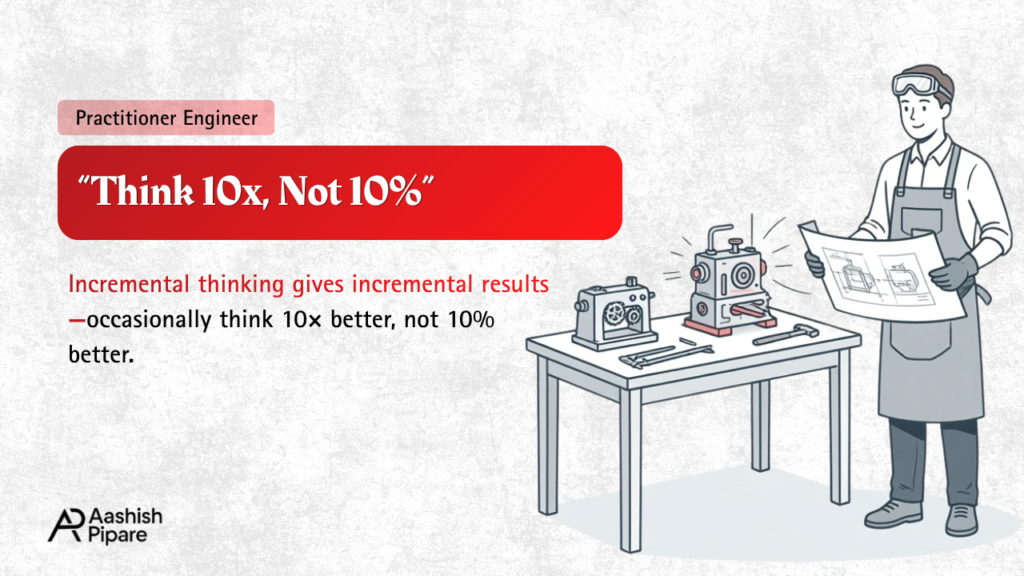
Most engineering improvements are small, safe, and predictable.
But real breakthroughs rarely come from doing the same thing slightly better.
The Trap of Incremental Thinking
In day-to-day engineering work, improvement usually means optimization—reducing error, improving efficiency, or lowering cost by a few percentage points. This approach feels practical because it builds on what already exists.
However, incremental thinking has a hidden limitation: it assumes that the current system, process, or design is fundamentally correct. It focuses on refinement, not reinvention.
Over time, this creates systems that are highly optimized—but only within their original constraints. The result is local efficiency, not transformative progress.
A practitioner engineer recognizes that while incremental improvement is necessary, it is not sufficient for solving larger or evolving problems.
What “10x Better” Really Means
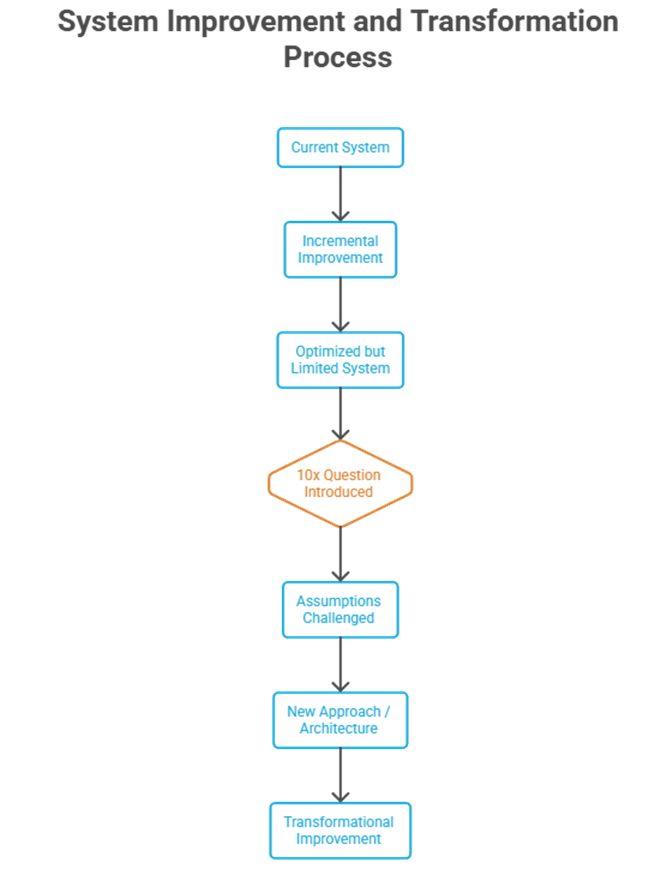
A tenfold improvement is not just a bigger version of a small improvement. It changes the nature of the problem itself.
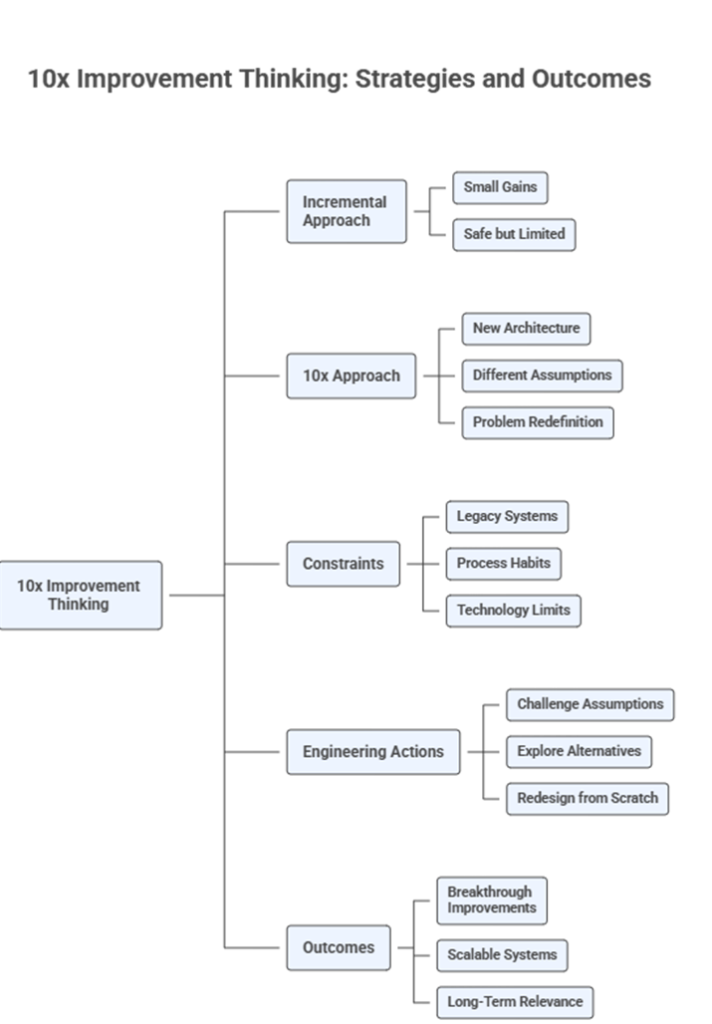
To be 10x better, a system often requires:
- a different architecture
- a different technology
- a different assumption about how the system should work
For example, improving a manual process by 10% might involve better tools or training. But improving it by 10x may require full automation, eliminating the manual step entirely.
This shift forces a fundamental question:
Are we solving the problem in the right way, or just improving the current method?
Breaking Existing Constraints
Thinking in terms of 10x exposes the constraints that incremental thinking hides.
Many limitations in engineering systems are not physical—they are inherited:
- legacy design decisions
- outdated assumptions
- process inertia
- organizational habits
When asked to improve something slightly, engineers work within these boundaries. When asked for a 10x improvement, those boundaries become obstacles that must be challenged.
This is where engineering judgment becomes critical. Not every constraint should be removed—but some must be questioned to unlock meaningful progress.
The Risk of Staying Incremental
Incremental improvements feel safe because they carry predictable outcomes. But they also carry a long-term risk: stagnation.
Systems that evolve only through small improvements may become:
- inefficient compared to newer alternatives
- difficult to scale
- incompatible with changing environments
In practice, many systems fail not because they were poorly designed, but because they were never reimagined when conditions changed.
A practitioner engineer understands that failure to rethink is also a form of risk.
Engineering for 10x Thinking
Designing for a 10x improvement does not mean ignoring practical constraints. It means deliberately stepping outside the current solution to explore fundamentally different approaches.
This involves:
- redefining the problem instead of accepting it as given
- exploring alternative technologies or architectures
- questioning whether certain steps are necessary at all
- considering how the system would be designed from scratch
Often, the goal is not to immediately achieve 10x improvement, but to uncover a direction that incremental thinking would never reveal.
Even if the final solution is only 2x or 3x better, it is often far more impactful than a series of small optimizations.
Real-World Implications
In real projects, 10x thinking is not applied continuously—it is applied deliberately.
Moments where it becomes critical include:
- early design phases
- system redesigns
- performance bottlenecks
- cost or scalability limits
At these points, continuing with incremental changes can lead to diminishing returns. A shift in approach becomes more valuable than further optimization.
Practitioner engineers know when to stop refining—and start rethinking.
Visual Representation
Practical Table
| Question / Factor | Why It Matters | Example |
| What assumption are we accepting? | Hidden assumptions limit breakthrough improvements | Assuming manual inspection is necessary |
| Can this step be eliminated? | Removal often creates larger gains than optimization | Automating data entry instead of speeding it up |
| What would we do if starting fresh? | Removes legacy constraints | Designing a system without existing infrastructure limits |
| Where are diminishing returns? | Indicates need for a different approach | Repeated small efficiency gains with rising effort |
| Is technology the limiting factor? | New tools may enable step-change improvements | Switching from mechanical to digital control systems |
Key Takeaways
- Incremental improvements optimize within limits but rarely create breakthroughs
- A 10x improvement usually requires a fundamentally different approach
- Hidden assumptions are the biggest barrier to transformative thinking
- Rethinking the problem is often more valuable than refining the solution
- Knowing when to shift from optimization to reinvention is critical
- Even partial outcomes of 10x thinking can significantly outperform small gains
Conclusion
Engineering progress is often measured in small, steady improvements. But the systems that define industries are rarely built through incremental thinking alone.
A practitioner engineer learns to operate in both modes—refining what exists while periodically stepping back to question whether the entire approach is still valid.
The question, “What would a 10x improvement look like?”, is not about ambition alone.
It is a tool to break assumptions, reveal hidden constraints, and explore possibilities beyond the current path.
Because sometimes, the most effective way to improve a system is not to make it better— but to build it differently.