
Introduction
Engineering does not end with a finished system.
It continues through the questions that remain unanswered.
Engineering as a Continuum, Not a Completion
It is tempting to see engineering work as complete when a system is delivered—when it functions, meets requirements, and performs reliably.
But no system is ever final.
Every design:
- operates under assumptions that may change
- exists in an environment that will evolve
- contains limitations that will only become visible over time
What appears complete today is only a temporary resolution within a larger, ongoing process.
A Master Engineer understands that their work is not an endpoint—it is a link in a much longer chain.
The Limits of Current Understanding
Every engineer works within the boundaries of what is currently known.
There are always:
- phenomena not yet fully understood
- conditions not yet encountered
- interactions not yet observed
These unknowns are not failures. They are inherent to complex systems.
The challenge is not to eliminate them—that is impossible.
The challenge is to recognize where understanding ends.
This awareness shapes how systems are designed:
- avoiding overconfidence
- leaving space for adaptation
- documenting uncertainty, not just certainty
Because what future engineers will need most is not just what is known—but where the knowledge is incomplete.
The Responsibility of Framing Questions
Solutions solve immediate problems.
Questions define the direction of future work.
A well-formed question:
- identifies the boundary of current knowledge
- highlights what remains uncertain
- provides a starting point for deeper exploration
Poorly framed or unasked questions create confusion and inefficiency for those who come later.
In contrast, clear and thoughtful questions:
- guide investigation
- reduce ambiguity
- accelerate understanding
A Master Engineer does not only deliver answers.
They ensure that the next set of questions is precise, meaningful, and actionable.
Designing for Future Learning
Engineering systems should not only function—they should also enable future engineers to learn from them.
This includes:
- making system behavior observable
- preserving context behind design decisions
- ensuring that assumptions are visible, not hidden
When systems are opaque, future engineers must rediscover knowledge from scratch.
When systems are transparent, knowledge builds over time.
This transforms engineering from isolated effort into cumulative progress.
Accepting Incompleteness with Discipline
There is a balance between striving for completeness and accepting that it cannot be achieved.
Overconfidence leads to rigid systems that fail under change.
Excessive uncertainty leads to indecision and lack of progress.
A Master Engineer navigates this balance by:
- making the best possible decisions with current knowledge
- clearly identifying limitations
- enabling future revision and improvement
This approach respects both present responsibility and future possibility.
Engineering Thinking: Building Across Generations
Engineering at its highest level is not about individual achievement.
It is about continuity.
Each generation inherits:
- systems they did not design
- assumptions they did not create
- constraints they must work within
The role of the current engineer is to:
- make systems understandable
- make decisions traceable
- make uncertainties visible
So that future engineers can move forward, rather than starting over.
Real-World Implications
In long-lived systems—such as infrastructure, industrial processes, and large-scale technologies—this continuity becomes critical.
When knowledge is not properly transferred:
- systems become harder to maintain
- errors are repeated
- progress slows down
When knowledge is extended effectively:
- improvements build on previous work
- risks are better managed
- innovation becomes more efficient
The difference lies not just in what is built, but in how knowledge is carried forward.
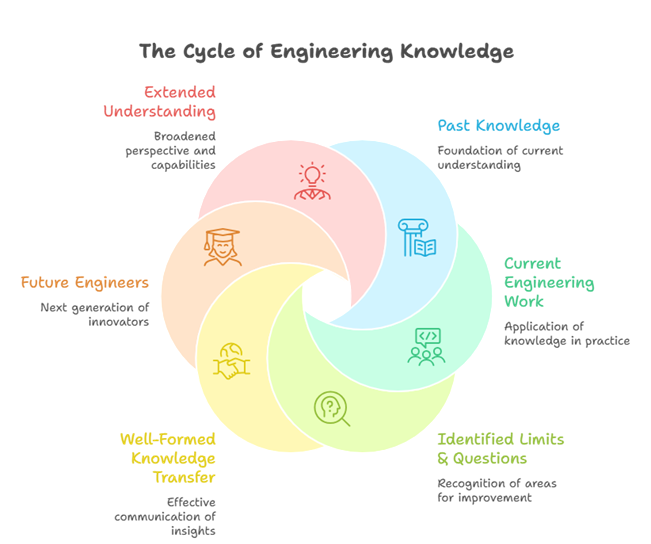
Visual Representation
Practical Table
| Factor / Question | Why It Matters | Example |
| What assumptions are we making? | Assumptions define system boundaries | Designing for expected operating conditions only |
| What remains uncertain? | Highlights areas for future investigation | Unknown behavior under extreme conditions |
| Are decisions well-documented with context? | Enables understanding of reasoning | Recording why a design choice was made |
| Can future engineers observe system behavior? | Observability supports learning | Monitoring and logging in complex systems |
| What questions remain unanswered? | Guides future development | Identifying areas needing deeper research |
Key Takeaways
- Engineering work is part of a continuous chain, not a final outcome
- Future engineers need clarity on what is unknown, not just what is known
- Well-formed questions are as valuable as solutions
- Systems should be designed to support future learning
- Recognizing limits of knowledge improves long-term resilience
- Master Engineers focus on extending knowledge across generations
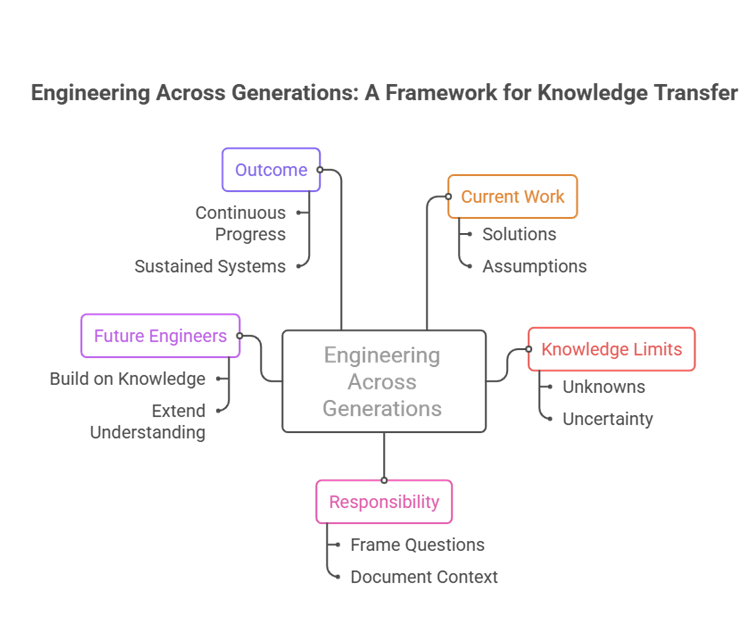
Mind Map
Conclusion
Engineering is often measured by what is built and delivered. But its deeper measure lies in what is left behind for those who follow.
No engineer completes the system. Each contributes a layer of understanding, a set of decisions, and a set of questions.
The most valuable contribution is not just a working solution—but a clear map of what remains to be understood.
A Master Engineer does not aim for finality.
They aim for continuity.
Because in the end, engineering is not just about solving today’s problems—
it is about extending human understanding across time.