Q1. What is the core problem domain this branch solves?
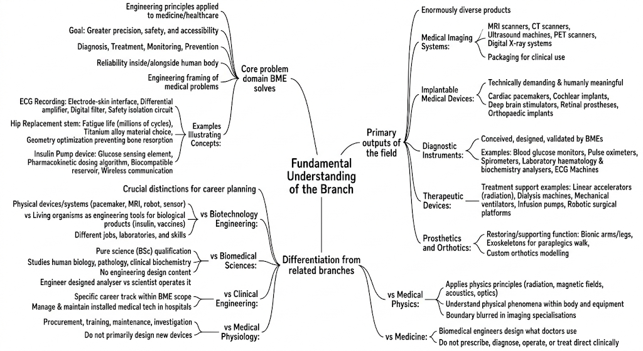
After fifty years in biomedical engineering, I can tell you with absolute certainty that the core mission of this discipline is elegantly simple to state yet enormously complex to execute. We apply the rigorous principles of engineering — mathematics, physics, materials science, electronics, and computing — specifically to solve problems in medicine and healthcare. Our ultimate goal is to design, develop, and deliver devices, systems, and solutions that diagnose, treat, monitor, and prevent human disease and disability with greater precision, safety, and accessibility than would otherwise be possible.
Unlike pure biology or clinical medicine, biomedical engineers are engineers first. We do not ask only ‘what is wrong with this patient?’ We ask ‘how do we build a device or system that reliably detects, corrects, or compensates for what is wrong — and that works safely inside or alongside a human body every single time, under all realistic conditions?’ That engineering framing of a medical problem is the defining characteristic of everything we do.
Let me make this concrete with three examples that most people use daily without thinking about the engineering beneath them. When a patient has an ECG recorded, the device does not simply display a heart rhythm. A biomedical engineer designed the electrode-skin interface, the differential amplifier that extracts microvolt-level cardiac electrical signals from overwhelming electrical noise, the digital filter that removes 50 Hz mains interference, and the safety isolation circuit that ensures no dangerous current can flow back into the patient — even during a defibrillation event happening simultaneously in the same room. When a patient receives a hip replacement, the implant is not simply a metal ball and socket. A biomedical engineer calculated the fatigue life of the femoral stem under 20 million walking cycles, selected a titanium alloy with surface chemistry that chemically bonds to bone, and designed the geometry of the implant to load the femur in a way that prevents the bone resorption called stress shielding. When a diabetic child wears an insulin pump, the device is not merely a miniature syringe. A biomedical engineer designed the electrochemical glucose sensing element, the pharmacokinetic control algorithm that calculates insulin dose in real time, the biocompatible reservoir and cannula, and the wireless communication system linking the pump to a smartphone display — all inside a device smaller than a mobile phone.
Q2. What are the primary outputs of this field?
The products of biomedical engineering are enormously diverse and present in virtually every clinical environment in the world. Medical imaging systems are perhaps the most visible category — MRI scanners, CT scanners, ultrasound machines, PET scanners, and digital X-ray systems. These are complete engineering systems combining powerful electromagnets or radiation sources, sophisticated radio-frequency or detector electronics, real-time signal processing algorithms, and three-dimensional image reconstruction software, all packaged in a format that a radiographer can operate and a radiologist can interpret clinically. Building any one of these from concept to clinical deployment is the work of dozens of specialist biomedical engineers working across a decade.
Implantable medical devices represent the category that I find most technically demanding and most humanly meaningful. Cardiac pacemakers, implantable cardioverter-defibrillators, cochlear implants for deafness, retinal prostheses for blindness, deep brain stimulators for Parkinson’s disease and depression, spinal cord stimulators for chronic pain, and orthopaedic implants for knees, hips, and spinal vertebrae are all devices that must function reliably inside a living human body for ten to twenty or more years — in an environment of salt water, mechanical loading, enzymatic activity, and immune response — without causing harm. The engineering challenge of achieving that reliability is extraordinary.
Diagnostic instruments used daily in every hospital and health centre represent another major output of the profession. Blood glucose monitors used by hundreds of millions of diabetic patients worldwide, pulse oximeters that became globally familiar during COVID-19, ECG machines in every general practitioner’s office, spirometers measuring lung function, and the sophisticated haematology and biochemistry analysers that run thousands of blood tests per hour in hospital laboratories — all of these were conceived, designed, validated, and brought to clinical use by biomedical engineers. Therapeutic devices including linear accelerators for cancer radiation therapy, dialysis machines for kidney failure, mechanical ventilators, infusion pumps for precise drug delivery, and robotic surgical platforms like the da Vinci system are equally important outputs of the profession. So too are prosthetics and orthotics — bionic arms and legs with myoelectric motor control, exoskeletons enabling paraplegic patients to walk, and custom orthotic devices designed using computer-aided biomechanical modelling.
Q3.How is this branch different from closely related branches?
This is the question I am asked most frequently by students exploring engineering options, and the distinctions matter profoundly for career planning. Biomedical engineering and biotechnology engineering are frequently confused but are fundamentally different disciplines. Biomedical engineering applies electronics, mechanics, computing, and materials science to design physical devices and systems used in clinical medicine — a pacemaker, an MRI scanner, a surgical robot, a glucose sensor. Biotechnology engineering uses living organisms — bacteria, cultured cells, enzymes, and DNA — as engineering tools to produce biological products such as insulin, vaccines, and monoclonal antibodies. A biomedical engineer and a biotechnology engineer rarely apply for the same job, work in the same laboratory, or use the same set of skills.
Biomedical engineering and biomedical science are similarly distinct. A biomedical science degree — typically a BSc — is a pure science qualification studying human biology, pathology, microbiology, and clinical biochemistry in the context of disease. It produces clinical laboratory scientists, pathologists’ assistants, and research scientists. It contains no engineering design content and does not produce device designers. A biomedical engineering degree is an engineering qualification that produces professionals who build the instruments and systems used in medicine. The clinical laboratory scientist operates the haematology analyser. The biomedical engineer designed it.
Biomedical engineering differs from clinical engineering in scope and focus. Clinical engineering is a specific career track within the broader biomedical engineering profession, focused on managing and maintaining medical technology already installed in hospitals — procurement decisions, acceptance testing, calibration, preventive maintenance, staff training, and incident investigation. Clinical engineers do not primarily design new devices; they ensure that existing devices function safely and effectively in the clinical environment. Medical physics is a related discipline that applies physics principles — radiation, magnetic fields, acoustics, optics — to medical practice and research. Medical physicists focus on understanding physical phenomena within the body and within medical equipment rather than on the complete engineering design of new devices, though the boundary between medical physics and biomedical engineering in imaging specialisations is genuinely blurred. And of course, biomedical engineering is emphatically not medicine. Biomedical engineers design what doctors use. They do not prescribe, diagnose, operate, or treat patients in any direct clinical sense.
Q4. What are the real-world applications of this field?
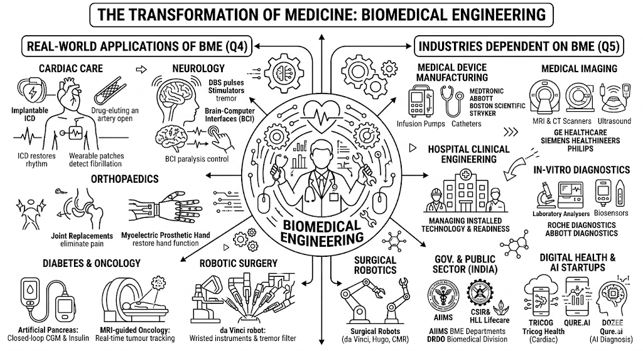
In half a century of practice, I have watched biomedical engineering transform medicine from an art of clinical judgment supported by basic instruments into a technology-enabled science of extraordinary precision. In cardiac care, implantable cardioverter-defibrillators continuously monitor cardiac rhythm and, when they detect ventricular fibrillation, deliver a precisely calculated electrical shock within seconds — restoring normal heart rhythm and preventing sudden cardiac death. Drug-eluting coronary stents — tiny tubular metal scaffolds coated with polymers that slowly release antiproliferative drugs — keep coronary arteries open after balloon angioplasty and have saved hundreds of millions of people from bypass surgery. Wearable ECG patches no larger than a credit card continuously record cardiac rhythm for fourteen days, enabling the detection of paroxysmal atrial fibrillation that would be missed by a standard ten-second ECG.
In the management of neurological disorders, deep brain stimulators implanted in the subthalamic nucleus of Parkinson’s disease patients deliver continuous high-frequency electrical pulses that suppress the pathological neural oscillations responsible for tremor, rigidity, and bradykinesia — allowing patients who could barely walk to move with near-normal function. Brain-computer interfaces, which record neural signals directly from the motor cortex using implanted electrode arrays, allow completely paralysed patients to control computer cursors, robotic arms, and even their own paralysed muscles by thought alone. In orthopaedics, titanium and ceramic total joint replacements designed using computer-aided engineering and validated through millions of cycles of mechanical fatigue testing have restored mobility and eliminated chronic pain for hundreds of millions of patients with arthritis. Myoelectric prosthetic hands decode the surface electromyographic signals generated by residual forearm muscles to control individual finger movements, returning functional hand capability to upper-limb amputees.
Diabetes management has been transformed by continuous glucose monitoring sensors worn on the arm that measure interstitial glucose every five minutes and transmit the reading wirelessly to a smartphone — alerting the patient before dangerous hypoglycaemia develops. When combined with an insulin pump controlled by a mathematical algorithm that mimics pancreatic beta-cell function, these systems create a closed-loop artificial pancreas — the closest engineering approximation to a cure for Type 1 diabetes short of a biological transplant. In oncology, MRI-guided radiation therapy systems use real-time MRI imaging to track tumour movement during breathing and adjust the treatment beam position in milliseconds, delivering radiation precisely to the tumour while protecting surrounding healthy tissue. The da Vinci surgical robot allows surgeons to perform radical prostatectomies through three eight-millimetre incisions using fully wristed instruments with seven degrees of freedom and tremor filtration, reducing blood loss, nerve damage, and recovery time compared to open surgery.
Q5. What industries heavily depend on this branch?
The medical device industry is the primary employer of biomedical engineering graduates globally. Companies including Medtronic, Abbott, Boston Scientific, Becton Dickinson, Stryker, Zimmer Biomet, Smith and Nephew, and Edwards Lifesciences collectively employ hundreds of thousands of engineers worldwide, with significant operations and R&D centres in India. Medical imaging companies — Siemens Healthineers, GE Healthcare, Philips Healthcare, Canon Medical, and Hologic — are heavy employers of biomedical engineers with strong physics and signal processing backgrounds. These companies have substantial engineering development centres in Bengaluru, Pune, and Hyderabad.
Hospital systems and healthcare networks employ biomedical engineers in clinical engineering departments, which manage the entire installed base of medical technology — from simple infusion pumps to MRI scanners — ensuring safety, compliance, and operational readiness. In-vitro diagnostics companies including Roche Diagnostics, Abbott Diagnostics, Sysmex, and Beckman Coulter require biomedical engineers to design laboratory analysers, biosensors, and point-of-care testing platforms. The surgical robotics sector, led by Intuitive Surgical and rapidly joined by CMR Surgical, Medtronic’s Hugo system, and dozens of startups, is one of the fastest-growing segments of the entire medical technology industry. In India specifically, the government sector — through AIIMS biomedical engineering departments, DRDO’s biomedical division, CSIR-CEERI, and HLL Lifecare — provides significant and stable employment for biomedical engineering graduates. The rapidly growing Indian digital health and medical AI startup ecosystem, exemplified by companies like Tricog Health, Qure.ai, Niramai, and Dozee, is creating entirely new categories of biomedical engineering employme