
Q1. What are the key subjects you must master?
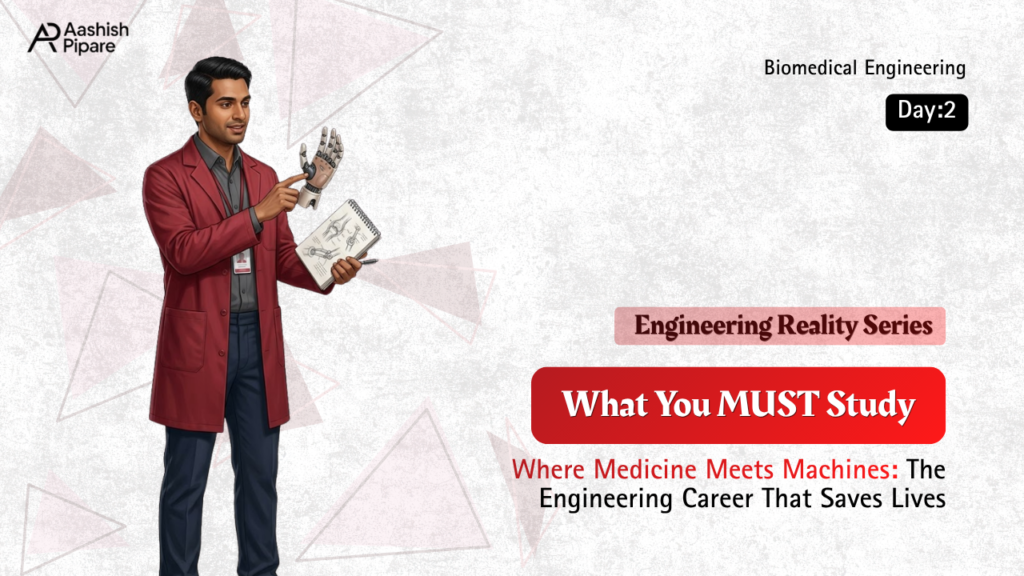
Biomedical engineering has a deliberately broad curriculum in the first two years, progressively narrowing into specialisation in years three and four. The subjects I consider the absolute non-negotiable intellectual foundations of this profession are the following. Anatomy and physiology is the most unique prerequisite of biomedical engineering compared to any other engineering discipline. You cannot design a solution to a medical problem without understanding the biological system you are intervening in. Understanding how the heart generates its electrical action potential and how that signal propagates through the conduction system is essential before you can meaningfully design an ECG amplifier. Understanding how the femur and acetabulum carry body weight through the hip joint is essential before you can design a hip replacement implant. The human body is your engineering environment — you must know it as intimately as a civil engineer knows soil mechanics or a mechanical engineer knows thermodynamics.
Bioelectronics and biomedical instrumentation forms the technical core of the discipline for most students. This subject covers the design of electronic circuits that acquire, amplify, filter, and process the tiny biological electrical signals produced by the heart, brain, muscles, and eyes — signals measured in microvolts and millivolts in an environment flooded with electrical interference from mains power, radio frequency sources, and patient movement. Understanding electrode-tissue interfaces, the physics of how a metal electrode contacts living tissue, instrumentation amplifier design for common-mode rejection, and the full signal conditioning chain from skin to digital data is fundamental. Medical imaging science covers the physics, signal processing, and engineering of the major clinical imaging modalities — X-ray and fluoroscopy, computed tomography, magnetic resonance imaging, diagnostic ultrasound, nuclear medicine with PET and SPECT, and optical imaging. Understanding the physical mechanism by which each modality generates image contrast, the engineering of the detection system, and the mathematical algorithms that reconstruct images from raw sensor data is essential for anyone entering medical technology.
Biomechanics applies the classical mechanics of statics, dynamics, materials, and fluid mechanics to biological structures and physiological systems. It encompasses calculating hip joint contact forces during walking and stair climbing, designing orthopaedic implant geometry to correctly transfer load to bone, modelling blood flow through a stenotic coronary artery, analysing gait using motion capture and force plate measurements, and simulating the crash biomechanics of head injury. Biomaterials science covers the specific science of materials that are intended to contact living biological tissue — metals such as titanium alloy Ti-6Al-4V and cobalt-chromium-molybdenum, polymers such as ultra-high-molecular-weight polyethylene and PEEK, ceramics such as hydroxyapatite and zirconia, and hydrogels for soft tissue applications. Understanding biocompatibility, corrosion in physiological salt solution, mechanical fatigue, wear debris generation and its biological consequences, and the mechanisms of osseointegration and tissue ingrowth are all essential knowledge for anyone working in implantable device design.
Digital signal processing is the mathematical and computational engine of biomedical instrumentation and medical imaging. Designing digital filters to remove artefacts from ECG signals while preserving clinically significant waveform features, applying the fast Fourier transform to characterise the frequency content of EEG signals, reconstructing CT images using filtered back-projection algorithms, and compressing medical images for digital storage and transmission are all DSP problems. Control systems engineering provides the theoretical framework for designing medical devices that must respond dynamically to physiological feedback — the closed-loop insulin pump algorithm, the automatic ventilator pressure controller, the adaptive deep brain stimulator. Finally, medical device regulation and quality systems is a subject with no parallel in any other engineering discipline — understanding the international standards that govern device design (IEC 60601-1 for electrical safety, ISO 13485 for quality management, ISO 14971 for risk management), and the regulatory pathways through which devices receive market approval (CDSCO in India, FDA 510(k) and PMA in the USA, CE marking under EU MDR in Europe) is professional knowledge that every practising biomedical engineer must possess.
Q2. What level of mathematics is required?
This question always reveals students who have a mistaken impression of biomedical engineering as a ‘softer’ technical discipline because it involves biology. The mathematical demands are genuine and significant. Calculus — both differential and integral — appears throughout the discipline. Differential equations model how biological signals evolve over time, describing the propagation of a cardiac action potential along a nerve fibre, the exponential decay of drug concentration in the bloodstream following a dose, and the transient thermal response of tissue during a radiofrequency ablation procedure. Integral calculus underlies image reconstruction — the CT image reconstruction problem is fundamentally the inversion of a set of line integrals of X-ray attenuation through the patient cross-section.
Linear algebra and matrix mathematics are essential for medical image reconstruction, where the relationship between the measured data and the unknown image is expressed as a large matrix equation, and for MRI data processing where the raw acquired data exists in a mathematical construct called k-space and the image is obtained by applying a two-dimensional Fourier transform. Probability and statistics are arguably the most practically important mathematical tools in the daily professional life of a biomedical engineer. Every clinical study of a medical device involves statistical testing of hypotheses, calculation of sample sizes for adequate statistical power, assessment of diagnostic test performance using receiver-operating characteristic curve analysis, and interpretation of survival data from long-term implant follow-up registries. Fourier analysis and frequency-domain signal processing methods form the mathematical foundation of all biomedical signal processing and medical imaging — every ECG digital filter, every MRI spatial encoding mechanism, every ultrasound pulse-echo time-of-flight calculation uses Fourier mathematics either directly or implicitly. Numerical methods including finite element analysis are used to solve the stress distribution in an orthopaedic implant under physiological loading, to simulate blood flow through a cardiac valve using computational fluid dynamics, and to model the thermal dose distribution during tumour ablation therapy.
Q3. Which scientific principles are fundamental?
Ohm’s law and circuit theory, applied not to resistors on a circuit board but to biological tissue, underpin all of biomedical electronics. Biological tissue conducts electricity with specific and frequency-dependent impedance characteristics — the skin-electrode interface has a high capacitive impedance at low frequencies that must be overcome for clean signal acquisition, the myocardium has specific resistive and capacitive properties that determine how a pacing current pulse spreads through the heart muscle, and the electrode-electrolyte interface at a biosensor surface determines the sensitivity and noise of the measurement. Every electrode design, every ECG lead configuration, and every neural stimulation parameter is engineered based on understanding the electrical properties of the relevant biological tissue.
Newton’s laws of motion and classical mechanics, applied to biological structures, constitute the scientific basis of biomechanics. Forces and moments acting on bones and joints are governed by the same static and dynamic equilibrium principles that govern any mechanical structure. The hip joint carries forces of three to five times body weight during normal walking — a fact that has direct consequences for the design of hip replacement implants that must withstand these forces for twenty or more years without fracture, loosening, or bearing surface wear. Fluid mechanics applied to the cardiovascular and respiratory systems provides the scientific basis for designing heart valves, vascular stents, and cardiac assist devices. Blood is a non-Newtonian fluid — its viscosity changes with flow rate — flowing through elastic, compliant vessels whose diameter changes with each heartbeat. The engineering of a prosthetic heart valve requires applying fluid mechanical principles to ensure adequate forward flow with minimal resistance while avoiding the turbulent flow conditions that cause red blood cell damage.
Thermodynamics and heat transfer in biological tissue underpin the engineering of all thermal therapy devices — laser ablation of arrhythmogenic cardiac tissue, radiofrequency ablation of liver tumours, cryotherapy for prostate cancer, high-intensity focused ultrasound for non-invasive tumour destruction. The fundamental principle is that biological tissue is irreversibly damaged when its temperature exceeds approximately 56 degrees Celsius or falls below approximately minus 20 degrees Celsius. The engineering challenge is to deliver a precisely calculated thermal dose to the target tissue while protecting surrounding critical structures — a problem that requires quantitative solution of the heat diffusion equation in heterogeneous, perfused biological tissue. Electromagnetic wave theory is the scientific foundation of medical imaging systems using electromagnetic radiation — X-rays and gamma rays for CT and nuclear medicine, radiofrequency waves in a powerful static magnetic field for MRI, and microwave frequencies for thermometry and emerging radar-based physiological monitoring. And electrochemistry provides the scientific basis for biosensor design — the glucose electrochemical sensor that has enabled modern diabetes management converts a biochemical concentration into an electrical current through an enzymatic oxidation-reduction reaction at an electrode surface, governed by the Nernst equation and limited by diffusion of glucose through a permeable membrane.
Q4. What are the most difficult concepts students struggle with?
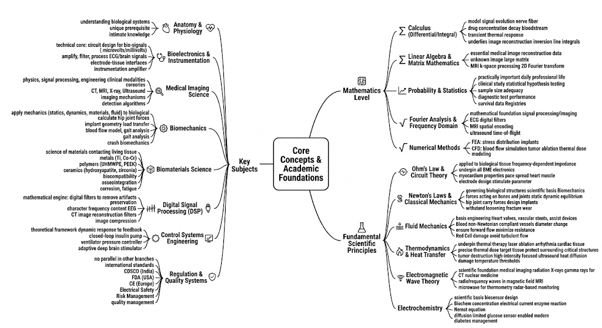
Medical image reconstruction mathematics is genuinely one of the most conceptually challenging topics in engineering education. Understanding how a CT scanner acquires a set of X-ray transmission measurements along hundreds of thousands of different ray paths through a patient cross-section, and how a 2D image of internal anatomy is computationally reconstructed from those measurements using the mathematics of the Radon transform and its inverse, requires sustained mathematical effort and repeated conceptual engagement before real understanding develops. The filtered back-projection algorithm and its modern iterative replacements are not intuitively obvious — most students need to work through the mathematics multiple times, implement the algorithm computationally, and see simulated examples before the concept becomes truly clear.
MRI physics is, in my honest assessment, the most conceptually demanding topic in all of biomedical engineering education. The interaction of nuclear magnetic moments — specifically those of hydrogen protons — with a powerful static magnetic field, the use of radiofrequency pulses to perturb those moments from equilibrium, the return to equilibrium through two independent relaxation processes with tissue-specific time constants that generate the image contrast that makes MRI clinically powerful, the use of switched magnetic field gradients to encode spatial position into the frequency and phase of the detected signal, and the acquisition of the complete dataset in a mathematical construct called k-space before applying a two-dimensional Fourier transform to obtain the final image — this chain of physical and mathematical concepts is genuinely difficult and requires persistent study.
Biocompatibility assessment challenges students because it requires simultaneous knowledge of materials science, cellular biology, and immunology. Understanding why the human immune system tolerates a titanium alloy implant indefinitely while mounting a destructive foreign body response against a different polymer requires knowing how proteins adsorb onto material surfaces from blood, how adsorbed proteins activate macrophages and giant cells, how the chronic inflammatory response damages surrounding tissue, and what surface chemistry modifications can modulate these interactions. Closed-loop physiological control system design is challenging because it requires integrating patient physiology, pharmacology, control theory, and sensor noise characteristics simultaneously. Designing a ventilator control algorithm that correctly adjusts breathing rate and tidal volume in response to changing blood gas measurements in patients with widely varying pulmonary mechanics is a genuinely multidisciplinary engineering challenge that tests the integration of knowledge across several subject areas simultaneously.
Q5. Is this branch more theoretical, practical, or hybrid?
Biomedical engineering is definitively a hybrid discipline, but the balance between theoretical and practical work shifts substantially depending on which specialisation you pursue within the field. The imaging and signal processing specialisation is strongly weighted towards the theoretical and computational — you spend significant time on mathematical image reconstruction theory, algorithm development, and simulation of imaging systems before engaging with physical hardware. Strong mathematics and programming skills are the primary determinants of success in this track. Medical device design and product development, by contrast, is strongly weighted towards the practical — prototyping, bench testing, animal implantation studies, human factors testing, design verification and validation testing, and manufacturing process development. This is hands-on engineering in the most tangible sense.
Biomechanics and orthopaedic engineering is the specialisation that most genuinely exemplifies the hybrid nature of the discipline. Theoretical finite element modelling of implant stress distributions under physiological loading must be validated by experimental mechanical fatigue testing of physical implant specimens on servo-hydraulic test machines. The two halves of the work are inseparable — neither the theoretical model without experimental validation nor the experimental testing without the mechanistic understanding provided by the model constitutes adequate engineering practice. Clinical engineering, as a career track, is strongly practical — managing equipment in a hospital involves physical inspection, electronic calibration, hands-on repair, and direct interaction with clinical staff and patients. The core message across all specialisations is the same: biomedical engineering cannot be done from a desk in isolation. Your device, your algorithm, or your system must ultimately work in contact with real biological tissue, in the hands of a real surgeon or patient, in the electrical and mechanical environment of a real hospital ward or operating theatre, and in the regulatory environment of a real approval authority that will scrutinise every design decision you have made.
Conclusion:
Understanding core subjects like biology, electronics, and mathematics is essential for success in biomedical engineering. These fundamentals help you design and improve healthcare technologies effectively.
CTA:
Start building a strong base in these subjects today. Bookmark this blog and continue to Day 3 to explore essential tools and technologies used in biomedical engineering.