Q1. What software tools are essential?
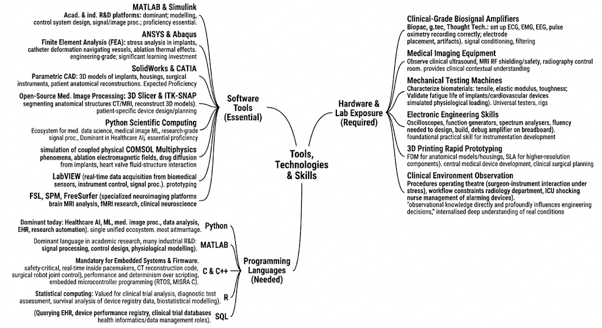
MATLAB and its Simulink simulation environment are the dominant platforms for biomedical signal processing, physiological system modelling, medical image analysis, and control system design in both academia and medical device industry R&D. If you leave a biomedical engineering degree without functional MATLAB proficiency, you are significantly disadvantaged in the job market. ANSYS and Abaqus are finite element analysis software platforms used for calculating stress distributions in orthopaedic and cardiovascular implants, simulating the deformation of catheter devices navigating through vessels, and analysing the thermal effects of ablation procedures on surrounding tissue. These are engineering-grade simulation tools with a significant learning investment required before useful results can be produced.
SolidWorks and CATIA are three-dimensional computer-aided design environments used to create engineering models of implants, medical device housings, surgical instruments, and patient-specific anatomical structures reconstructed from clinical imaging data. Proficiency in at least one parametric CAD platform is increasingly expected even for biomedical engineers who are not primarily mechanical designers. 3D Slicer and ITK-SNAP are open-source medical image processing platforms for segmenting anatomical structures in CT and MRI datasets and reconstructing three-dimensional models — converting a patient’s CT scan data into a 3D surface model of their femur for implant design, for example. These tools are essential for anyone working in patient-specific device design or surgical planning.
Python with its scientific computing ecosystem — NumPy, SciPy, Pandas, scikit-learn, TensorFlow, and PyTorch — is essential for biomedical data science, medical image machine learning, and research-grade signal processing. The Python ecosystem has become the dominant platform for healthcare AI development and is increasingly present in industrial medical device development as well. COMSOL Multiphysics enables simulation of coupled physical phenomena — electromagnetic fields in tissue during radiofrequency ablation, drug diffusion from a polymer-coated implant surface, fluid-structure interaction in a heart valve simulation. LabVIEW from National Instruments is used for real-time data acquisition from biomedical sensors, instrument control, and signal processing in laboratory and prototype development settings. Specialised neuroimaging software platforms including FSL, SPM, and FreeSurfer are essential for anyone working in brain MRI analysis, functional MRI research, or clinical neuroscience applications.
Q2.What hardware or lab exposure is required?
Biomedical signal acquisition systems — clinical-grade biosignal amplifiers such as those produced by Biopac Systems, g.tec, and Thought Technology — are the fundamental instrumentation of the discipline. Learning to set up ECG, EMG, EEG, and pulse oximetry recordings correctly, understanding the clinical significance of electrode placement and skin preparation, identifying common signal artefacts such as motion artefacts and mains interference, and applying appropriate signal conditioning and digital filtering are skills every biomedical engineering student must develop through hands-on laboratory work. Medical imaging equipment exposure — operating a clinical ultrasound scanner, understanding the RF shielding and magnetic safety zones around an MRI scanner, observing a radiography procedure from the control room — provides the contextual understanding of how imaging systems function in clinical practice that purely theoretical study cannot provide.
Mechanical testing machines, specifically servo-hydraulic universal testing machines and fatigue testing rigs, are used to characterise the mechanical properties of biomaterials — tensile strength, elastic modulus, fracture toughness — and to validate the fatigue life of orthopaedic implants and cardiovascular devices under simulated physiological loading. Experience with these systems is essential for anyone working in implantable device design or biomaterials research. Oscilloscopes, function generators, and spectrum analysers are the basic toolkit of electronic engineering, equally essential in biomedical instrumentation development. The ability to use these instruments fluently to design, build, and debug an amplifier circuit on a breadboard is a foundational practical skill. Three-dimensional printing for rapid prototyping — FDM printers for anatomical models and device housings, SLA printers for higher-resolution components — is increasingly central to the medical device development process and to clinical surgical planning.
Clinical environment observation is a category of experiential learning that is not found in any textbook or laboratory and cannot be substituted by any simulation. Time spent observing procedures in an operating theatre, watching how surgeons interact with instrumentation under the stress of a complex procedure, understanding the workflow constraints of a radiology department handling two hundred studies per day, or seeing how ICU nurses manage multiple simultaneously alarming devices at three in the morning — this observational knowledge directly and profoundly influences the quality of engineering decisions you make when you return to the design office. The best biomedical engineers I have worked with over fifty years were invariably those who spent significant time in clinical environments and internalised a deep understanding of the real conditions in which their devices would be used.
Q3.Which programming languages are needed?
Python is the single most important programming language for the majority of biomedical engineering roles today. Its comprehensiveness — covering scientific computing, statistical analysis, machine learning, medical image processing, electronic health record data analysis, and research automation in a single unified ecosystem — makes it the first language every student should develop genuine proficiency in. The healthcare AI sector, which is one of the fastest-growing employment areas for biomedical engineers, is almost entirely Python-based. MATLAB remains the dominant language in academic biomedical engineering research and in many industrial R&D departments for signal processing, control system design, and physiological modelling work. If you enter an academic research laboratory or a medical device company’s core research team, MATLAB proficiency will be expected.
C and C++ programming are mandatory for engineers targeting embedded systems and firmware development roles in medical devices. The firmware that runs inside a pacemaker, the real-time image reconstruction code executing on the signal processing hardware of a CT scanner, and the motor control code managing the surgical robot’s seven joint axes all run in C or C++. These safety-critical, real-time applications require the performance and determinism that interpreted scripting languages cannot provide. Developing proficiency in C for embedded microcontroller programming — understanding memory management, interrupt service routines, real-time operating systems, and safety-critical coding standards like MISRA C — is a specific skill investment that opens the most hardware-intensive and highest-value engineering roles in the medical device industry. R is a statistical computing language particularly valued for clinical trial data analysis, diagnostic test performance assessment, survival analysis of long-term device registry data, and any work involving complex biostatistical modelling. SQL is important for querying electronic health record databases, device performance registries, and clinical trial databases in health informatics and clinical data management roles.
Q4.What are the must-have technical skills for freshers?
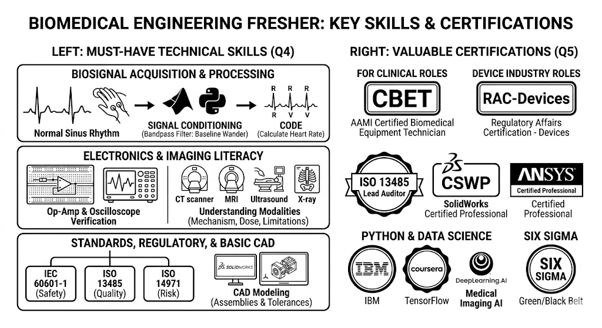
The first skill every biomedical engineering fresher must demonstrate is competent biological signal acquisition and interpretation. Setting up an ECG recording correctly — selecting appropriate electrodes and skin preparation, connecting the lead configuration correctly, identifying normal sinus rhythm, and recognising obvious arrhythmias — is the fundamental practical entry point of the profession. Being able to additionally apply a digital bandpass filter in MATLAB or Python to remove baseline wander and mains interference from an ECG signal, and to write code that calculates heart rate from the detected R-wave peak positions, demonstrates the integration of clinical knowledge and engineering skill that defines a biomedical engineer.
Basic electronics and circuit design proficiency — the ability to design an operational amplifier circuit on paper, build it on a breadboard, power it, and use an oscilloscope to verify its frequency response and measure its noise floor — is a foundational practical competency. Without this hands-on electronics capability, even a student with excellent theoretical knowledge will be unable to contribute to instrumentation or device hardware development. Understanding of the core medical imaging modalities — being able to explain to a clinical colleague the physical imaging mechanism, primary clinical advantages, important limitations, radiation dose implications where relevant, and typical clinical applications of X-ray, computed tomography, MRI, and diagnostic ultrasound — is baseline professional literacy in this discipline. Recruiters at medical imaging companies consistently test this knowledge in interviews.
Introductory proficiency in medical device standards and regulatory framework — knowing the scope and key requirements of IEC 60601-1 (general safety and essential performance of medical electrical equipment), ISO 13485 (quality management systems for medical devices), and ISO 14971 (application of risk management to medical devices) — demonstrates professional maturity and seriousness of purpose to employers. Most engineering graduates from other disciplines arrive in interviews with no awareness of these frameworks. A biomedical engineering graduate who can discuss them knowledgeably stands out immediately. Basic CAD modelling proficiency — creating simple three-dimensional models of device components in SolidWorks or Autodesk Fusion 360, applying basic geometric tolerances, and creating an assembly from multiple parts — is increasingly expected even for candidates entering non-mechanical engineering roles in medical device companies.
Q5.What certifications add value in this domain?
The Certified Biomedical Equipment Technician (CBET) certification, offered by the Association for the Advancement of Medical Instrumentation, is the most widely recognised credential for clinical engineering and hospital biomedical equipment management roles. If your career target is clinical engineering in hospital settings, this certification signals professional competence in a directly relevant domain and is valued by hospital procurement and HR departments. The Regulatory Affairs Certification for devices (RAC-Devices), offered by the Regulatory Affairs Professionals Society, is in my view the most strategically valuable certification for engineers targeting medical device industry roles. Regulatory affairs professionals who understand both the technical engineering content of device submissions and the regulatory science of approval pathways are consistently in demand and command premium compensation. This certification demonstrates that dual competence.
ISO 13485 Lead Auditor certification demonstrates verified competence in medical device quality management systems and is valued by device manufacturers of all sizes globally. Engineers with this certification can lead internal audits and represent the company in supplier audits and certification body assessments — a commercially important capability. Software-specific certifications including ANSYS Certified Professional for finite element simulation and the SolidWorks Certified Professional (CSWP) for CAD modelling demonstrate verified tool proficiency to potential employers in orthopaedic implant, cardiovascular device, and medical equipment design companies. Python and data science certifications — the IBM Data Science Professional Certificate, the DeepLearning.AI specialisations in medical imaging AI, and the Coursera TensorFlow Developer Certificate — are increasingly valued as the healthcare AI sector expands. Six Sigma Green Belt or Black Belt certification demonstrates statistical quality methodology and process improvement capability valued in medical device manufacturing quality engineering roles.