Q1.What are the core job roles in this branch?
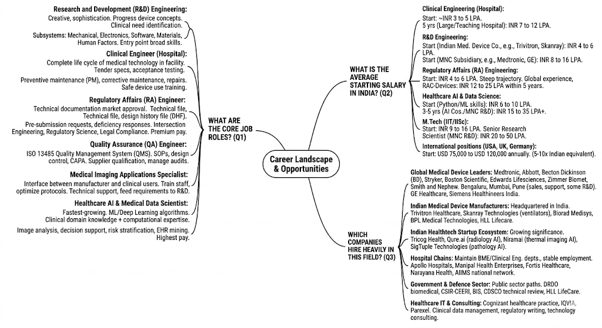
The Research and Development Engineer is the most creatively demanding and technically sophisticated role in the medical device industry, responsible for progressing new device concepts from initial clinical need identification through functional prototype, design verification testing, and design validation into a manufacturable product. R&D engineers work across the full spectrum of device subsystems — mechanical design, electronics, software, materials, and human factors — and must understand each subsystem well enough to identify and resolve interaction problems between them. This role requires the broadest combination of engineering skills and is typically the entry point for graduates from top programmes with strong technical backgrounds.
The Clinical Engineer working in a hospital biomedical equipment management department is responsible for the complete life cycle of all medical technology in the facility — from writing technical specifications for procurement tenders, conducting acceptance testing of newly delivered equipment, establishing and executing preventive maintenance programmes, managing corrective maintenance and equipment repair, investigating equipment-related adverse incidents, training clinical staff on safe device use, and ensuring compliance with all applicable electrical safety testing standards. This role provides the deepest operational understanding of how medical technology functions in real clinical environments and is the primary entry point for graduates targeting the healthcare provider sector rather than the device industry. The Regulatory Affairs Engineer prepares the complete technical documentation required to obtain market approval for medical devices — writing the technical file or design history file, coordinating clinical evidence reviews, preparing pre-submission requests to regulatory agencies, authoring responses to regulatory deficiency letters, and managing the post-market surveillance activities required to maintain device approval. This is a role at the intersection of engineering knowledge, regulatory science, and legal compliance, and it commands premium compensation because of the difficulty of developing genuine competence across all three dimensions.
The Quality Assurance Engineer develops and maintains the ISO 13485 quality management system — writing and maintaining standard operating procedures, managing the design control process, overseeing supplier qualification and management, investigating non-conformances, managing corrective and preventive action processes, conducting internal audits, and hosting regulatory inspection readiness activities. The Medical Imaging Applications Specialist works at the interface between medical imaging equipment manufacturers and clinical users — training radiologists, radiographers, and sonographers on new imaging systems, optimising clinical imaging protocols, providing on-site technical support, and feeding clinical user requirements back to the engineering development team. The Healthcare AI and Medical Data Scientist role is the fastest-growing position category in the entire biomedical engineering job market — developing machine learning and deep learning algorithms for medical image analysis, clinical decision support, patient risk stratification, and electronic health record mining. This role requires the deepest combination of clinical domain knowledge and computational expertise and commands the highest compensation of any biomedical engineering specialisation.
Q2.What is the average starting salary in India?
The starting salary for biomedical engineering graduates in India varies substantially by role type, employer tier, and individual skill differentiation. A graduate entering a hospital clinical engineering department can expect a starting compensation of approximately INR 3 to 5 LPA, with growth to INR 7 to 12 LPA after five years of experience in a large teaching hospital or multi-speciality hospital chain. A graduate entering an R&D engineering role at an Indian medical device company such as Trivitron, Skanray, or BPL Medical Technologies will typically start at INR 4 to 6 LPA, while the same qualification at a multinational subsidiary such as Medtronic India, GE Healthcare Bengaluru, or Siemens Healthineers will command INR 8 to 16 LPA.
Regulatory affairs engineering roles, though the starting compensation of INR 4 to 6 LPA is similar to R&D entry levels, have one of the steepest salary growth trajectories in the profession — an experienced regulatory affairs professional with global submission experience and a RAC-Devices certification can earn INR 12 to 25 LPA within five years. Healthcare AI and data science roles for biomedical engineers with strong Python and machine learning skills start at INR 6 to 10 LPA and grow to INR 15 to 35 LPA or higher at health AI companies and multinational R&D centres within three to five years of experience. For graduates who pursue an M.Tech from an IIT or IISc and then enter industry, the starting compensation is typically INR 9 to 16 LPA, with senior research scientist roles at MNC R&D centres reaching INR 20 to 50 LPA. International positions — in the USA, UK, or Germany — typically pay USD 75,000 to USD 120,000 annually for the same level of experience, representing five to ten times the Indian equivalent.
Q3.Which companies hire heavily in this field?
The global medical device leaders with significant operations in India are the primary industrial employers of biomedical engineering graduates. Medtronic, Abbott, Becton Dickinson, Stryker, Boston Scientific, Edwards Lifesciences, Zimmer Biomet, and Smith and Nephew all have Indian offices in Bengaluru, Mumbai, and Pune handling sales, clinical support, and some R&D functions. GE Healthcare’s Bengaluru R&D centre and Siemens Healthineers India are particularly significant employers of engineers with imaging physics and signal processing backgrounds. Indian medical device manufacturers including Trivitron Healthcare, Skanray Technologies — which developed India’s first domestically produced ventilator at significant scale during COVID-19 — Biorad Medisys, BPL Medical Technologies, and HLL Lifecare provide Indian-headquartered industry employment opportunities.
The Indian healthtech startup ecosystem is increasingly significant as an employer — Tricog Health employs biomedical engineers in AI algorithm development and clinical validation, Qure.ai has grown rapidly as its radiology AI platform has been deployed in thousands of hospitals globally, Niramai employs engineers in thermal imaging system development and AI model training, and SigTuple Technologies employs engineers in AI-powered pathology image analysis system development. Hospital chains — Apollo Hospitals, Manipal Health Enterprises, Fortis Healthcare, Narayana Health, and the AIIMS national network — maintain biomedical engineering and clinical engineering departments that provide stable healthcare sector employment. Government and defence sector employers including DRDO’s biomedical division, CSIR-CEERI, BIS, CDSCO’s technical review division, and HLL Lifecare provide public sector career paths. Healthcare IT and consulting companies including Cognizant’s healthcare practice, IQVIA, and Parexel provide roles in clinical data management, regulatory writing, and healthcare technology consulting that draw on biomedical engineering backgrounds.
Q4.What is the future demand from 2025 to 2040?
Medical AI and computational diagnostics will be the dominant growth sector for biomedical engineering employment through 2040. The integration of deep learning into radiology — detecting lung cancer nodules in CT, diabetic retinopathy in retinal photographs, pneumothorax in chest X-rays, and fractures in musculoskeletal radiographs — is moving from research proof-of-concept to clinical deployment at scale. India’s Qure.ai has already deployed its AI chest X-ray analysis in over four thousand hospitals across sixty-five countries. As every imaging modality in every imaging centre globally becomes a potential deployment target for validated AI algorithms, the demand for engineers who can build, validate, and seek regulatory clearance for medical imaging AI will significantly exceed supply for at least fifteen years.
Wearable and continuous remote patient monitoring technology will expand from current consumer-grade devices into clinically validated, physician-prescribed monitoring systems for managing chronic heart failure, atrial fibrillation, hypertension, and respiratory disease in the home. The engineering challenge of creating devices that are accurate enough for clinical decision-making, comfortable enough for continuous long-term wear, connected enough for reliable data transmission, and affordable enough for widespread prescription is the defining wearables engineering challenge of the next decade. India’s National Medical Devices Policy 2023 explicitly targets growing India’s domestic medical device industry from USD 11 billion to USD 50 billion by 2030, with a specific emphasis on developing domestic engineering capability to substitute for current import dependence — this policy creates a direct government mandate that translates into industry investment and employment demand for Indian biomedical engineering graduates. Surgical robotics, neural engineering and brain-computer interfaces, regenerative medicine device development, and the ongoing COVID-pandemic-accelerated shift to digital and remote healthcare delivery will each generate significant additional demand for biomedical engineers with specialised competencies.
Q5.Can this branch lead to entrepreneurship or startups?
Medical technology entrepreneurship has produced some of the most impactful companies to emerge from the Indian engineering ecosystem. Tricog Health was founded in Bengaluru by a cardiologist and engineers who recognised that the inability of rural clinicians to obtain rapid specialist interpretation of ECGs was causing preventable deaths from acute myocardial infarction. They built a cloud-connected ECG system that transmits a recording from a rural health centre to a cardiologist who provides a report within fifteen minutes. Tricog now processes over six million ECGs annually across more than three thousand facilities in India, Southeast Asia, and Africa. Niramai was founded to address the specific challenge that the primary screening tool for breast cancer — mammography — is expensive, radiation-delivering, and requires equipment and expertise that is unavailable in most of India. Their AI-powered thermal imaging system provides a non-invasive, radiation-free screening alternative that is effective for the dense breast tissue most prevalent in Indian women and deployable in settings without mammography infrastructure. Qure.ai has built radiology AI algorithms that interpret chest X-rays and CT brain scans for abnormalities and has demonstrated clinical-grade performance validated in peer-reviewed journals — growing into a company with global hospital deployment across sixty-five countries.
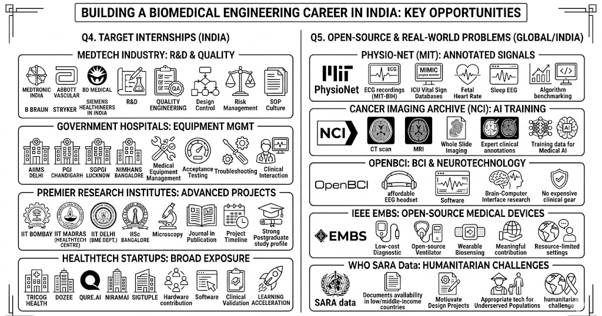
The funding infrastructure for Indian medical technology startups has developed substantially. BIRAC grants support early-stage device development through the Biotechnology Industry Research Assistance Council. The IIT Madras Healthcare Technologies Innovation Centre incubates medical device startups with mentoring, laboratory access, clinical connections, and investment facilitation. DPIIT-recognised healthcare startups receive tax and regulatory benefits. The Ministry of Health’s medical technology policy provides additional support pathways. For a biomedical engineering graduate with a genuine clinical insight — a problem you have seen firsthand that engineering can solve — the combination of technical knowledge, government support infrastructure, and growing domestic and international investor interest in Indian healthtech makes this a genuinely feasible entrepreneurship pathway.