
Q1. What are some beginner-level projects in this branch?
The best beginner projects teach you to observe, measure, and analyse biological systems. They require minimal equipment but maximum curiosity.
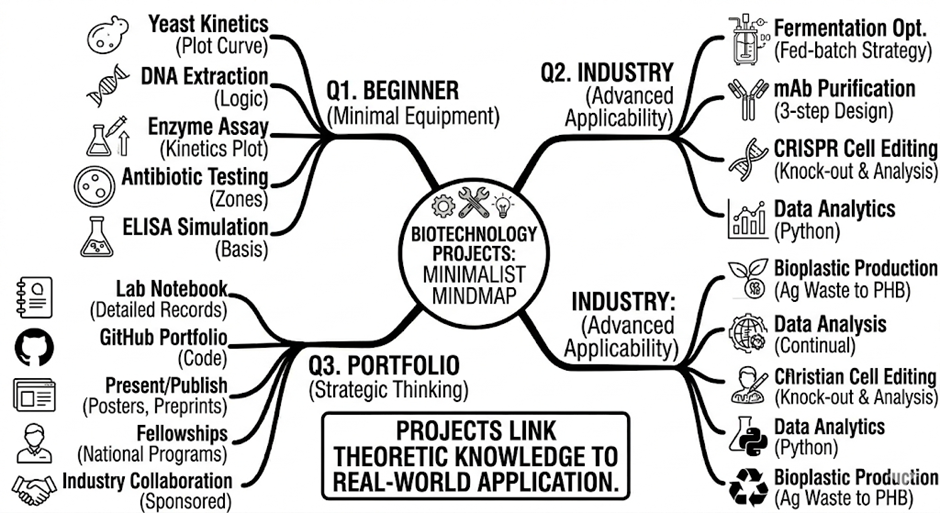
Project 1 — Yeast Fermentation Kinetics: Set up a simple glucose-yeast fermentation in sealed bottles. Measure CO2 production over time using a water displacement setup. Plot a growth curve. Understand lag phase, log phase, and stationary phase. This simple experiment teaches you more about bioreactor behaviour than any textbook.
Project 2 — Extraction and Quantification of DNA: Extract DNA from bananas or onions using household materials (detergent, salt, ethanol). Then use UV spectrophotometry to quantify and assess purity. This introduces you to downstream processing logic.
Project 3 — Enzyme Activity Assay: Measure the effect of temperature and pH on enzyme activity using amylase from saliva or papain from papaya. Plot a Michaelis-Menten-like response curve. You will viscerally understand why enzyme kinetics matters.
Project 4 — Antibiotic Sensitivity Testing (Kirby-Bauer): Test bacterial sensitivity to different antibiotics using disk diffusion. Measure inhibition zones. Understand the relationship between drug concentration and biological effect — a direct pharmacology concept.
Project 5 — ELISA Simulation: Using colour-change models or actual ELISA kits (available affordably from educational suppliers), learn how antigen-antibody binding is detected and quantified. This is the basis of COVID-19 antibody tests.
Q2. What are industry-level projects I should aim for?
- Optimization of Fed-Batch Fermentation for Recombinant Protein Production: Develop a feeding strategy for E. coli expressing recombinant human insulin or GFP. Measure productivity, yield, and specific growth rate. Scale from shaker flask to 5L bioreactor.
- Monoclonal Antibody Purification Train Design: Design a 3-step purification process (Protein A affinity → Ion Exchange → Size Exclusion) for a mAb. Calculate yield and purity at each step. Compare to industry benchmarks.
- CRISPR-Cas9 Knock-out in Cell Culture: Design guide RNAs targeting a gene of interest in HEK293 cells. Perform editing, confirm via sequencing, and analyse phenotypic effects. This is directly transferable to gene therapy research roles.
- Bioprocess Data Analytics: Take a publicly available fermentation dataset (e.g., from BioNumbers or DECHEMA) and build a predictive model in Python for dissolved oxygen based on agitation speed and airflow. Present as a data science project.
- Bioplastic Production from Agricultural Waste: Ferment sugarcane bagasse or rice straw to produce PHB (polyhydroxybutyrate) using Bacillus species. Characterize the polymer by FTIR. Relevant to sustainability and the circular bioeconomy.
Q3. How can I build a portfolio in this domain?
Building a portfolio in biotechnology requires strategic thinking because the domain is experimental and lab-heavy. Here is my structured approach:
Document Everything: Maintain a detailed lab notebook (digital, using Benchling or a physical book). Industry recruiters value candidates who can demonstrate structured experimental thinking.
GitHub for Bioinformatics: If you write any Python or R code for data analysis, genomic analysis, or modelling — put it on GitHub. A Biotechnology Engineering student with a well-maintained GitHub is immediately noticed.
Research Papers & Posters: Present your final year project at inter-college symposia. Publish even minor findings on ResearchGate or as a preprint. Having one published paper or conference paper as an undergraduate is extraordinary.
CSIR & DBT Summer Research Fellowships: Apply aggressively to CSIR-SRFP and DBT’s summer research programme. Working in a national-level research institute for two months gives you material for your portfolio and powerful reference letters.
Industry-Sponsored Projects: Many biotech companies sponsor final year projects. Target companies like Biocon, Serum Institute, Praj Industries, and Bharat Biotech for project collaborations.
Q4. What kind of internships should I target?
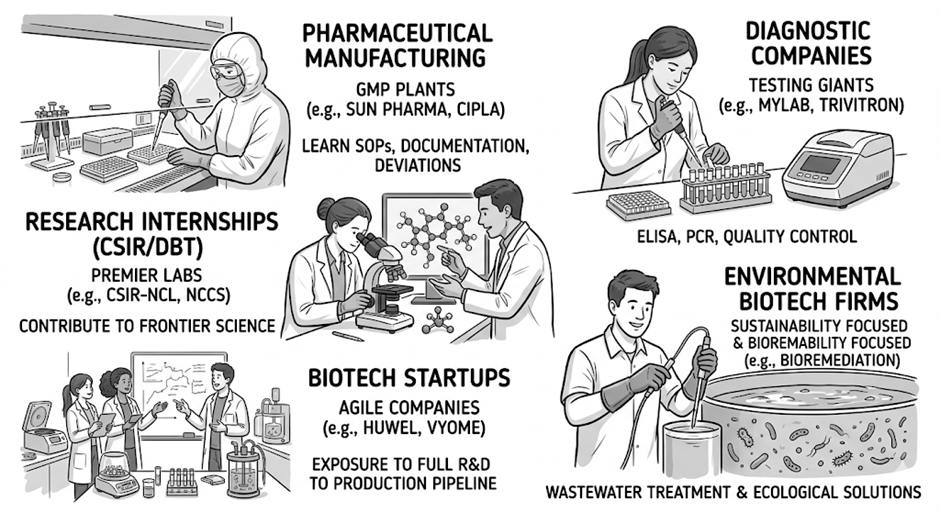
- Pharmaceutical Manufacturing Internships (GMP Plants): Companies like Sun Pharma, Cipla, Lupin, and Serum Institute offer internship programs. Learning to work under GMP conditions — batch documentation, SOPs, deviations — is the single most valuable manufacturing experience.
- Research Internships at CSIR/DBT Labs: CSIR-NCL (Pune), CSIR-IMTECH (Chandigarh), NCCS (Pune), NII (New Delhi), CDRI (Lucknow). Apply through the CSIR-SRFP portal (applications usually open in November-December).
- Biotech Startups: Working in a biotech startup exposes you to the entire pipeline — from research to production to regulatory. Companies like Huwel Lifesciences, Vyome, Sapien Biosciences are worth targeting.
- Diagnostic Companies: Abbott, Mylab, Trivitron — excellent for learning ELISA, PCR diagnostics, quality control, and regulatory documentation.
- Environmental Biotech Firms: Companies doing bioremediation and wastewater biotreatment — particularly valuable if you are interested in environmental applications.
Q5. Are there open-source or real-world problems I can work on?
- OpenWetWare.org: An open-source platform for sharing biotechnology protocols and projects. Contribute protocols, review others, and collaborate globally.
- iGEM (International Genetically Engineered Machine): One of the world’s premier synthetic biology competitions. Many Indian college teams participate. It is the single best open-source, real-world bioengineering experience available to undergraduates.
- Kaggle Bioinformatics Competitions: Genomics and proteomics data challenges — excellent for building Python and data science skills alongside biological knowledge.
- WHO Global AMR Challenge: Antimicrobial resistance is a global crisis. The WHO has open calls for innovative solutions. Contributing even a small conceptual solution builds your profile.
- OSDD (Open Source Drug Discovery): CSIR India’s open-source drug discovery platform — join working groups on tuberculosis or neglected tropical disease drug discovery.
Conclusion:
Practical projects help you apply your theoretical knowledge in biotechnology. From lab experiments to data analysis, hands-on experience is very important.
CTA:
Start with simple projects and build your confidence. Don’t miss Day 5 to explore different career opportunities in biotechnology engineering.