
a. What are the key subjects I must master in this branch?
To become strong in Industrial Engineering, you must master subjects that help in decision-making, optimization, and system improvement.
The most important subjects include:
- Operations Research (OR): Helps in making optimal decisions using mathematical models.
- Supply Chain Management (SCM): Focuses on the flow of goods from raw materials to final customers.
- Production Planning and Control (PPC): Ensures that production happens efficiently and on time.
- Quality Control: Ensures products meet standards and reduces defects.
- Statistics and Probability: Helps in analyzing data and dealing with uncertainty.
At a beginner level, these subjects may seem theoretical.
At an expert level, they become powerful tools for solving real-world industrial problems.
Example:
A company must decide which supplier to choose based on cost, time, and quality.
Operations Research techniques help select the best option scientifically.
b. What level of mathematics is required?
Industrial Engineering requires a moderate to advanced level of mathematics, especially in areas that support optimization and analysis.
Key areas include:
- Algebra and basic calculus
- Probability and statistics
- Optimization techniques
At a beginner level, basic formulas are used.
At an advanced level, mathematical models are built to solve complex problems.
Example:
A company wants to minimize transportation cost while delivering goods to multiple locations.
Mathematical optimization models help find the lowest-cost route.
c. Which scientific principles are fundamental here?
Industrial Engineering is based on a combination of:
- Mathematics and statistics (for analysis and decision-making)
- Basic physics (for understanding machines and processes)
- Human factors (ergonomics) (for improving worker efficiency and safety)
At a beginner level, these are studied separately.
At an expert level, they are combined to design efficient systems.
Example:
If workers are getting tired quickly, productivity decreases.
Ergonomic principles are used to redesign the workstation, improving comfort and output.
d. What are the most difficult concepts students struggle with?
Students often face difficulty in topics that involve mathematical modeling and uncertainty.
Common challenging areas include:
- Linear programming (optimization problems)
- Simulation modeling (predicting system behavior)
- Inventory control models (managing stock efficiently)
- Statistical quality control (analyzing defects and variation)
At a beginner level, these concepts may feel abstract.
At an expert level, they become essential tools for solving real industrial problems.
Example:
A company does not know how much stock to keep due to unpredictable demand.
Inventory models help determine the optimal stock level to avoid shortages and excess.
e. Is this branch more theoretical, practical, or hybrid?
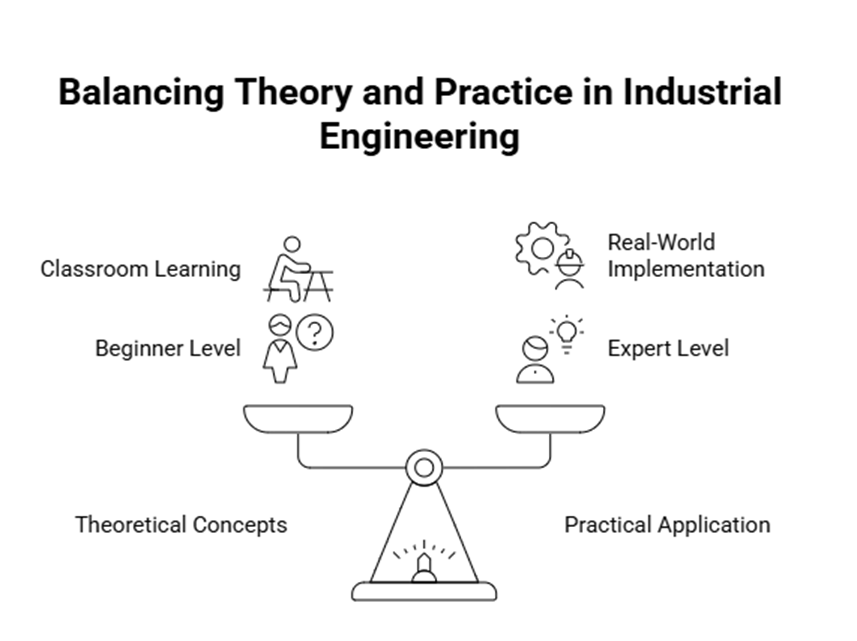
Industrial Engineering is a hybrid field, combining both theory and practical application.
- Theory provides models, formulas, and frameworks
- Practical application involves implementing these models in real systems
At a beginner level, students learn concepts in classrooms.
At an advanced level, they apply these concepts to improve real-world operations.
Example:
A student learns about queue theory (waiting line models).
Later, they apply it in a bank to reduce customer waiting time by optimizing counters.
Conclusion :
Core concepts in Industrial Engineering build a strong foundation in mathematics, data analysis, and decision-making, enabling engineers to solve complex real-world problems. These concepts bridge theory and practice, helping professionals design efficient, optimized systems across industries.