
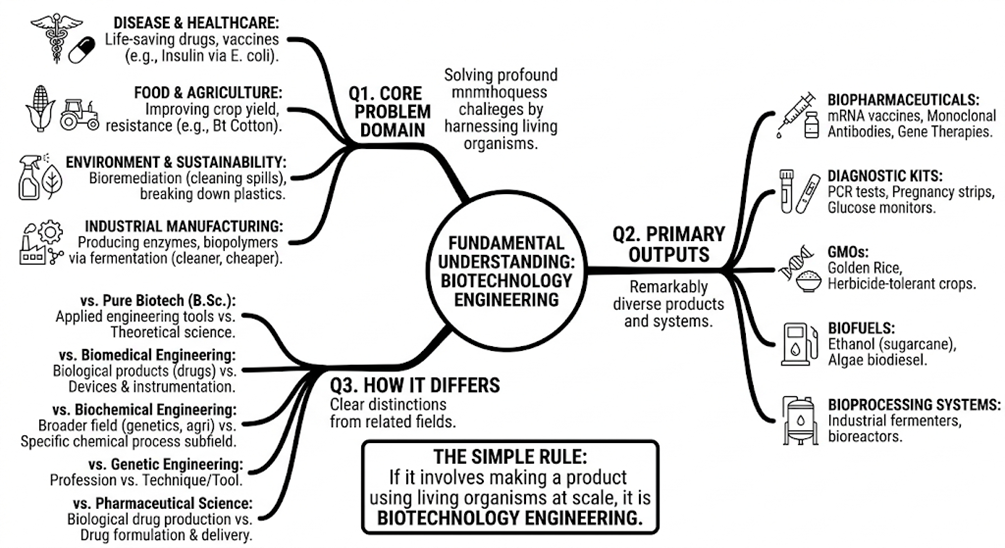
Q1. What is the core problem domain this branch solves?
Biotechnology Engineering sits at the intersection of biology, chemistry, genetics, and engineering. At its heart, it solves one of humanity’s most profound challenges: how do we harness the power of living organisms — bacteria, yeast, plant cells, human cells — to create useful products and solve real-world problems?
Think of it this way: Nature has spent 3.8 billion years perfecting biological machines. Biotechnology Engineering is the discipline that learns, reverse-engineers, modifies, and deploys those machines for human benefit. The core problem domains include:
- Disease & Healthcare: Developing life-saving drugs, vaccines, diagnostics, and gene therapies. For example, insulin used by diabetics worldwide is no longer extracted from pig pancreases — it is produced by genetically engineered E. coli bacteria, a direct result of biotechnology engineering.
- Food & Agriculture: Improving crop yield, pest resistance, and nutritional value. Bt cotton, which has transformed Indian agriculture, was developed through biotech principles.
- Environment & Sustainability: Using microorganisms to clean oil spills (bioremediation), produce biofuels, and break down plastics.
- Industrial Manufacturing: Producing enzymes, biopolymers, and specialty chemicals using fermentation technology — far cleaner and cheaper than chemical synthesis.
In short, if a problem involves living systems and engineering solutions, Biotechnology Engineering owns that space.
Q2. What are the primary outputs of this field (products, systems, services)?
After 50 years in this field, I have seen biotechnology evolve from producing simple enzymes in small fermentation tanks to editing the human genome itself. The primary outputs are remarkably diverse:
Biopharmaceuticals: Monoclonal antibodies (used in cancer therapy), recombinant proteins (Factor VIII for haemophilia), therapeutic enzymes, and mRNA vaccines like those developed for COVID-19. Every COVID-19 vaccine you received is a direct product of biotechnology engineering.
Diagnostic Kits: PCR-based COVID tests, pregnancy strips, blood glucose monitors, and cancer biomarker panels — all engineered using biotech principles.
Genetically Modified Organisms (GMOs): BT Brinjal, Golden Rice (enriched with Vitamin A), herbicide-tolerant soybeans. These are systems designed in biotechnology labs.
Biofuels: Ethanol from sugarcane fermentation, algae-based biodiesel, and second-generation biofuels from agricultural waste.
Bioprocessing Systems: Industrial-scale fermenters, bioreactors, and downstream purification systems that produce everything from beer to antibiotics.
Gene Therapy Products: Treatments like Luxturna (for genetic blindness) and Zolgensma (for spinal muscular atrophy) — products that were science fiction 30 years ago.
The field produces both tangible products (drugs, foods, fuels) and intellectual systems (CRISPR protocols, metabolic engineering pathways, bioprocess optimization models).
Q3. How is this branch different from closely related branches?
This is one of the most important questions a student can ask. Many students confuse Biotechnology Engineering with related fields. Here is a clear distinction:
Biotechnology Engineering vs. Pure Biotechnology (B.Sc.): B.Sc. Biotechnology is theoretical and science-oriented. Biotechnology Engineering applies those principles using engineering tools — designing reactors, scaling up processes, automating systems. The engineer builds the factory; the scientist designs the molecule.
vs. Biomedical Engineering: Biomedical Engineering focuses on devices and instrumentation (MRI machines, pacemakers, prosthetics). Biotechnology Engineering focuses on biological products and processes (drugs, vaccines, fermentation). Both touch medicine, but through very different pathways.
vs. Biochemical Engineering: Biochemical Engineering is a subfield — it specifically deals with chemical processes involving biological molecules. Biotechnology Engineering is broader and includes genetic engineering, molecular biology, and agricultural applications.
vs. Genetic Engineering: Genetic Engineering is a technique used within Biotechnology Engineering. It is like saying ‘welding’ versus ‘mechanical engineering’ — one is a tool, the other is a profession.
vs. Pharmaceutical Science: Pharmaceutical Science focuses on drug formulation and delivery. Biotechnology Engineering focuses on how to produce the biological drug in the first place.
The simplest rule: if it involves making a product using living organisms at scale, it is Biotechnology Engineering.
Q4. What are the real-world applications of this field?
Let me walk you through real, tangible applications that you encounter or will encounter in your lifetime:
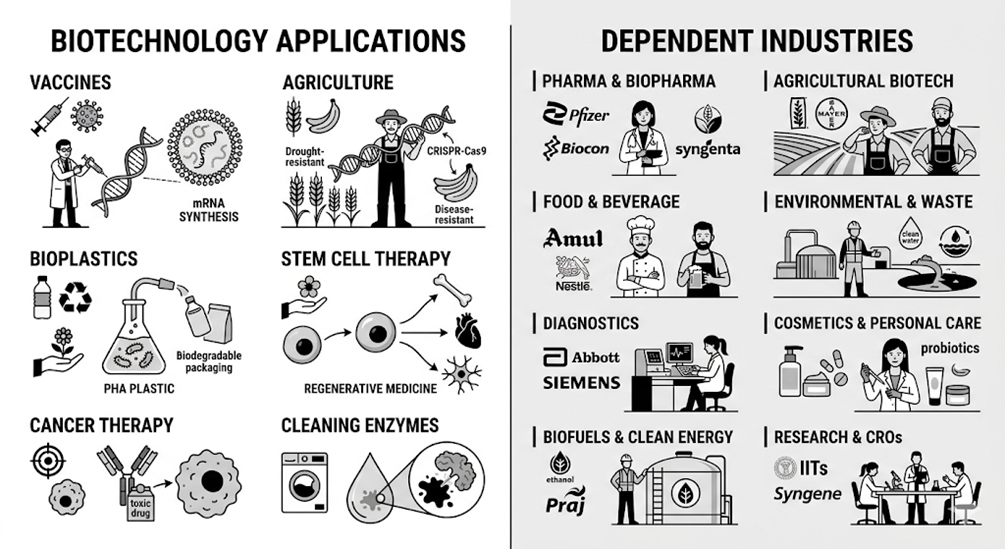
- COVID-19 mRNA Vaccines (Pfizer, Moderna): Designed using biotechnology tools — mRNA synthesis, lipid nanoparticle encapsulation, and cell biology testing.
- CRISPR Crops: Scientists have used CRISPR-Cas9 to develop drought-resistant wheat and disease-resistant bananas, directly addressing food security.
- Bioplastics: Companies like Novamont produce PHA (polyhydroxyalkanoates) — fully biodegradable plastics — using genetically engineered bacteria. This is the future of packaging.
- Stem Cell Therapy: Biotech engineers develop protocols for growing stem cells in culture, differentiating them into specific tissues, and applying them in regenerative medicine.
- Antibody-Drug Conjugates (ADCs): These are cancer-killing missiles — antibodies engineered to carry toxic drugs directly to tumour cells. Developed entirely through biotechnology engineering pipelines.
- Enzyme-based Detergents: The enzyme protease in your laundry detergent was developed and produced by biotech fermentation — it removes protein stains at low temperatures, saving energy globally.
- Bioremediation in Bhopal & Oil Spills: Engineered microbial consortia have been used to clean contaminated soil at industrial disaster sites.
Every single year, new applications emerge. The field is genuinely infinite in scope.
Q5. What industries heavily depend on this branch?
- Pharmaceutical & Biopharmaceutical Industry (Biocon, Dr. Reddy’s, Cipla Biotech, Pfizer, Roche, Genentech)
- Agricultural Biotechnology (Monsanto/Bayer, Syngenta, Mahyco, UPL)
- Food & Beverage Industry (fermentation technology in brewing, dairy, baking — Amul, Nestle, InBev)
- Environmental & Waste Management (bioremediation companies, biogas plant operators)
- Diagnostics & Medical Devices (Abbott, Siemens Healthineers, Mylab)
- Cosmetics & Personal Care (enzyme-based skincare, probiotics in beauty products — Biotique, Forest Essentials using biofermentation)
- Biofuels & Clean Energy (ONGC Biofuels, Praj Industries, Indian Oil’s ethanol programs)
- Research & Academic Institutions (IITs, IISc, CSIR, DBT labs, NIH, MIT)
- Contract Research Organizations (CROs): Syngene, Jubilant Biosys, Lambda Therapeutic
- Conclusion:
Biotechnology Engineering combines biology and technology to solve real-world problems in healthcare, agriculture, and environment. It is one of the fastest-growing fields with strong future potential. - CTA:
If you are interested in science and innovation, biotechnology could be the right career for you. Keep following this series and move to Day 2 to understand the core subjects you need to master.