
What are the specializations available?
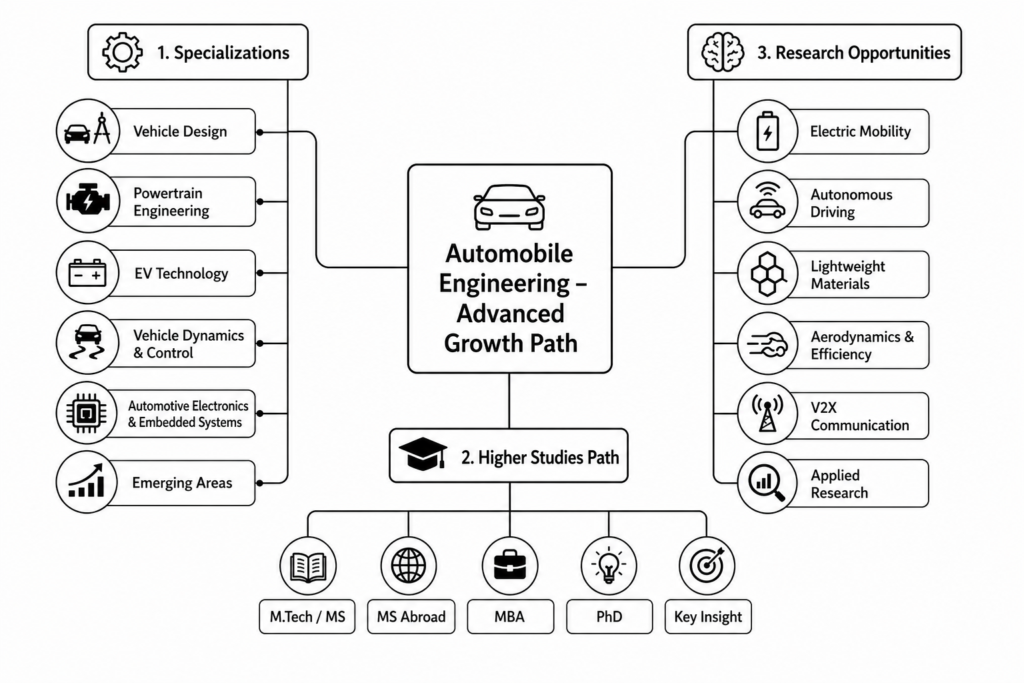
From my experience, Automobile Engineering becomes truly powerful when you move into specializations because modern vehicles are too complex to be handled as a single field. One of the most traditional specializations is vehicle design and development, where engineers focus on creating complete vehicles including chassis, body structure, and powertrain integration. Another major specialization is powertrain engineering, which focuses on engines, transmissions, and energy conversion systems. I have also seen strong growth in electric vehicle technology, where engineers work on batteries, motor control, charging systems, and energy efficiency. Vehicle dynamics and control systems is another important area that deals with stability, braking, steering behavior, and ride comfort. In recent years, automotive electronics and embedded systems has become extremely important because modern vehicles depend heavily on sensors and software. There are also growing areas like autonomous vehicles, ADAS systems, lightweight materials, and aerodynamics, which are shaping the future of mobility.
Should I pursue higher studies (M.Tech, MS, MBA, PhD)?
From my perspective, higher studies in Automobile Engineering should always depend on long-term career direction rather than being a default choice. If a student wants to go deeper into technical expertise, design, simulation, or research-based roles, then M.Tech or MS is very useful because it strengthens core engineering knowledge and specialization. I have seen that an MS abroad is especially valuable for students interested in electric vehicles, autonomous systems, or advanced automotive design because global universities work closely with industry research. If someone is more interested in leadership, business strategy, or managing automotive companies, then an MBA after some work experience can open strong opportunities in operations, supply chain, and product management. A PhD is ideal for those who want to enter research, innovation, or academia, especially in areas like EV technology, materials, or vehicle intelligence systems. In my experience, higher education becomes truly powerful when it aligns with a clear career vision instead of being done without direction.
What are the research opportunities?
From what I have observed, research in Automobile Engineering is expanding rapidly because the industry is undergoing technological transformation. One major area of research is electric mobility, especially improving battery efficiency, charging speed, and thermal management systems. Another important field is autonomous driving systems, where researchers work on making vehicles understand their environment safely and accurately. I have also seen strong research interest in lightweight materials and structural optimization, which helps improve fuel efficiency and performance. Aerodynamics and energy efficiency studies are also important for reducing resistance and improving vehicle stability. Another growing area is vehicle-to-everything (V2X) communication, where cars interact with infrastructure and other vehicles. In my experience, automobile research is highly applied, meaning most innovations are directly tested in real-world conditions, which makes it very impactful compared to purely theoretical fields.
What global opportunities exist in this field?
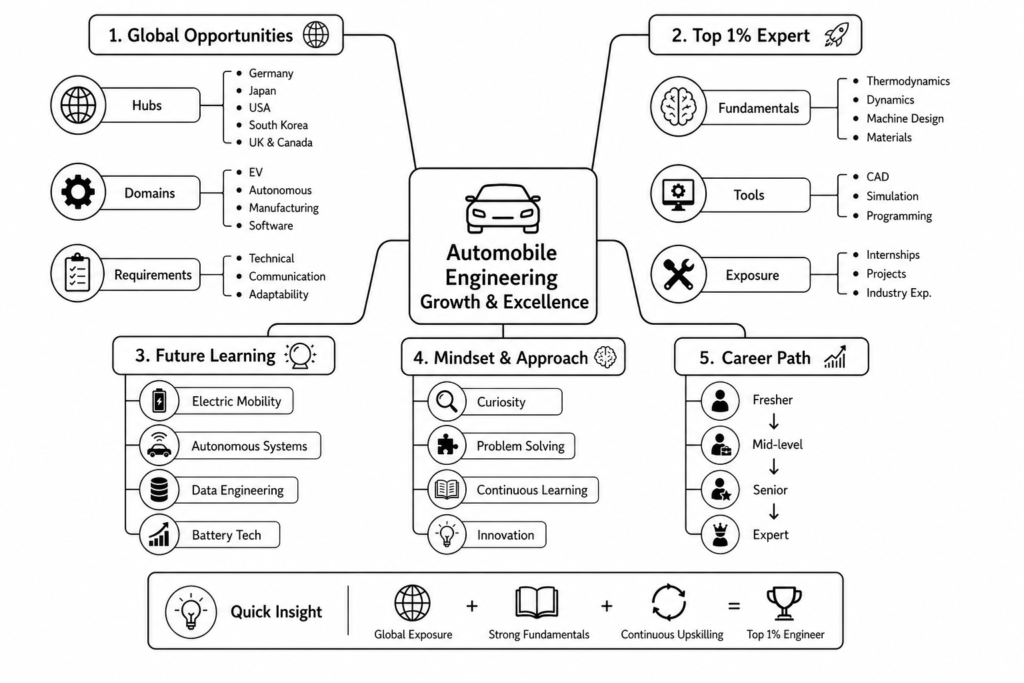
From my experience, Automobile Engineering offers strong global opportunities because transportation is a universal industry and every country has mobility needs. Countries like the Germany, Japan, United States, South Korea, Canada, and United Kingdom have strong automotive industries with advanced research and manufacturing ecosystems. I have noticed that global companies actively hire engineers for roles in electric vehicles, autonomous systems, design engineering, and manufacturing optimization. Europe, in particular, has strong demand for sustainable mobility and electric vehicle technologies. In my experience, engineers who combine technical knowledge with global exposure and communication skills can build careers that extend across multiple countries and industries.
How can I become a top 1% expert in this domain?
From my perspective, becoming a top 1% expert in Automobile Engineering requires much more than completing a degree—it requires continuous learning, deep practical exposure, and strong curiosity about how vehicles actually work. The first step is mastering fundamentals such as thermodynamics, vehicle dynamics, materials, and machine design so well that you can understand any automotive system logically. I have seen that top engineers also develop strong skills in simulation and digital tools because modern automotive development is highly software-driven. Working on real projects, internships, and industry exposure is extremely important because true expertise develops when theory meets real-world complexity. I believe learning emerging areas like electric vehicles, autonomous systems, and data-driven engineering is essential because the industry is shifting rapidly. In my experience, the top professionals are those who constantly ask deeper questions about performance, efficiency, safety, and innovation instead of just accepting standard solutions. Ultimately, becoming a top expert means combining strong technical foundations with adaptability, creativity, and real industrial experience over time.
Conclusion:
Advanced growth in Automobile Engineering comes from choosing the right specialization (EVs, powertrain, vehicle dynamics, electronics, autonomous systems) and aligning higher studies (M.Tech/MS/MBA/PhD) with clear career goals, while leveraging global opportunities and research-driven learning.
CTA:
Pick one specialization early, build deep expertise through projects and tools, consider higher studies only with a clear goal, and continuously upskill to move toward the top 1% in this evolving field.