
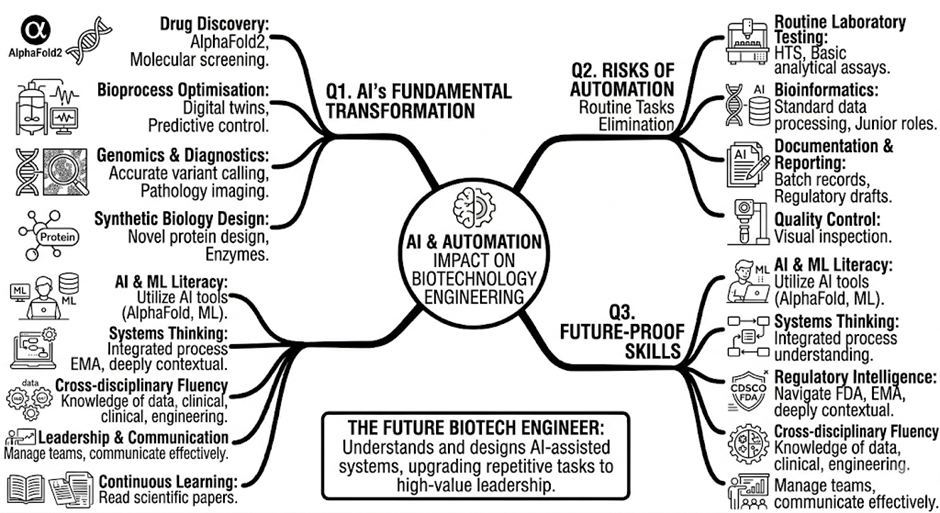
Q1. How will AI impact this branch?
AI is not just impacting biotechnology engineering — it is fundamentally transforming it. This transformation is already underway and will accelerate dramatically through 2040.
Drug Discovery: AlphaFold2 (DeepMind) solved the 50-year-old protein folding problem in 2020. This single AI breakthrough has accelerated drug discovery by years. AI models can now screen billions of drug-like molecules computationally in days. Companies like Insilico Medicine have used AI to discover a novel drug candidate in 46 days — a process that took 4–5 years conventionally.
Bioprocess Optimization: AI is used to create ‘digital twins’ of bioreactors — real-time simulation models that predict process behaviour and suggest control adjustments. Sartorius’s Biostat bioreactor systems, for example, now include AI-assisted process control.
Genomics & Diagnostics: AI models like DeepVariant can identify genetic variants from genome sequencing data with superhuman accuracy. AI-powered diagnostics (pathology image analysis, CT scan interpretation) are transforming clinical settings.
Synthetic Biology Design: AI tools like Rosetta, ESMFold, and ProteinMPNN can design novel proteins with desired properties — this is the foundation of enzyme engineering and the next generation of biopharmaceuticals.
Q2. What parts of this field are at risk of automation?
I believe strongly that being honest about automation risk is essential for good career planning:
- Routine Laboratory Testing: High-throughput screening (HTS) robots already perform thousands of assays per day that previously required lab technicians. Basic analytical testing (HPLC runs, ELISA plate reading, colony counting) is increasingly automated.
- Bioinformatics Data Processing: Standard pipeline analysis of genomic data (alignment, variant calling) is largely automated. Junior bioinformatics roles that only involve running existing pipelines will be automated away.
- Documentation and Reporting: AI-assisted document generation tools will automate standard batch record compilation, regulatory document drafting, and deviation report writing.
- Visual Quality Inspection: Machine vision systems are replacing human inspectors in fill-finish pharmaceutical manufacturing.
Important perspective: These automations eliminate tedious, repetitive tasks. They do not eliminate the need for biotech engineers — they upgrade what biotech engineers do. The engineer who understands AI tools will design and oversee these systems. The engineer who ignores AI will be displaced.
Q3. What skills make me future-proof in this domain?
- AI and Machine Learning Literacy: You do not need to be an AI researcher, but you must be able to use AI tools — AlphaFold, Large Language Models for scientific literature, Python ML libraries — to solve biotechnology problems.
- Systems Thinking: The ability to understand a bioprocess not as a collection of individual steps but as an integrated, dynamic system. This kind of thinking is extremely hard to automate.
- Regulatory Intelligence: Understanding how regulatory frameworks work — FDA, EMA, CDSCO — and being able to navigate them is a deeply human, contextual skill that AI cannot replace.
- Cross-disciplinary Fluency: The biotech engineer who can speak the language of data science, clinical research, mechanical engineering, and regulatory affairs is invaluable. Build T-shaped expertise — deep in one area, broad across many.
- Leadership and Communication: The ability to lead a project team, communicate results to non-specialists, and manage complex stakeholder environments will always be irreplaceable.
- Continuous Learning: Build the habit of reading 2–3 scientific papers per week from day one of your undergraduate studies. The field moves fast. Staying current is itself a competitive advantage.
Q4. Is this branch evolving towards interdisciplinary roles?
Without question, yes. This is one of the most important trends shaping the future of biotechnology engineering careers.
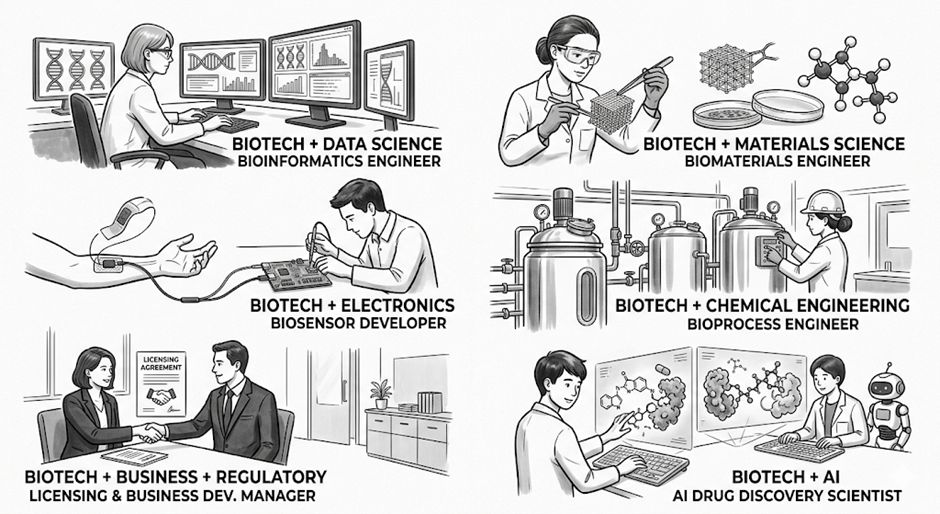
The roles I see attracting the highest salaries and most impactful work in 2025 are not pure biotechnology roles — they are interdisciplinary hybrids:
- Biotech + Data Science = Bioinformatics Engineer / Computational Biologist
- Biotech + Materials Science = Biomaterials Engineer (tissue engineering, drug delivery)
- Biotech + Electronics = Biosensor Developer, Wearable Medical Device Designer
- Biotech + Chemical Engineering = Bioprocess Engineer / Biochemical Engineer (most classical hybrid)
- Biotech + Business + Regulatory = Licensing & Business Development Manager (pharma industry)
- Biotech + AI = AI Drug Discovery Scientist (fastest growing role globally)
My advice: from Year 2 of your degree, deliberately cultivate expertise in ONE adjacent field alongside your core biotechnology curriculum. Choose based on your natural inclinations. This deliberate cross-training will define your career trajectory more than your GPA.
Conclusion:
AI and data science are transforming biotechnology by speeding up research, drug discovery, and disease prediction. This integration is shaping the future of the biotech industry.
CTA:
Start learning basic AI and data analysis skills to stay ahead. Follow this series and move to Day 7 to understand the challenges of this field.