
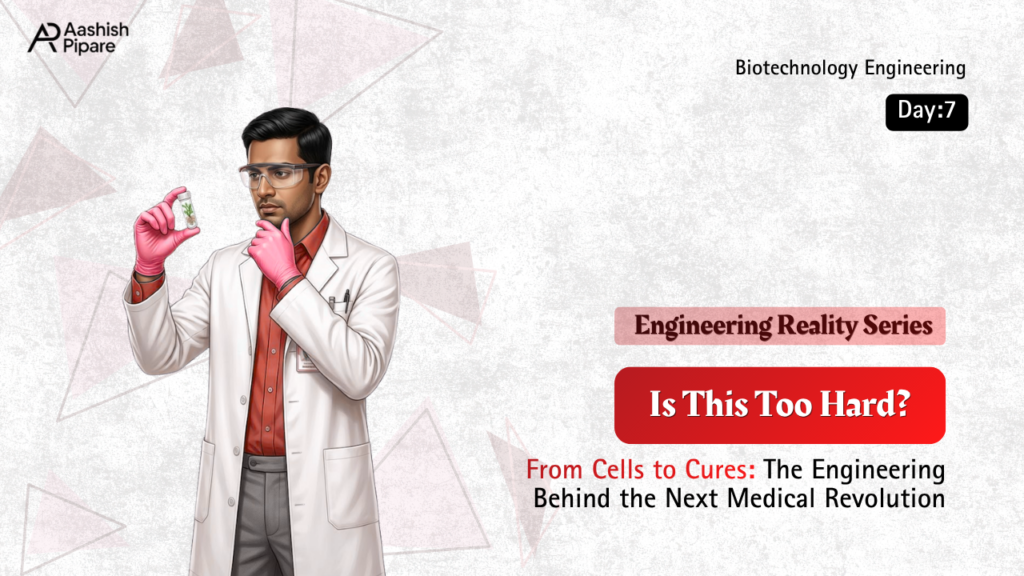
Q1. How difficult is this branch compared to others?
Biotechnology Engineering sits at moderate-to-high difficulty. Let me give you an honest comparison:
It is less mathematically intensive than Electrical Engineering or Aerospace Engineering. It does not require the spatial precision of Civil or Mechanical design. However, it requires something arguably harder: the ability to work simultaneously across multiple scientific disciplines with comfort and integration.
You must understand biology deeply enough to design experiments, chemistry precisely enough to interpret analytical results, mathematics well enough to model bioreactor behaviour, and engineering broadly enough to scale up processes. The integration demand is high. Students who struggle are usually those who try to compartmentalize — they are good at ‘biology’ but consider ‘engineering maths’ a different, irrelevant subject.
The students who thrive see Biotechnology Engineering as one unified problem-solving discipline. A bioreactor culture failure is simultaneously a biology problem (wrong growth conditions), a chemistry problem (wrong pH), an engineering problem (insufficient mixing), and a statistics problem (wrong experimental design). Seeing all four dimensions at once is the skill.
Q2. What type of students excel in this field?
- Naturally curious about how life works at the molecular level — students who wonder why cells behave the way they do, not just accept that they do.
- Comfortable with ambiguity — biological systems are inherently variable. The student who panics when an experiment gives unexpected results will struggle. The student who asks ‘why did this happen?’ will excel.
- Patient and meticulous — a chromatography experiment may require 8 hours of continuous monitoring. Cell culture requires attention at odd hours.
- Quantitative thinkers who enjoy data — students who instinctively reach for graphs and numbers to understand biological phenomena.
- Good written communicators — scientific documentation (SOPs, reports, regulatory submissions) is a large part of professional life in biotechnology.
- Adaptable learners — the field changes rapidly. Students who read beyond the syllabus, follow industry news, and are excited by new discoveries thrive.
Q3. Does it require fieldwork, desk work, or both?
This varies significantly by role, and this is one of the wonderful things about Biotechnology Engineering — you can choose your work environment:
Primarily Lab-Based: R&D scientists, QC analysts, bioprocess engineers in development. You spend 60–80% of your time in a laboratory environment. Physical stamina for standing hours, attention to safety protocols, and comfort with hands-on work are essential.
Primarily Desk-Based: Regulatory affairs, bioinformatics, clinical research associate roles (admin side), business development. Heavy documentation, computer work, and stakeholder management.
Mixed (Most Common in Industry): Most professional roles involve 40% lab/field and 60% desk work. A bioprocess engineer in a GMP facility reviews batch records, writes reports, and analysed data at a desk — but also troubleshoots equipment and monitors fermentation on the production floor.
Fieldwork-Heavy: Environmental biotechnology consulting, biofuel plant commissioning, clinical trial monitoring (CRA roles) — these involve significant travel to client sites, industrial plants, or clinical sites.
Q4. What is the typical work-life balance?
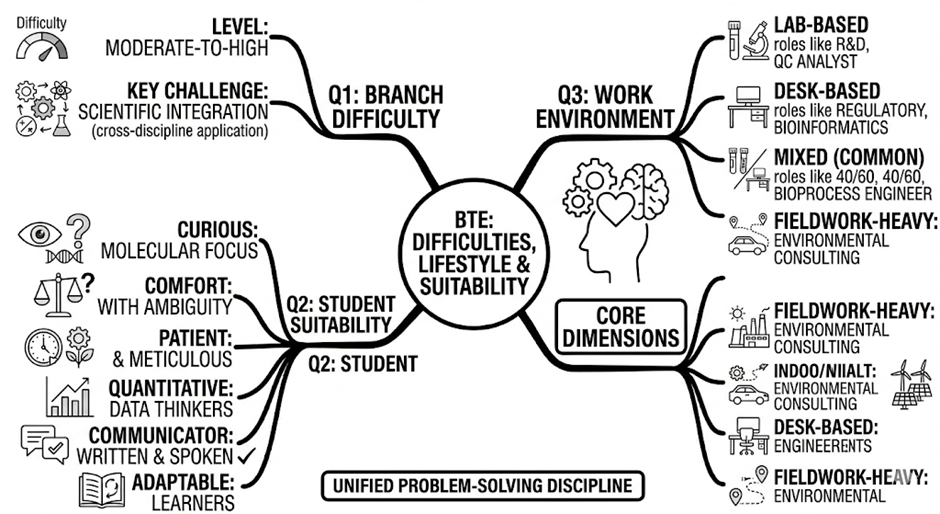
Work-life balance varies considerably by employer type:
Pharmaceutical Manufacturing (Shift Work): GMP manufacturing runs 24/7. Engineers in production roles work rotating shifts (including night shifts). This is physically demanding and affects personal life significantly. However, it comes with higher pay and faster practical learning.
R&D Roles (Pharma / Biotech): Generally a 9–6 culture with occasional extended hours during project crunch periods. Comparable to IT services work culture.
Academic Research (PhD / Postdoc): Demands can be extreme — 60–70 hour weeks are not uncommon in competitive labs, particularly as PhD deadlines approach. However, there is significant freedom in structuring your time.
Regulatory Affairs / CROs: Generally good work-life balance, typically 9–6, with some project deadline crunch periods.
My honest advice: in the first 5 years of your career, prioritize learning over balance. Every challenging experience — the night shift batch failure, the chromatography method that took 3 months to optimize — builds the expertise that will define your career for the next 30 years.
Q5. Does it involve high physical, mental, or creative demand?
Physical Demand: Moderate. Laboratory work involves prolonged standing, handling of chemicals and biological materials, and use of physical equipment. Proper ergonomics, PPE compliance, and biosafety awareness are important. There is no heavy physical labour, but there is physical attention and dexterity required.
Mental Demand: High. Problem-solving, experimental design, data interpretation, regulatory compliance — these are constant mental demands. The mental load is intellectually stimulating rather than stressful for the right type of person.
Creative Demand: Moderate-to-high in R&D roles. Designing a novel genetic construct, imagining a new purification strategy, developing a new diagnostic assay — these require genuine creativity. Biotechnology engineering at its best is an art form practiced with a scientific toolkit.
Summary: if you enjoy solving puzzles with living systems, the demands are energizing rather than exhausting. If you prefer routine and predictability, the creative and problem-solving demands may feel overwhelming.
Conclusion:
Biotechnology Engineering can be challenging because it involves both theory and practical work. However, with consistency and curiosity, it becomes easier and more interesting.
CTA:
Stay motivated and keep learning step by step. Continue to Day 8 to explore the latest trends in biotechnology.