
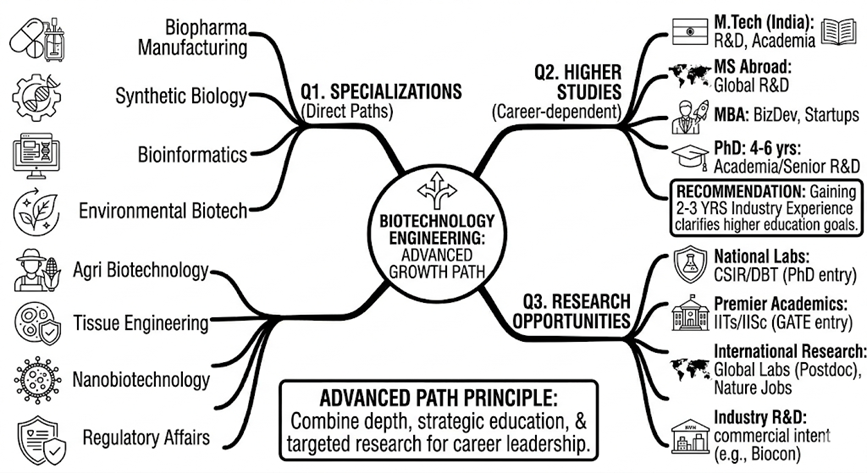
Q1. What are the specializations available?
Biopharmaceuticals & Drug Manufacturing: Focus on upstream (fermentation, cell culture) and downstream processing (purification). The most direct path to pharmaceutical industry leadership.
Synthetic Biology: Engineering biological systems for novel applications — from biosensors to living factories. Requires strong molecular biology and computational skills.
Bioinformatics & Computational Biology: Analysis of genomic, proteomic, and metabolomic data using computational tools. A cross-disciplinary specialization with enormous growth.
Environmental Biotechnology: Bioremediation, biofuels, biogas, and green chemistry. Growing in importance with global sustainability commitments.
Agricultural Biotechnology: Crop improvement, biopesticides, biofertilizers. Particularly relevant in India’s agricultural context.
Tissue Engineering & Regenerative Medicine: Growing cells and tissues for therapeutic applications — 3D bioprinting, scaffold design, stem cell engineering.
Nanobiotechnology: Using nanomaterials for drug delivery, diagnostics, and biosensing. One of the most cross-disciplinary and rapidly growing areas.
Regulatory Affairs & Quality Management: A specialization that is less research-intensive but critical to drug development — and among the best-paid senior roles in the industry.
Q2. Should I pursue higher studies (M.Tech, MS, MBA, PhD)?
This is the most common career planning question I receive. My answer is: it depends entirely on the career path you are targeting.
M.Tech (India — IITs, NITs, IISc): Ideal if you want to enter research & development or academia in India. The IIT brand significantly improves your entry-level position and salary. Target through GATE (Biotechnology, XL paper).
MS Abroad (USA, Europe, Canada): Best for those targeting global R&D roles, genomics, or computational biology. US MS programs (MIT, Johns Hopkins, UCSD, Purdue) are well-recognised by global pharmaceutical companies. Typically self-funded or with RA/TA assistantship.
MBA after B.Tech: Ideal for those targeting business development, licensing, regulatory management, or startup founding. IIM or global MBA combined with biotechnology knowledge creates a uniquely powerful profile.
PhD: Only if you are deeply passionate about research and willing to commit 4–6 years to a focused research question. PhD is not necessary for most industry roles. It IS essential for academic faculty positions, senior R&D leadership, and independent research careers.
My personal recommendation: Take 2–3 years of industry experience after B.Tech before deciding on higher education. Real-world experience will clarify exactly what higher degree — if any — will best serve your specific career goals.
Q3. What are the research opportunities?
- CSIR Laboratories: 37 national labs across India — CSIR-NCL, CSIR-IMTECH, CSIR-CDRI, CSIR-CFTRI. Offer PhD positions (SRF/JRF scholarships via CSIR-NET) and project scientist positions.
- DBT-supported Institutes: NCBS Bangalore, NIBMG Kalyani, NII Delhi, RGCB Thiruvananthapuram — excellent research in molecular biology, genomics, and immunology.
- IITs and IISc: Strong biotech/biosciences departments — particularly IIT Bombay, IIT Madras, IIT Delhi, and IISc Bangalore. GATE + written test + interview is the entry path.
- International Research: Apply for postdoctoral positions at NIH (USA), Wellcome Trust-funded labs (UK), Max Planck Institutes (Germany), and RIKEN (Japan). Platforms like Nature Jobs, Science Careers, and Euraxess list international positions.
- Industry R&D: Biocon, Dr. Reddy’s Laboratories, and Serum Institute all operate significant in-house research programs — these are ‘research with commercial intent’ environments distinct from academic research.
Q4. What global opportunities exist in this field?
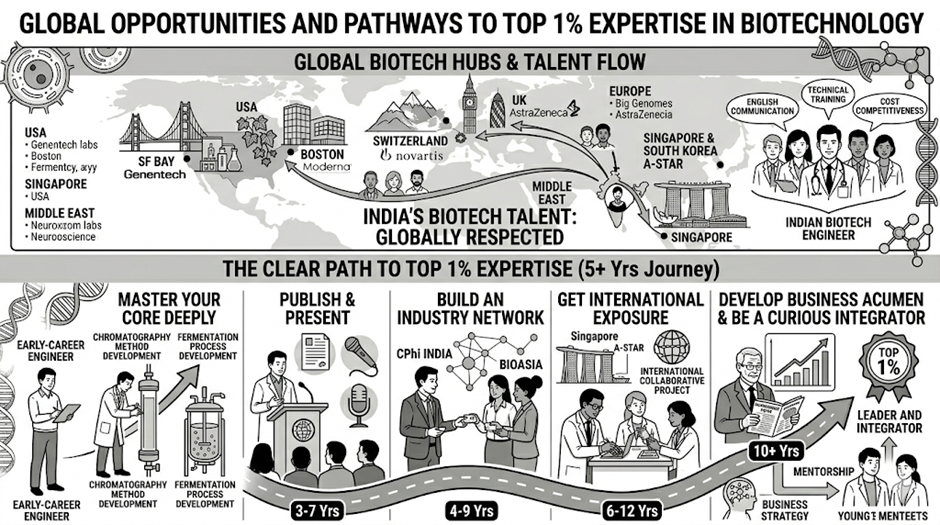
- USA: The San Francisco Bay Area (Genentech, Roche, Gilead), Boston-Cambridge corridor (Moderna, Biogen, Sanofi Genzyme), and Research Triangle Park, North Carolina are the world’s leading biotech hubs. US FDA’s BIO program and biotech visa pathways support skilled immigration.
- Europe: Switzerland (Novartis, Roche headquarters in Basel), UK (AstraZeneca, GSK), Germany (Bayer, Merck KGaA), Ireland (MSD, Pfizer manufacturing hubs). EU Blue Card supports skilled professional immigration.
- Singapore and South Korea: Both are rapidly building biotech ecosystems with strong government investment. A-STAR (Singapore) offers research fellowships for international scientists.
- Middle East: Saudi Arabia and UAE are investing in biotech as part of economic diversification — opportunities in hospital systems, research institutes, and new biotech parks.
Indian biotechnology engineers are globally respected, particularly for pharmaceutical manufacturing expertise. The combination of strong English communication, technical training, and cost competitiveness makes Indian biotech graduates attractive internationally.
Q5. How can I become a top 1% expert in this domain?
This question deserves the most honest and direct answer I can give, because there are no shortcuts, but there is a clear path:
- Master Your Core Deeply: In your first 5 years, become the absolute best at ONE specific thing — fermentation process development, chromatography method development, bioinformatics pipeline design, or regulatory dossier preparation. Depth before breadth.
- Publish and Present: Write papers, even on small findings. Present at conferences. The act of writing for publication forces clarity of thought that no course can provide.
- Build an Industry Network: Join ISPE, ISBTECH, BioSpectrum, and iGEM alumni networks. Attend conferences like CPhI India, BioAsia, and DCAT Week. The strongest careers I have seen were built on networks as much as on technical skill.
- Get International Exposure: A stint at an international company, research lab, or through a collaborative project changes your professional perspective and expands your credibility exponentially.
- Develop Business Acumen: Understand how your company makes money. Understand pricing, margins, competitive landscape. The engineer who understands business becomes the leader.
- Be Genuinely Curious About Adjacent Fields: The top 1% in biotechnology are not specialists trapped in a narrow domain — they are integrators. They read neuroscience papers with the same curiosity they bring to bioreactor design.
- Mentor Others: There is no better way to deeply understand a subject than to teach it. Mentor younger students from your first year onward. It builds leadership, communication, and forces mastery.
Conclusion:
Choosing the right specialization like genetics, bioinformatics, or microbiology can shape your career in biotechnology. Each area has unique scope and growth potential.
CTA:
Research all options carefully before deciding. Continue to Day 10 for final insights and career clarity.