What are the key subjects I must master in this branch?
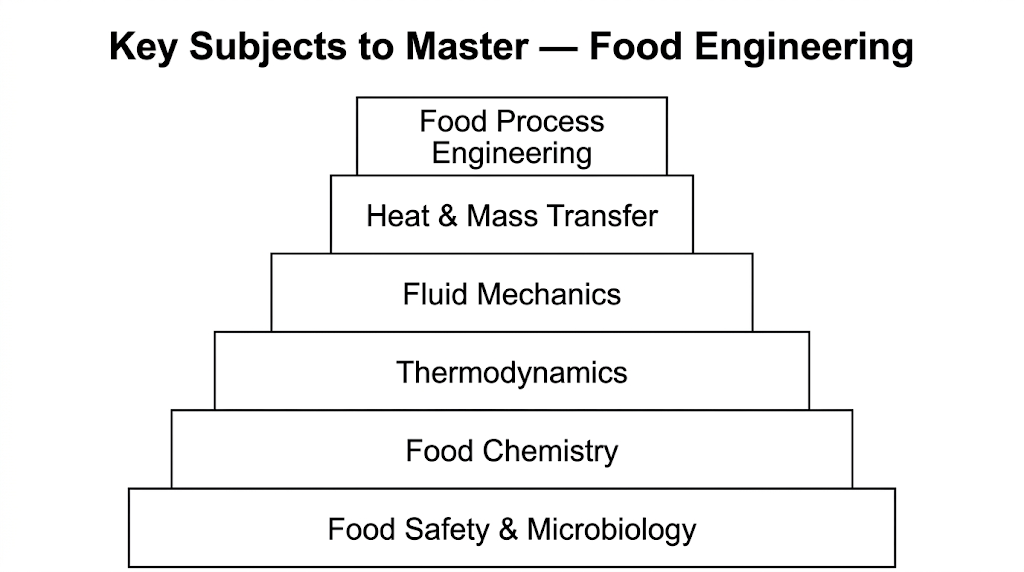
From my experience, succeeding in Food Engineering requires building a strong foundation in several interconnected subjects because this field sits between engineering and food science. One of the most important subjects is food process engineering, because it teaches how raw food materials are transformed through heating, cooling, drying, mixing, and preservation. Heat and mass transfer is another essential area because food engineers constantly deal with movement of heat, moisture, and gases within food systems. I have noticed that fluid mechanics becomes very important when working with liquids such as milk, juices, oils, and sauces because these products behave differently from simple industrial fluids. Thermodynamics is also critical because understanding energy changes helps in refrigeration, freezing, and evaporation systems. In addition to these engineering subjects, students must understand food chemistry, microbiology, and food safety, because food is a biological material that reacts chemically and can support microbial growth. In my view, mastering this branch requires not only understanding machinery but also understanding how food itself behaves inside that machinery.
What level of mathematics is required?
In my experience, Food Engineering requires a moderate to advanced level of mathematics, but it is usually more applied than abstract. Students need a solid understanding of basic algebra, calculus, differential equations, and statistics because these are used to model processing operations and analyze production data. Calculus is especially useful for understanding heat transfer rates, moisture movement, and reaction kinetics in food systems. Differential equations often appear when studying temperature distribution during sterilization or drying. I have also seen that statistics plays a very important role because food engineers frequently analyze quality data, shelf-life studies, process variation, and sensory evaluation results. Compared with some branches of pure engineering, the mathematics may not feel overwhelmingly theoretical, but it must be understood well enough to solve real industrial problems. From what I have observed, students who are comfortable with applied mathematics usually find the branch much easier to understand because mathematical thinking supports almost every engineering decision.
Which scientific principles are fundamental here?
From what I have seen, Food Engineering depends on a combination of scientific principles from physics, chemistry, biology, and engineering science. Heat transfer is fundamental because many food processes involve cooking, pasteurization, freezing, and sterilization. Mass transfer is equally important because water, salt, gases, and flavor compounds move through food during drying, concentration, and packaging. Thermodynamics explains how energy moves and changes form during processing operations. Microbiology is essential because food engineers must understand how bacteria, yeast, and molds grow and how processing can control them. Food chemistry is also central because proteins, carbohydrates, fats, vitamins, and enzymes all respond differently under temperature and pressure. I often explain that Food Engineering is unique because food is not just a material; it is a living chemical system that changes continuously. Because of that, food engineers must understand both the scientific behavior of food and the engineering systems used to process it.
What are the most difficult concepats students struggle with?
In my experience, students often struggle most with the concepts that combine mathematics with physical understanding. One of the hardest areas is heat and mass transfer, because students must understand not only equations but also how heat and moisture move inside complex food structures. Many students find it difficult to visualize how drying, freezing, or sterilization occurs inside a food product rather than only on its surface. Another challenging area is reaction kinetics, where students must predict how nutrients, color, or microbial populations change over time during processing. I have also noticed that fluid behavior of non-Newtonian foods such as ketchup, yogurt, and sauces can be confusing because these foods do not flow like water. Understanding how biological materials respond differently under stress often requires deeper thinking. Some students also struggle with connecting theory to industry because the food system is more variable than other engineering materials. From what I have observed, the most difficult part is learning to think of food as both a scientific substance and an engineering material at the same time.
Is this branch more theoretical, practical, or hybrid?
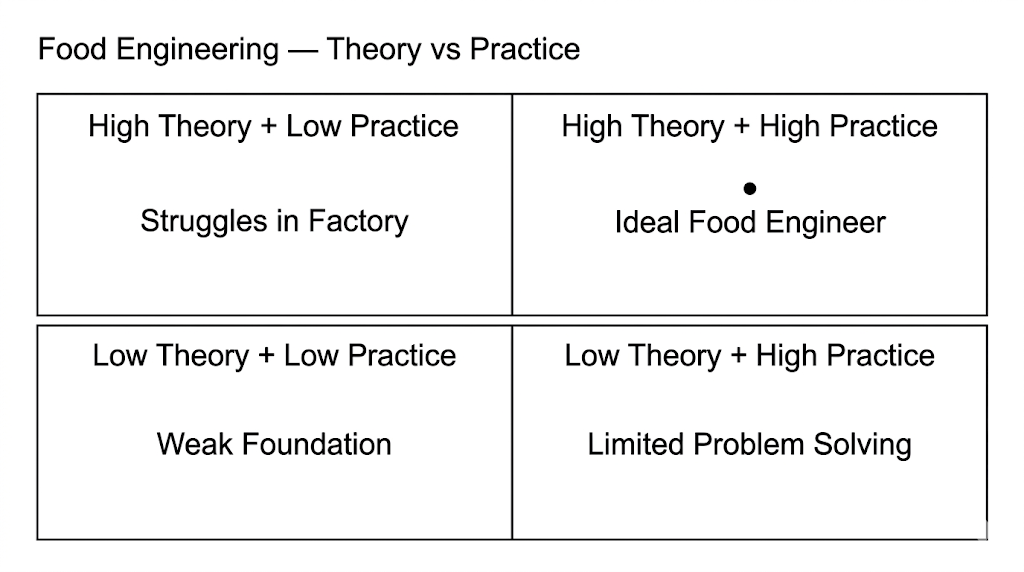
From my perspective, Food Engineering is clearly a hybrid branch, because it combines strong theoretical knowledge with practical industrial application. The theoretical side includes understanding transport phenomena, thermodynamics, microbiology, and mathematical modeling of food processes. However, theory alone is never enough because food engineers must apply that knowledge to real production environments where factors such as cost, hygiene, machine limitations, and consumer expectations matter. I have seen that students who only focus on theory sometimes struggle in industrial settings because food processing rarely behaves exactly like textbook examples. At the same time, students who rely only on practical skills may lack the deeper understanding needed to solve complex problems. What makes this field rewarding, in my opinion, is that it constantly connects classroom knowledge with real-world manufacturing. A food engineer must understand the science behind a process while also knowing how to make that process work reliably on a factory scale.