
🔹 What is the core problem domain this branch solves?
Environmental Engineering solves real-world problems related to pollution, sustainability, and public health protection. The main focus is to control air, water, and soil pollution caused by human activities. Engineers design systems like wastewater treatment plants to clean contaminated water before it is released into rivers. For example, untreated sewage can spread diseases such as cholera, so proper treatment is essential. They also work on reducing industrial emissions that harm air quality. Climate change mitigation and resource conservation are also major problem areas. Engineers ensure industries follow environmental regulations to minimize damage. Waste management systems are developed to handle solid waste safely. The field balances development with environmental protection. Overall, it ensures a cleaner, safer, and sustainable future for society.
🔹 What type of students excel in this field?
Students who are curious about nature and passionate about sustainability perform best in environmental engineering. Those who enjoy subjects like chemistry, biology, and geography find concepts easier to understand. Analytical thinkers who like solving real-life problems, such as water pollution or waste management, excel in this field. For example, a student interested in improving water quality can design innovative filtration systems. Practical learners who enjoy experiments, fieldwork, and lab testing also succeed. Attention to detail is important when analyzing environmental data and reports. Students with patience and responsibility towards society perform better. Good communication skills help in presenting environmental findings clearly. Adaptability and willingness to learn new technologies are also important. Overall, motivated and environmentally conscious students thrive in this branch.
🔹 Does it require fieldwork, desk work, or both?
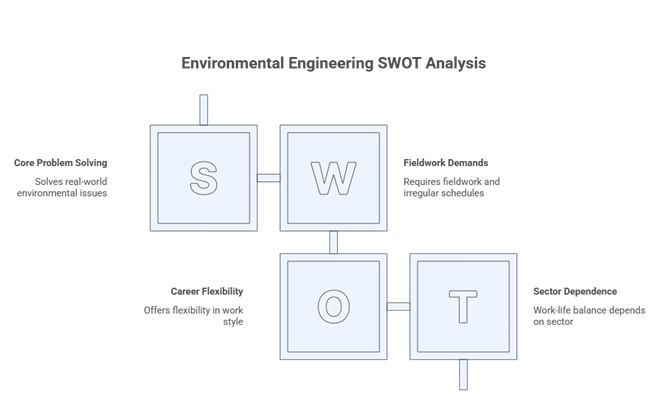
Environmental Engineering involves a balanced combination of fieldwork and desk work. Fieldwork includes collecting samples of water, air, and soil from real locations like rivers, factories, or construction sites. For example, engineers may visit a polluted river to test contamination levels. Desk work involves analyzing collected data, preparing reports, and designing treatment systems. Engineers also use software tools for simulations and environmental modeling. Research roles are more desk-based, focusing on analysis and innovation. Industry roles involve more field exposure and site inspections. This combination helps engineers understand real-world conditions and apply theoretical knowledge effectively. It keeps the work dynamic and engaging. Professionals can choose roles based on their preference. Therefore, it offers flexibility in work style.
🔹 What is the typical work-life balance?
Work-life balance in environmental engineering depends on the sector and job role. Government jobs and research positions usually provide stable working hours and a better balance. Private sector roles, especially in consulting or project-based work, may involve deadlines and longer hours. Fieldwork can sometimes require travel and irregular schedules. For example, environmental audits or site inspections may extend beyond regular hours. However, compared to heavy industrial jobs, this field is less physically exhausting. With experience, professionals can move into managerial roles with improved work-life balance. Proper planning and time management help maintain personal life. Choosing the right job role is important for comfort. Overall, the field offers a reasonable and manageable work-life balance.
🔹 Does it involve high physical, mental, or creative demand?
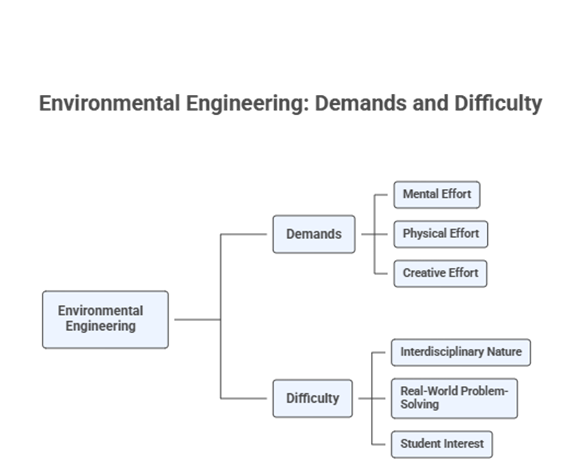
Environmental engineering mainly involves high mental effort along with moderate physical and creative demands. Engineers must analyze complex environmental problems and design effective solutions. For example, designing a wastewater treatment plant requires strong analytical and technical thinking. Physical work is limited but present during field visits and sample collection. Creative thinking is essential for developing innovative and sustainable solutions. Engineers must adapt to changing environmental conditions and regulations. Decision-making skills are important when dealing with critical environmental issues. Research roles are more analytical, while field roles involve some physical activity. The job requires focus, precision, and responsibility. Overall, it is intellectually demanding but well-balanced in terms of effort.
🔹 How difficult is this branch compared to others?
Environmental Engineering is considered moderately difficult because it combines multiple disciplines like chemistry, biology, physics, and engineering. Students must understand both theoretical concepts and practical applications. Subjects like fluid mechanics and environmental chemistry can be challenging initially. For example, calculating water flow in treatment plants requires strong mathematical and analytical skills. Compared to purely theoretical branches, it involves more real-world problem-solving. However, students who are interested in environmental issues find it easier to learn. Regular practice and hands-on experience reduce difficulty. Understanding concepts is more important than memorization. The branch requires consistency and curiosity. With the right approach, students can manage it successfully.
Conclusion
Environmental engineering is a balanced and purpose-driven field that combines intellectual challenge with real-world impact. It is neither the easiest nor the hardest branch—but it demands consistency, curiosity, and a genuine interest in solving environmental problems. Students who enjoy subjects like chemistry, biology, and real-life applications will find this field engaging and meaningful over time.
The profession offers a flexible lifestyle with a mix of fieldwork and desk-based tasks. Whether it’s collecting samples on-site or analyzing data using software, the work remains dynamic and practical. While some roles may involve travel or deadlines, overall work-life balance is manageable—especially in government and research positions. Compared to many engineering fields, it is less physically demanding but requires strong analytical thinking and problem-solving skills.
What makes this branch unique is its alignment with purpose. Environmental engineers don’t just build systems—they protect public health, conserve resources, and contribute to a sustainable future. The challenges are real, but so is the impact. With the right mindset and skills, the difficulty becomes manageable and even rewarding.
In summary, environmental engineering is ideal for students who want a meaningful career with long-term relevance. It offers a blend of technical knowledge, practical exposure, and societal contribution—making it a smart and future-focused choice.
If you want a career that balances skill, stability, and real-world impact—environmental engineering is your path. Start exploring, stay consistent, and build your future with purpose. 🌍
Call to Action
Take a clear step toward understanding your fit in this field
- Reflect honestly on your interest in environment, sustainability, and real-world problem solving
- Strengthen your basics in chemistry, biology, and analytical thinking
- Try one small practical activity like water testing or waste analysis
- Talk to seniors or professionals to understand real job experiences
- Stay consistent and focus on concept-based learning
Choosing the right branch is about alignment, not trends. If this field matches your interest and mindset, commit to it fully and build your path with clarity.