a. How difficult is this branch compared to others?
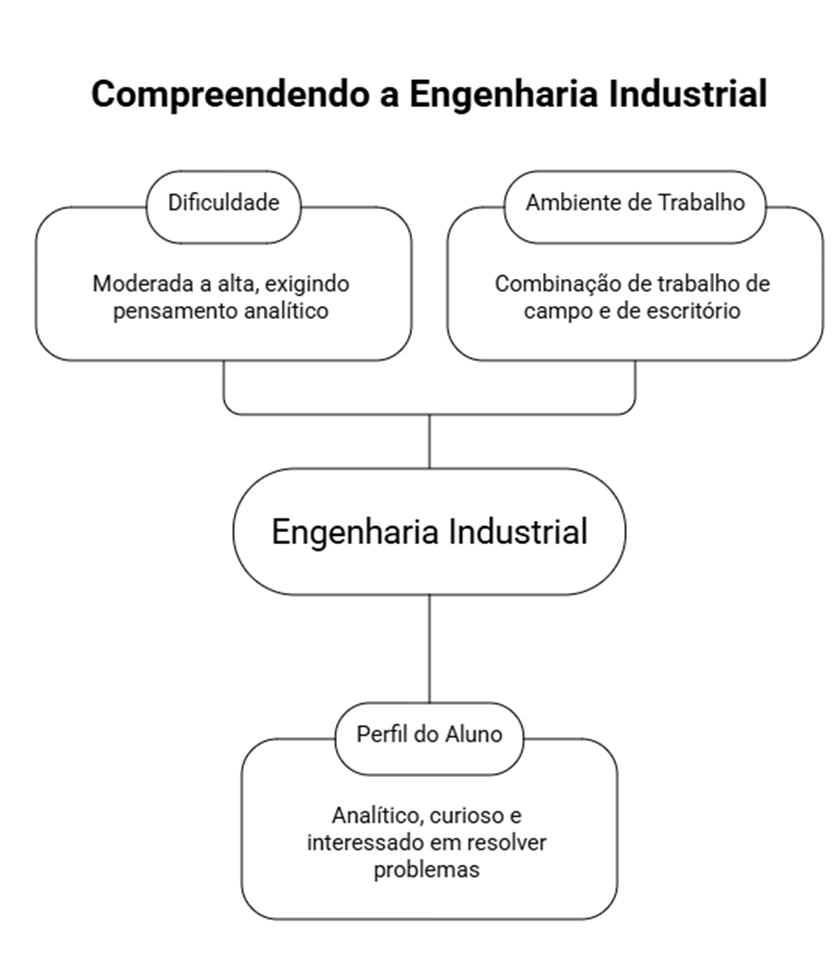
Industrial Engineering is considered moderate to high in difficulty, depending largely on your comfort with mathematics, logic, and analytical thinking.
It is not as physically intensive as some core branches, but it requires strong mental effort and problem-solving ability.
At a beginner level, subjects may seem manageable.
At an advanced level, complexity increases due to real-world problem-solving and decision-making.
Example:
Solving a simple mathematical problem is easy in class, but applying it to optimize a real production system with multiple constraints becomes much more complex.
b. What type of students excel in this field?
Students who perform well in Industrial Engineering usually have:
- Strong analytical and logical thinking
- Interest in problem-solving
- Ability to work with data
- Curiosity to improve systems
At a beginner level, interest is important.
At an expert level, consistency and deep thinking are critical.
Example:
A student who enjoys analyzing why a process is slow and finding ways to improve it will naturally excel in this field.
c. Does it require fieldwork, desk work, or both?
Industrial Engineering involves a combination of both fieldwork and desk work.
- Fieldwork : Observing processes, studying operations
- Desk work : Data analysis, planning, and decision-making
At a beginner level, students mostly study theory.
At an expert level, professionals balance both environments.
Example:
An engineer may visit a factory floor to observe production issues and then return to the office to analyze data and design solutions.
d. What is the typical work-life balance?
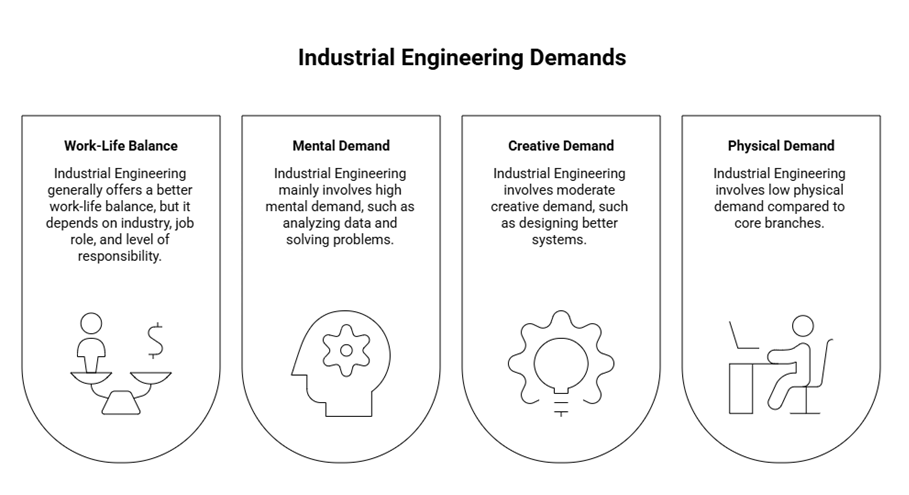
Compared to many core engineering fields, Industrial Engineering generally offers a better work-life balance, especially in roles related to operations and management.
However, the balance depends on:
- Industry
- Job role
- Level of responsibility
At a beginner level, work pressure is moderate.
At an expert level, leadership roles may involve higher responsibility and longer hours.
Example:
An operations manager may need to work extra hours during peak production periods, but overall the work is less physically exhausting.
e. Does it involve high physical, mental, or creative demand?
Industrial Engineering mainly involves:
- High mental demand : analyzing data and solving problems
- Moderate creative demand : designing better systems
- Low physical demand : compared to core branches
At a beginner level, tasks involve learning concepts.
At an expert level, tasks involve making complex decisions under uncertainty.
Example:
Designing a new workflow for a factory requires creative thinking and logical analysis, but not heavy physical labor.