How will AI impact this branch?
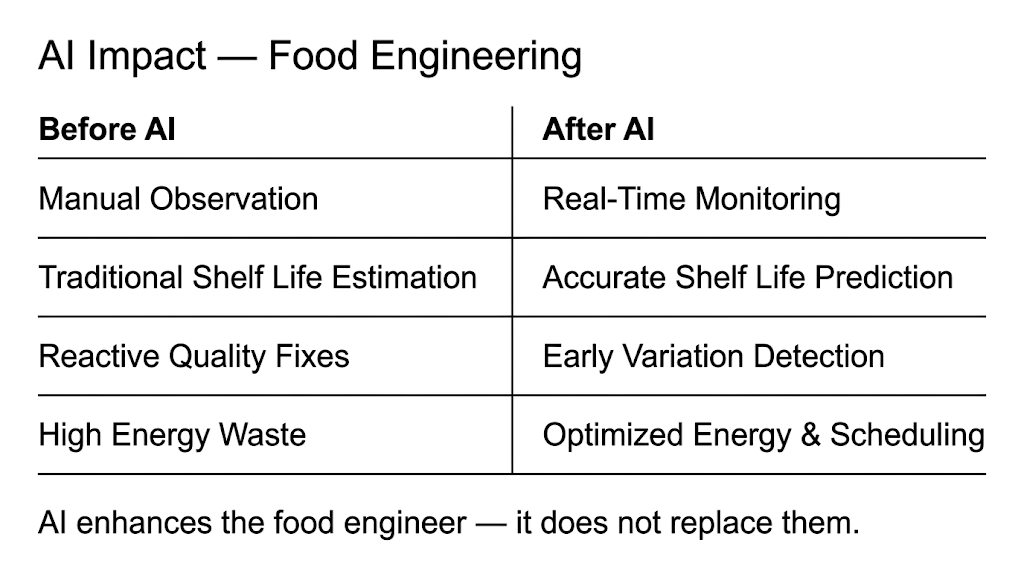
From my perspective, artificial intelligence is beginning to change Food Engineering in ways that are both exciting and transformative because food production is becoming more data-driven than ever before. In the past, many food processing decisions depended heavily on manual observation and operator experience, but now AI can analyze temperature data, moisture levels, microbial risk patterns, and production efficiency in real time. I have seen that AI can help predict shelf life more accurately by studying storage conditions and product composition instead of relying only on traditional estimation methods. It can also improve product consistency by identifying small process variations before they become major quality issues. In large food plants, AI is increasingly being used to optimize energy consumption, reduce waste, and improve production scheduling. From what I have observed, AI is not replacing the importance of Food Engineering itself, but it is changing how food engineers make decisions by giving them smarter tools to monitor and improve processing systems.
What parts of this field are at risk of automation?
From what I have seen, the parts of Food Engineering that are most vulnerable to automation are the repetitive and routine tasks that can be standardized. Activities such as temperature monitoring, filling, sorting, labeling, packaging, and basic quality inspection are increasingly being handled by automated systems and machine vision technologies. In some modern factories, sensors can continuously check moisture content, color uniformity, and contamination risk without constant human involvement. Even production line adjustments that once required an operator can now be managed automatically through digital control systems. However, in my experience, the more complex tasks such as process design, troubleshooting unexpected production issues, product innovation, and food safety decision-making still require human judgment. Automation can replace repetitive execution, but it cannot easily replace the deeper understanding needed when biological materials behave unpredictably. That is why I believe automation changes the role of the engineer more than it eliminates it.
What skills make me future-proof in this domain?
From my experience, the skills that make a Food Engineer future-proof are the ones that combine traditional engineering knowledge with digital understanding. A strong grasp of food processing fundamentals will always remain important because no software can replace a deep understanding of how food behaves during heating, cooling, drying, or storage. At the same time, I have noticed that engineers who can work with data analysis tools such as Python or understand automation systems have a clear advantage. Knowledge of sensor technology, process modeling, and predictive maintenance is becoming increasingly valuable. I also believe that problem-solving ability remains one of the most important future-proof skills because food systems often present unexpected challenges that machines alone cannot interpret correctly. Communication skills are equally important because modern engineers often work with cross-functional teams. In my view, the safest career path belongs to engineers who can understand both food science and emerging technology instead of relying on only one side.
Is this branch evolving towards interdisciplinary roles?
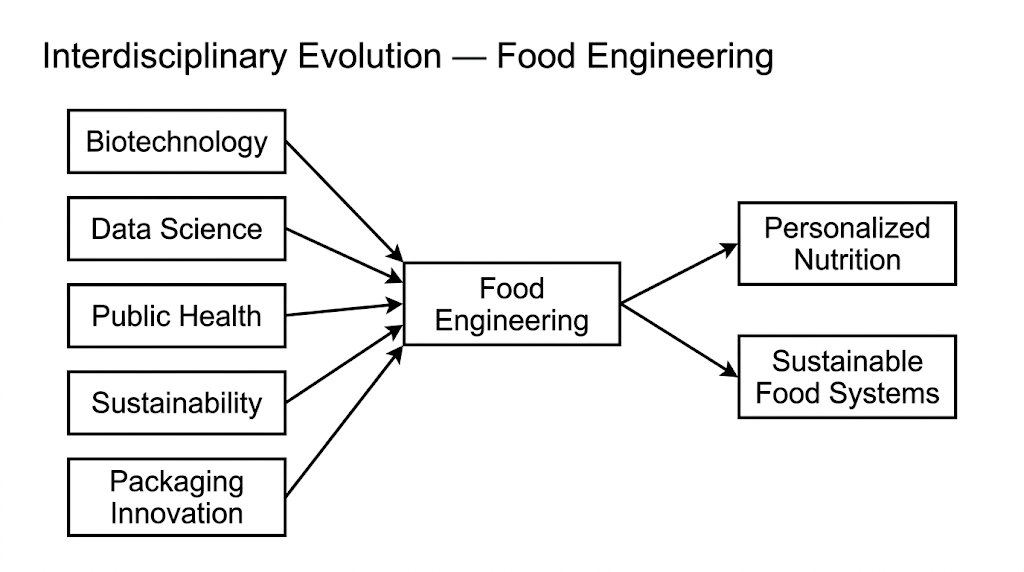
From my perspective, Food Engineering is definitely moving toward more interdisciplinary roles because modern food systems have become too complex for one field alone. In earlier years, a food engineer could focus mainly on processing equipment, but now the field increasingly overlaps with biotechnology, data science, sustainability, packaging innovation, and public health. I have seen food engineers working with microbiologists to improve safety, with software specialists to build smart monitoring systems, and with environmental experts to reduce industrial waste. New product development now often requires collaboration between nutrition experts, process engineers, and digital analysts. The rise of personalized nutrition and sustainable food systems is pushing the field even further into interdisciplinary work. From what I have observed, future food engineers will not simply operate machines; they will work at the intersection of engineering, biology, and digital technology, making the branch much broader and more dynamic than many students realize at first.