
🔹 Why should I choose this branch over others?
Environmental Engineering is not the “easiest” or “fastest money-making” branch—so don’t choose it for the wrong reasons. You should choose it only if you genuinely care about environmental problems and want to solve real-world issues that directly impact human life. This field deals with critical challenges like water scarcity, air pollution, waste management, and climate change, which are becoming more serious every year. For example, designing a wastewater treatment plant that provides clean water to thousands of people is not just a job—it is a social contribution.
Unlike some branches that focus mainly on products or software, environmental engineering focuses on public health and sustainability, which gives your work a deeper purpose. The demand for environmental engineers is increasing due to stricter environmental laws, urbanization, and global sustainability goals. Governments, industries, and international organizations are investing heavily in environmental solutions, ensuring long-term job stability.
However, this branch requires patience and consistency. Results are not always immediate—projects can take years to show impact. You may also need to work on-site, interact with government authorities, or handle environmental compliance issues. If you prefer only desk jobs or quick results, this branch may not suit you.
On the positive side, it offers diverse career options such as consulting, research, policy-making, and industrial roles. It also allows you to work on global problems, giving international exposure. Choosing this branch means choosing a career with purpose, responsibility, and long-term relevance. If your goal is to make a meaningful difference while building a stable career, environmental engineering is a strong choice.
🔹 What are the biggest misconceptions about this field?
One of the biggest misconceptions is that environmental engineering only involves “cleaning garbage” or working in sanitation. In reality, the field is much broader and more advanced. It includes areas like climate change modeling, renewable energy systems, environmental data analytics, and sustainable urban planning. For example, designing a smart city with efficient water reuse systems requires advanced engineering knowledge—not just basic cleaning tasks.
Another common myth is that there are limited job opportunities. This is outdated thinking. With increasing environmental regulations and global sustainability goals, demand for environmental engineers is rising rapidly across industries such as construction, manufacturing, energy, and consulting. Many multinational companies now have dedicated sustainability teams.
Some students also believe that salaries are low in this field. While entry-level salaries may be moderate compared to IT, skilled professionals—especially consultants, specialists, and international experts—can earn very competitive salaries. Growth depends on skills, certifications, and experience rather than just the branch itself.
There is also a misconception that this field is “old” or not technologically advanced. In reality, modern environmental engineering uses tools like AI, GIS, remote sensing, and data analytics. For example, air quality prediction models now use machine learning algorithms.
These misconceptions usually arise due to lack of awareness. Once you understand the real scope, you’ll see that environmental engineering is a modern, evolving, and high-impact field with strong future potential.
🔹 What are the hidden challenges no one talks about?
Environmental engineering has real challenges that are often not discussed openly. One major challenge is that solutions are not always straightforward. You may design a technically perfect system, but implementation can be delayed due to cost, government approvals, or lack of public awareness. For example, a waste management system may fail if people do not follow proper segregation practices.
Another hidden challenge is dealing with regulations and compliance. Environmental engineers often have to work within strict legal frameworks, which can be complex and time-consuming. Preparing environmental impact assessments or audit reports requires accuracy and responsibility, as mistakes can have legal consequences.
Fieldwork can also be demanding. Visiting polluted sites, industrial areas, or waste treatment plants may involve unpleasant conditions. Travel may be required, and sometimes work schedules can be irregular.
Initial salary growth can be slower compared to some high-paying branches, especially in the early stages. However, growth improves significantly with experience and specialization.
Continuous learning is another challenge. Environmental standards, technologies, and policies keep changing, so engineers must constantly update their knowledge. Competition for top roles in consulting or international organizations can also be tough.
Despite these challenges, the field is highly rewarding for those who are committed. Being aware of these realities helps you prepare better and avoid unrealistic expectations.
visual
🔹 If I fail in core roles, what are my backup career paths?
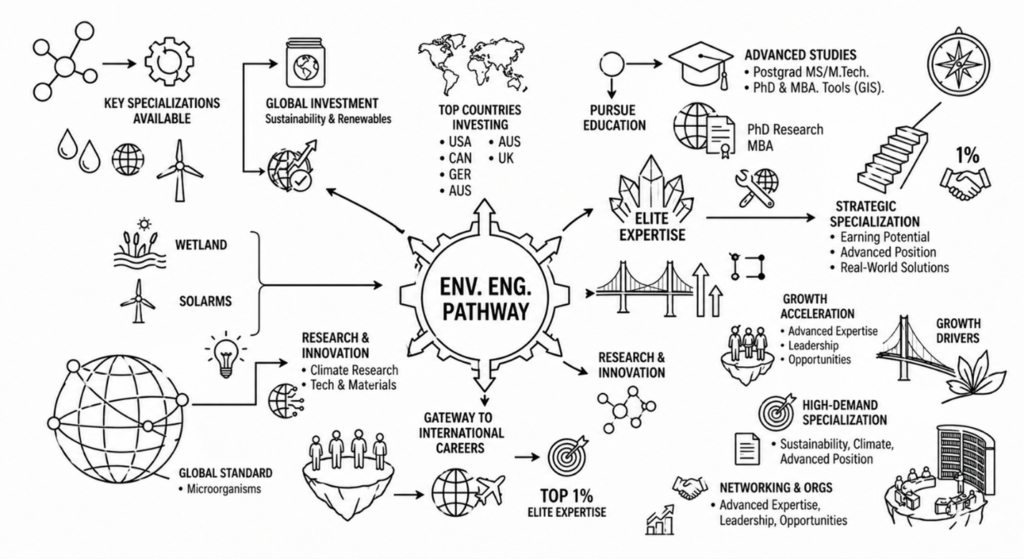
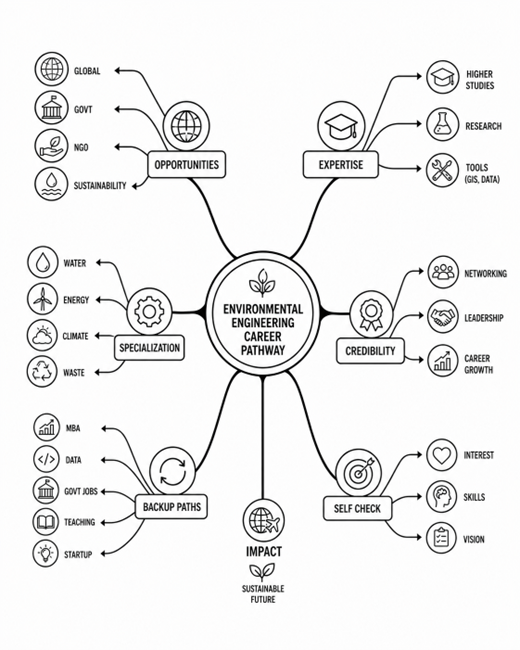
If core environmental engineering roles don’t work out, you are not stuck—this field actually offers a wide range of alternative career paths. One strong option is moving into management by pursuing an MBA. This can lead to roles in project management, operations, or sustainability leadership within companies.
Another growing option is working in data-related fields. With skills in tools like GIS and Python, you can move into environmental data analysis or even broader data science roles. For example, analyzing pollution trends or climate data is highly valuable in both government and private sectors.
Teaching and academics are also good options, especially if you pursue higher studies like M.Tech or PhD. You can become a lecturer or researcher and contribute to knowledge development.
Government jobs provide stable career alternatives through exams for public sector roles, pollution control boards, and environmental agencies. NGOs and international organizations also offer opportunities in social and environmental projects.
You can also work as an independent consultant, advising industries on environmental compliance and sustainability practices. Entrepreneurship is another path—starting a water testing lab, waste management service, or eco-friendly startup.
The key is skill diversification. Learning additional skills like programming, management, or policy-making increases your flexibility. Planning backup options early ensures career security and confidence.
🔹 Is this branch aligned with my interest, aptitude, and long-term vision?
This is the most important question—and it requires honest self-evaluation. Environmental engineering is best suited for students who are genuinely interested in sustainability, environmental protection, and solving real-world problems. If you enjoy subjects like chemistry, biology, and geography, and like understanding how systems work in nature, you will find this field engaging.
Aptitude-wise, you need analytical thinking, problem-solving ability, and attention to detail. For example, designing a water treatment system requires understanding both scientific principles and practical constraints. If you prefer creative problem-solving with real-world impact, this branch fits well.
Your long-term vision also matters. This field often involves working on long-term projects, interacting with multiple stakeholders, and adapting to changing environmental conditions. If you are willing to work in diverse environments—sometimes in offices, sometimes in the field—you will be comfortable here.
However, if your primary interest is coding, finance, or purely desk-based work, you may find this field less satisfying. Choosing environmental engineering just because it “sounds good” without real interest can lead to frustration.
Aligning your career with your interests leads to long-term satisfaction and success. Take time to assess your strengths, preferences, and goals. If you see yourself contributing to a sustainable future and solving environmental challenges, then this branch is not just suitable—it can be highly fulfilling.
Conclusion
Environmental Engineering is not a shortcut career—it’s a purpose-driven profession that demands patience, adaptability, and genuine interest. It sits at the intersection of technology, sustainability, and public health, solving some of the most critical problems of our time—pollution, water scarcity, climate change, and waste management.
This field rewards those who think long-term, are comfortable with complexity, and are willing to work both on-ground and behind the scenes. While it may not always offer instant results or the highest starting salary, it provides something far more valuable: impact, stability, and global relevance.
You’ve now seen the full picture—from fundamentals to career paths, skills, challenges, and future scope. The truth is simple:
If your goal is just money or comfort, there are easier paths.
But if your goal is meaningful work + long-term growth + real-world impact, this branch stands strong.
Environmental Engineering is not just a career choice—it’s a commitment to building a better future.
Call to Action
If you are serious about Environmental Engineering, do not just study it, start building in it.
Begin with small projects like water testing or waste management. Learn at least one tool such as GIS or Python. Apply for internships early, even if they are small. Create a portfolio that shows real work, not just marks. Stay updated with environmental issues around you and think about solutions.
Start now, stay consistent, and focus on skills over shortcuts.
Your goal should not be just getting a job, but becoming someone who can solve real environmental problems.