How difficult is this branch compared to others?
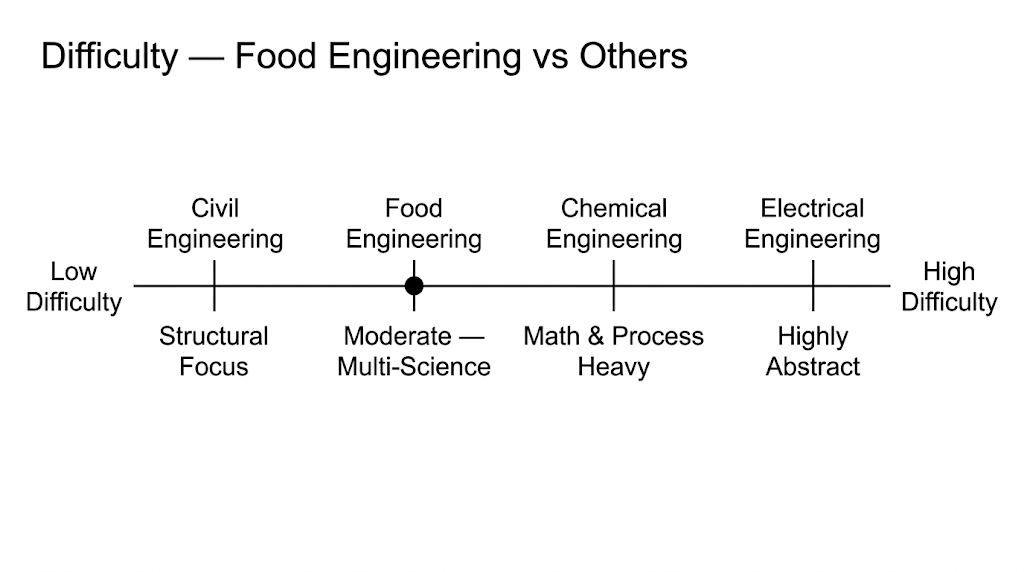
From my experience, Food Engineering is moderately challenging compared to other engineering branches because it requires students to understand both engineering principles and biological systems at the same time. Unlike branches that deal only with mechanical structures or electrical circuits, Food Engineering asks students to think about heat transfer, fluid flow, microbiology, chemistry, and process design together within a single system. I have noticed that some students initially underestimate the branch because the word “food” sounds familiar and approachable, but the academic depth can be significant once subjects such as thermodynamics, mass transfer, and food process calculations begin. What makes the branch unique is that food materials behave unpredictably compared with metals or standard industrial fluids, so students often need patience to understand real process behavior. In my view, it may not feel as mathematically intense as some core engineering disciplines, but it can be intellectually demanding because it combines multiple sciences into one practical field.
What type of students excel in this field?
From what I have observed, the students who excel most in Food Engineering are those who are naturally curious about how science affects daily life and who enjoy connecting theory with practical outcomes. Students who have an interest in biology, chemistry, and engineering together usually adapt well because this branch sits at the intersection of all three. I have seen that students who are detail-oriented often perform better because food safety and quality require careful observation and precision. Those who enjoy solving real-world problems also tend to do well because many challenges in this field involve improving shelf life, reducing waste, or making processing more efficient. In my experience, creativity can also be surprisingly important because developing new food products or better packaging often requires innovative thinking. The students who succeed are usually not just technically strong, but also patient enough to understand that small changes in process conditions can create major differences in final food quality.
Does it require fieldwork, desk work, or both?
From my experience, Food Engineering usually involves a combination of both desk work and field-based industrial work, which is one reason many people find the field balanced. During academic study and research, students spend time analyzing data, studying process design, writing reports, and using software for calculations or plant layouts. However, once they enter industry, they often spend a significant amount of time on the production floor observing equipment, checking hygiene conditions, monitoring processing parameters, and solving operational problems. I have noticed that a food engineer may move between a laboratory, an office, and a manufacturing unit within the same day depending on the role. In research positions, desk work can dominate, while production roles involve more direct plant exposure. From what I have seen, the branch suits people who enjoy both analytical thinking and practical industrial environments rather than staying in only one type of work setting.
What is the typical work-life balance?
From what I have observed, the work-life balance in Food Engineering can vary depending on the sector and job role, but it is often more stable than in some other industrial branches. In quality assurance, research, or regulatory roles, the schedule is often closer to standard working hours, which can provide a healthier routine. In production-based roles, especially in large food manufacturing plants, shift work may be common because food factories often operate continuously. I have seen engineers in plant operations sometimes handle early morning or night shifts during peak production periods, particularly in dairy or frozen food industries. However, compared with highly stressful sectors, many food engineering roles offer a reasonable professional lifestyle once experience is gained. In my experience, work-life balance tends to improve significantly as engineers move from entry-level operational roles into supervisory or specialized technical positions where responsibilities become more strategic rather than constant physical monitoring.
Does it involve high physical, mental, or creative demand?
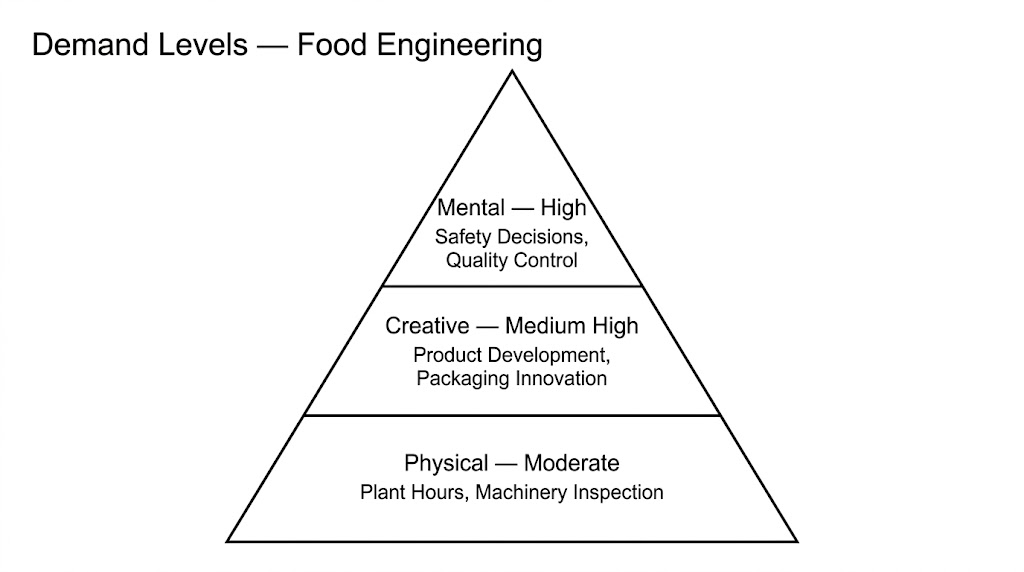
From my perspective, Food Engineering involves a combination of physical, mental, and creative demand, though the balance depends on the specific role. Production and plant roles can involve moderate physical demand because engineers may spend long hours standing, inspecting machinery, or moving through processing areas. Mentally, the field can be demanding because food systems are sensitive, and engineers must make decisions that affect safety, quality, and efficiency at the same time. I have found that creative demand is often underestimated in this branch because innovation is increasingly important in areas such as sustainable packaging, product development, and waste reduction. Some roles emphasize technical problem-solving, while others require imaginative thinking to improve consumer products. In my experience, the branch is best suited for people who can handle technical responsibility while also appreciating that food engineering is not only about machines but also about improving something that directly affects everyday life.