Q1. How will AI impact this branch?
AI will transform agricultural engineering the way the tractor transformed manual farming — it will not eliminate the engineer, but it will make one engineer capable of doing what ten could do before. Here is specifically how:
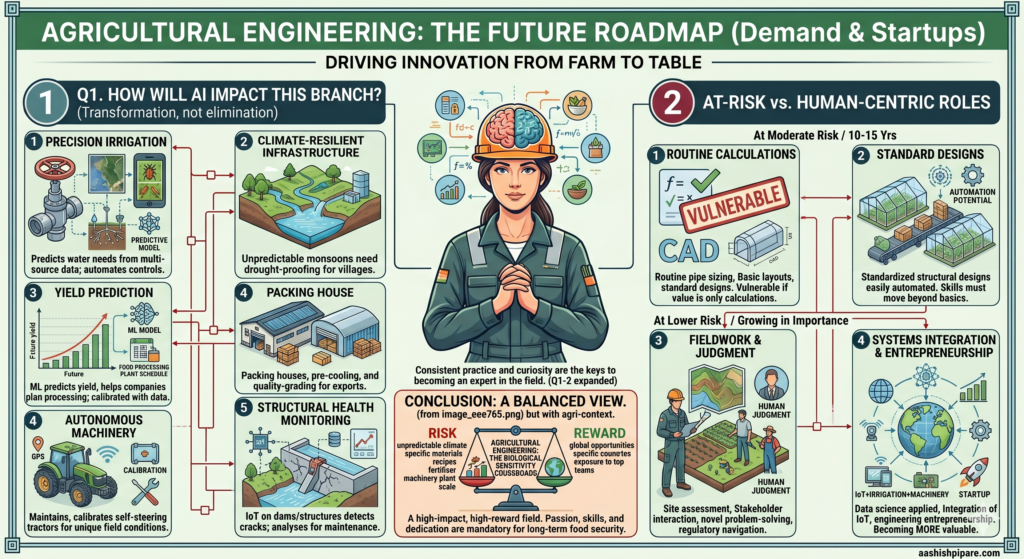
- Precision Irrigation: AI models can predict crop water requirement from satellite imagery, weather forecasts, and soil sensor data — and automate irrigation valve control. Agricultural engineers design and validate these systems.
- Disease & Pest Detection: Computer vision models (already deployed by companies like Intello Labs) detect crop diseases from smartphone images. Agricultural engineers integrate these tools into field advisory systems.
- Yield Prediction & Harvest Planning: Machine learning models predict yield weeks before harvest, helping food companies plan processing plant schedules. Agricultural engineers calibrate these models with field data.
- Autonomous Machinery: Self-steering tractors (already available from John Deere and Kubota) use GPS and computer vision. Agricultural engineers maintain, calibrate, and adapt them for Indian field conditions.
- Structural Health Monitoring: IoT sensors on check-dams and irrigation structures detect cracks, settlement, and seepage. Agricultural engineers analyse this data for maintenance planning.
Q2. What parts of this field are at risk of automation?
I want to give you an honest answer here, not a reassuring one:
- At Moderate Risk (10–15 years): Routine design calculations that follow standard procedures — pipe sizing, basic irrigation layouts, standard structural designs — can be automated by AI-assisted design software. If your value as an engineer is only doing these calculations, you are vulnerable.
- At Lower Risk: Fieldwork, site assessment, stakeholder interaction with farmers, complex problem-solving in novel situations, regulatory navigation, and interdisciplinary project management cannot be automated easily. These require human judgment.
- Growing in Importance: Data science skills applied to agricultural data, system integration of IoT + irrigation + machinery, and engineering entrepreneurship are becoming more valuable, not less.
Q3. What skills make me future-proof in this domain?
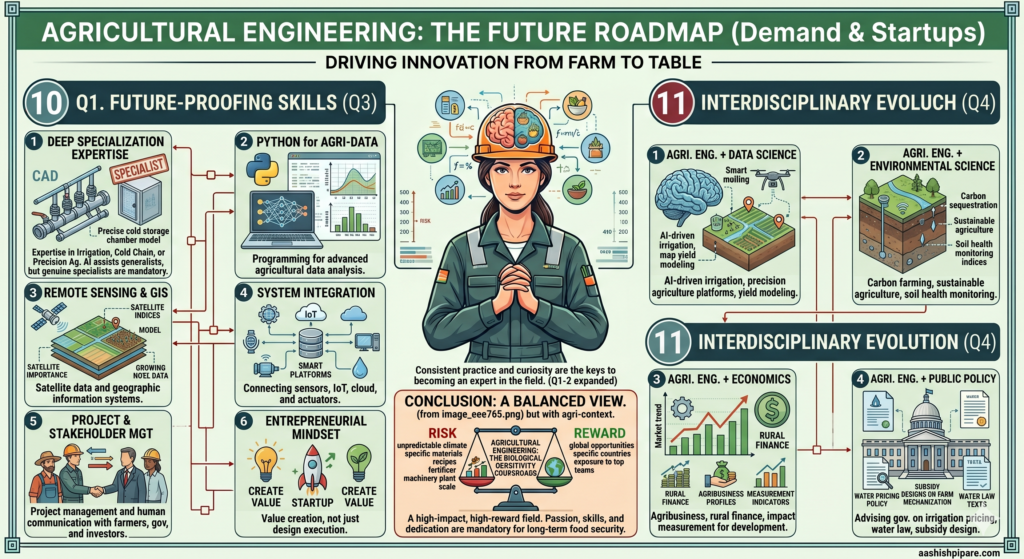
- Deep expertise in one area (irrigation design, or cold chain, or precision agriculture) — AI assists generalists but cannot replace genuine specialists
- Python programming for agricultural data analysis
- Remote sensing and GIS — satellite data will only grow in importance
- System integration skills — connecting sensors, IoT devices, cloud platforms, and actuators
- Project management and stakeholder communication — farmers, government officials, and investors are human
- Entrepreneurial mindset — creating value, not just executing designs
Q4. Is this branch evolving towards interdisciplinary roles?
Yes, strongly and rapidly. The most exciting and high-impact work in agricultural engineering today sits at the intersection of:
- Agricultural Engineering + Data Science: Precision agriculture platforms, AI-driven irrigation, yield modelling
- Agricultural Engineering + Environmental Science: Carbon farming, sustainable agriculture, soil health monitoring
- Agricultural Engineering + Economics: Agri-business, rural finance, impact measurement for development projects
- Agricultural Engineering + Public Policy: Advising governments on irrigation pricing, water law, subsidy design for farm mechanisation
The engineer who can speak the language of both the farmer and the data scientist is going to be extraordinarily valuable for the next two decades.