
a. What does “outputs” mean in Mechatronics?
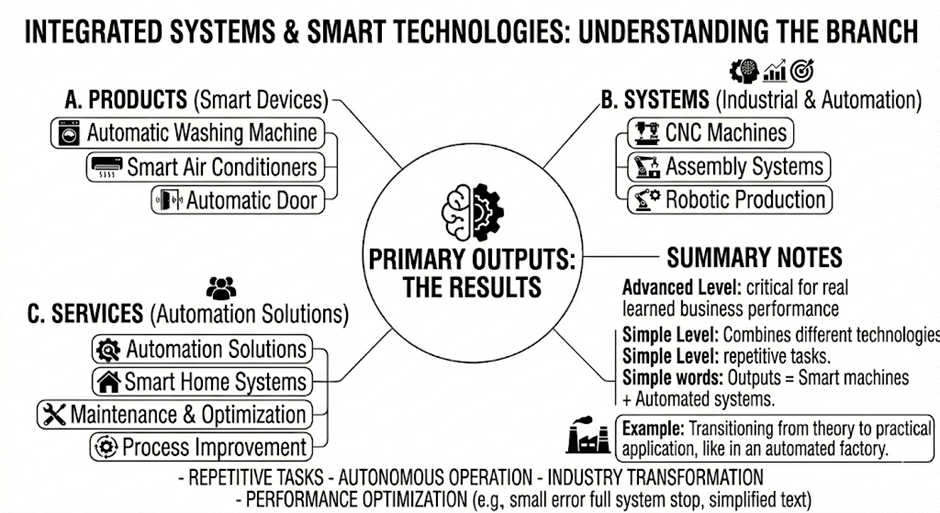
In Mechatronics Engineering, “outputs” refer to the final results or creations that engineers design and develop.
These outputs are usually:
- Products : Physical devices you can use
- Systems : Integrated setups performing tasks automatically
- Services : Solutions that improve efficiency in industries
In simple words:
Mechatronics outputs = Smart machines + Automated systems
b. What are the main types of outputs?
Mechatronics Engineering mainly produces three types of outputs:
🔹 A. Products (Smart Devices)
These are physical devices used in daily life that work automatically using sensors, electronics, and software.
Examples include:
- Automatic washing machines
- Smart air conditioners
- Automatic doors
- Vending machines
At a beginner level, these look like simple machines.
At an expert level, they are complex systems with real-time decision-making.
Example:
An automatic washing machine:
- Detects water level (sensor)
- Decides wash cycle (software)
- Controls motor (mechanical system)
This is a complete mechatronic product.
A. Systems (Industrial & Automation Systems)
These are large-scale integrated systems used in industries to automate processes.
Examples include:
- CNC machines (computer-controlled manufacturing)
- Assembly line automation systems
- Robotic production systems
- Packaging and sorting systems
At a beginner level, systems perform repetitive tasks.
At an expert level, they become highly optimized, intelligent production systems.
Example:
In a factory:
- Sensors detect product position
- Controllers decide next step
- Machines perform operations automatically
This entire setup is a mechatronic system.
B. Services (Automation Solutions)
Mechatronics also provides services that improve efficiency, productivity, and safety.
These include:
- Automation solutions for industries
- Smart home systems
- Maintenance and optimization services
- Process improvement solutions
At a beginner level, services may not be visible.
At an expert level, they are critical for business performance.
Example:
An engineer designs a system that reduces production time by automating manual tasks.
This is a service-based output.
c. What makes these outputs unique?
Mechatronics outputs are unique because they combine:
Sensors (input) + Controller (brain) + Actuators (action)
This allows systems to:
- Sense the environment
- Process information
- Take automatic action
Example:
An automatic door:
- Sensor detects a person
- Controller processes signal
- Motor opens the door
d. How do outputs evolve from beginner to expert level?
- Beginner level: Simple automated devices
- Intermediate level: Integrated systems with control
- Expert level: Intelligent, optimized, and adaptive systems
Example:
Basic machine → Automated system → Smart AI-driven system

Conclusion :
Mechatronics Engineering outputs are smart products, automated systems, and efficiency-driven services that combine sensing, decision-making, and action. As you progress, these outputs evolve from simple devices to complex, intelligent systems. This makes mechatronics a key field for building modern automated technologies.
CTA (Call To Action):
- Start observing everyday smart devices and understand how sensors, controllers, and actuators work together.
- Try building small automation systems to gain practical understanding of mechatronics outputs.