
🔹 What are some beginner-level projects in this branch?
Beginner-level projects in Robotics Engineering play a crucial role in helping students understand the fundamental concepts of how robots function. These projects are designed to introduce learners to essential components such as sensors, motors, and microcontrollers, while also building basic programming skills. At this stage, the focus is not on complexity but on understanding how different parts of a robotic system interact with each other. By working on simple projects, students gain hands-on experience and develop confidence in building and experimenting with robotic systems.
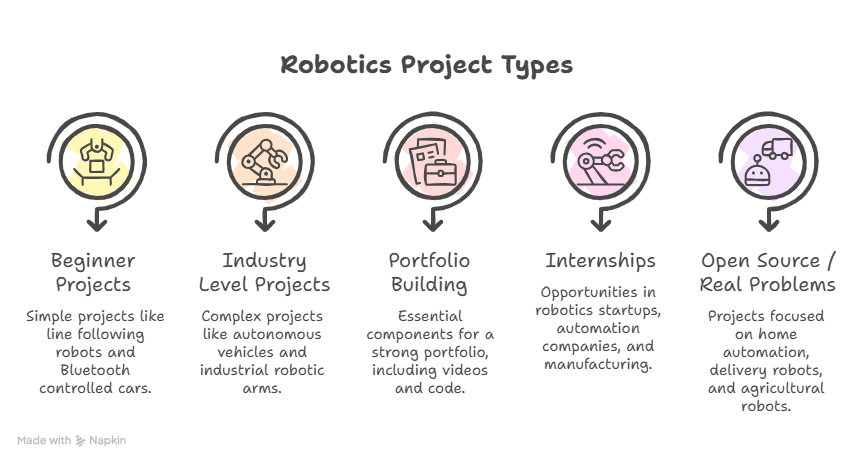
Common beginner projects include line-following robots, obstacle-avoiding robots, Bluetooth-controlled cars, and basic robotic arms. Each of these projects teaches a specific concept. For example, a line-following robot helps students understand sensor-based navigation, while a Bluetooth-controlled car introduces wireless communication and control. These projects are relatively simple but provide a strong foundation for more advanced learning.
At a beginner level, the goal is to understand how components work together in a system. As students progress, these basic concepts are expanded into more complex and intelligent systems. For instance, an obstacle-avoiding robot uses sensors to detect obstacles, a microcontroller to process signals, and motors to change direction. This demonstrates the complete cycle of sensing, decision-making, and action, which is the core principle of robotics.
Subpoints:
- Line-following robot
- Obstacle-avoiding robot
- Bluetooth-controlled car
- Basic robotic arm
- Understanding sensors, motors, and microcontrollers
- Learning sensing → decision → action workflow
🔹 What are industry-level projects I should aim for?
Industry-level projects in Robotics Engineering involve the development of complex systems that integrate automation, intelligence, and real-world problem-solving capabilities. These projects go beyond basic functionality and require a deep understanding of multiple domains, including programming, electronics, control systems, and artificial intelligence. They are designed to replicate or solve real-world industrial challenges, making them highly valuable for career development.
Examples of industry-level projects include autonomous vehicles, industrial robotic arms, drone navigation systems, AI-based robots, and warehouse automation systems. These projects often involve advanced technologies such as computer vision, machine learning, and real-time data processing. For instance, autonomous vehicles must be able to detect obstacles, interpret traffic conditions, and make decisions in real time, which requires a high level of integration and precision.
At a beginner level, students may start by simulating these systems using software tools. However, at an expert level, the goal is to build fully functional prototypes that can operate in real environments. For example, a warehouse robot that automatically picks and places items using sensors and AI represents an industry-level project. Such projects demonstrate advanced technical skills and the ability to solve practical problems, making them highly valuable for professional growth.
Subpoints:
- Autonomous vehicles (self-driving systems)
- Industrial robotic arms
- Drone navigation systems
- AI-based robots (object detection, facial recognition)
- Warehouse automation robots
- Real-world system integration and automation
🔹 How can I build a portfolio in this domain?
Building a strong portfolio in Robotics Engineering is essential for showcasing your skills and attracting opportunities in internships or jobs. A well-structured portfolio demonstrates both your technical knowledge and your ability to apply that knowledge in real-world projects. It should highlight your experience in both hardware and software aspects of robotics, as employers look for candidates who can design, build, and program complete systems.
A good portfolio should include videos of working robots, code repositories hosted on platforms like GitHub, CAD design files, and detailed project reports explaining the problem and the solution. These elements provide a complete picture of your work and make it easier for others to evaluate your capabilities. At a beginner level, small working projects are sufficient, but they should be clearly documented and functional.
At an advanced level, your portfolio should include innovative projects that solve real-world problems or demonstrate advanced technologies such as AI or automation. For example, building a smart robot that detects objects using a camera and sharing its code and demonstration video shows both practical and technical skills. A strong portfolio not only reflects your knowledge but also your creativity, problem-solving ability, and commitment to learning.
Subpoints:
- Videos of working robots
- Code repositories (GitHub)
- CAD design files
- Detailed project reports
- Demonstration of real-world applications
- Innovation and problem-solving focus
🔹 What kind of internships should I target?
Internships are a vital part of learning in Robotics Engineering, as they provide exposure to real-world applications and industry practices. They allow students to work on actual projects, gain practical experience, and understand how robotics is used in professional environments. Choosing the right type of internship can significantly impact your learning and career growth.
Students should target internships in robotics startups, automation companies, manufacturing industries that use robots, and AI or technology companies. These organizations often work on cutting-edge technologies and provide opportunities to learn about system design, development, and testing. At a beginner level, any internship that offers exposure to robotics is beneficial, even if the role is basic or supportive.
At an advanced level, internships should involve hands-on development, problem-solving, and working with real systems. For example, during an internship, you may be involved in improving the accuracy of a robot, testing automation systems, or developing new features. These experiences not only enhance technical skills but also improve teamwork, communication, and industry understanding, which are essential for a successful career in robotics.
Subpoints:
- Robotics startups
- Automation companies
- Manufacturing industries using robots
- AI and tech companies
- Hands-on development experience
- Real-world problem-solving exposure
🔹 Are there open-source or real-world problems I can work on?
Robotics Engineering offers numerous opportunities to work on open-source projects and real-world problems that have a meaningful impact on society. These projects allow students to apply their knowledge to solve practical challenges and contribute to innovation. Working on such problems not only enhances technical skills but also helps in understanding how robotics can improve everyday life.
Examples of real-world problems include home automation systems, delivery robots, agricultural robots, smart surveillance systems, and assistive robots for elderly or disabled individuals. These applications address real needs and have significant potential for growth and development. At a beginner level, students can start by building simple prototypes that demonstrate the basic functionality of these systems.
At an advanced level, these projects can be developed into full-scale solutions, startups, or research initiatives. For example, designing a smart irrigation system that automatically waters plants based on sensor data solves a real agricultural problem and demonstrates practical innovation. Working on such projects not only strengthens your portfolio but also prepares you to tackle real-world challenges and contribute to technological advancements.
Subpoints:
- Home automation systems
- Delivery robots
- Agricultural robots
- Smart surveillance systems
- Assistive robots (elderly/disabled support)
- Real-world problem-solving and innovation
🔹Conclusion
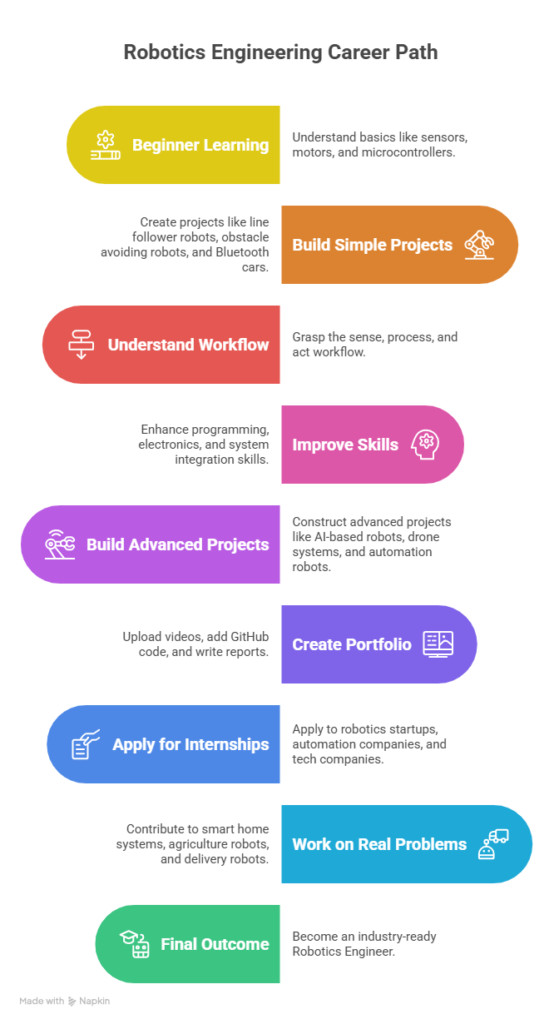
Project-based learning is one of the most effective ways to master Robotics Engineering, as it bridges the gap between theoretical knowledge and practical application. Starting with beginner-level projects helps students understand the basic components and workflows of robotic systems, such as sensing, decision-making, and action. These foundational projects build confidence and provide the skills needed to progress to more complex challenges.
As students advance, industry-level projects play a crucial role in developing deeper technical expertise and real-world problem-solving abilities. These projects require integration of multiple technologies and simulate real industrial applications, making them highly valuable for career development. Working on such projects helps students understand the demands of the industry and prepares them for professional roles.
Building a strong portfolio and gaining internship experience further enhances learning by showcasing skills and providing exposure to real-world environments. A well-documented portfolio demonstrates technical ability, creativity, and innovation, while internships offer practical insights into how robotics is applied in industry. Together, these elements significantly improve career opportunities.
Finally, working on open-source and real-world problems allows students to apply their knowledge to meaningful challenges and contribute to society. These projects encourage innovation and can even lead to startup ideas or research opportunities. Overall, project-based learning is essential for becoming a skilled robotics engineer, as it combines knowledge, creativity, and practical experience into a powerful learning approach.