
🔹 a. What are the core job roles in this branch?
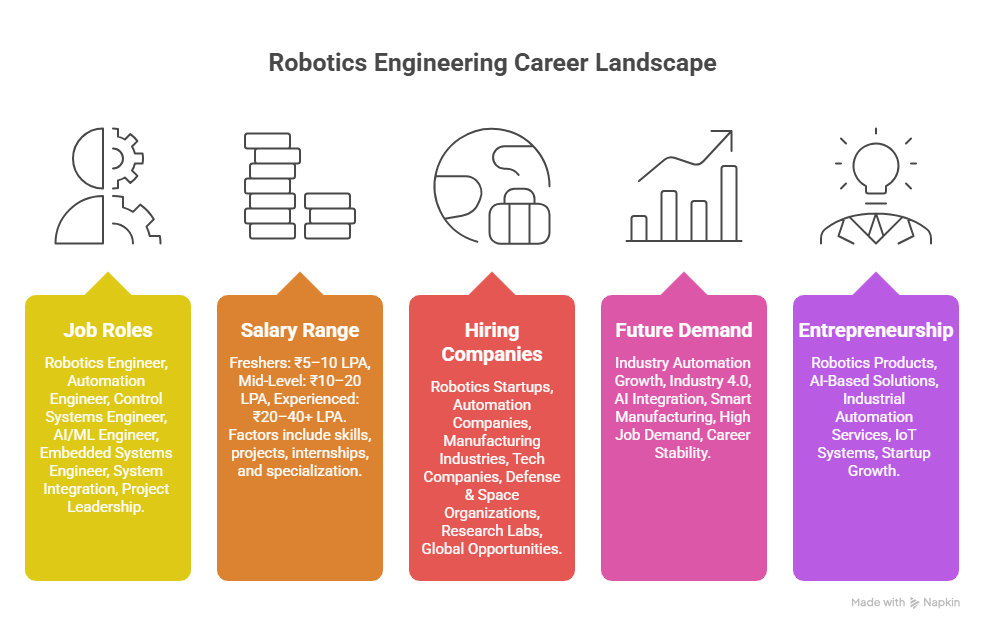
Robotics Engineering offers a wide range of career opportunities because it integrates mechanical systems, electronics, and software into a single domain. This multidisciplinary nature allows professionals to specialize in different aspects of robotics based on their interests and strengths. One of the primary roles is that of a Robotics Engineer, who is responsible for designing, developing, and testing robotic systems for various applications such as manufacturing, healthcare, and automation. This role requires a deep understanding of both hardware and software, as well as the ability to integrate different components into a functional system.
Another important role is that of an Automation Engineer, who focuses on implementing robotic systems in industrial environments to improve efficiency and reduce manual labor. Control Systems Engineers play a critical role in ensuring that robots operate with stability and precision by designing feedback mechanisms and control algorithms. Additionally, AI/ML Engineers in robotics work on developing intelligent systems that can learn from data and make decisions, enabling robots to perform complex tasks autonomously.
Embedded Systems Engineers are also essential in robotics, as they are responsible for programming and managing hardware components such as microcontrollers and sensors. At a beginner level, professionals often start by assisting in development, testing systems, or working on smaller components of larger projects. At an expert level, they take on leadership roles, designing complete robotic systems and managing complex projects. For example, a Robotics Engineer may design a robot that can accurately pick and place objects in a factory, improving efficiency and reducing errors.
Subpoints:
- Robotics Engineer (design and development of robots)
- Automation Engineer (industrial automation systems)
- Control Systems Engineer (stability and precision)
- AI/ML Engineer in Robotics (intelligent systems)
- Embedded Systems Engineer (hardware programming)
- System integration and project leadership roles
🔹 What is the average starting salary?
Salaries in Robotics Engineering vary significantly depending on factors such as skill level, project experience, company, and location. In India, freshers in this field typically earn between ₹5–10 LPA, although this range can vary based on the candidate’s expertise and the organization they join. Those with strong project portfolios, internships, and programming skills often secure higher salaries compared to average candidates, as companies value practical experience and problem-solving abilities.
As professionals gain experience, their salaries increase substantially. Mid-level engineers with 3–5 years of experience can earn between ₹10–20 LPA, depending on their specialization and the complexity of the projects they handle. At this stage, engineers are expected to take on more responsibility, contribute to system design, and work independently on tasks. The demand for skilled robotics professionals in industries such as automation, AI, and manufacturing further drives salary growth.
Experienced professionals and experts in robotics can earn ₹20–40+ LPA or even higher, especially if they specialize in advanced areas such as artificial intelligence, autonomous systems, or industrial automation. At a beginner level, salary variations are common due to differences in skill sets and opportunities. However, at an expert level, salaries increase significantly due to the high demand for specialized knowledge and the ability to lead complex projects. For example, a fresher with strong robotics projects and coding expertise can secure a higher package than someone with only theoretical knowledge.
Subpoints:
- Freshers: ₹5–10 LPA
- Mid-level (3–5 years): ₹10–20 LPA
- Experienced professionals: ₹20–40+ LPA
- Higher salaries for specialized skills (AI, automation)
- Impact of projects and internships on salary
- Growth with experience and expertise
🔹 Which companies hire heavily in this field?
Robotics Engineers are in demand across a wide range of industries, particularly those focused on automation, artificial intelligence, and advanced technologies. Companies that invest heavily in robotics include startups, manufacturing firms, technology companies, defense organizations, and research institutions. Robotics startups are often at the forefront of innovation, working on cutting-edge solutions such as delivery robots, drones, and autonomous systems, making them attractive options for engineers seeking dynamic environments.
Automation and manufacturing companies are among the largest employers of robotics engineers, as they rely on robotic systems to improve efficiency, reduce costs, and maintain consistent quality. Tech companies, especially those working in AI and software-driven robotics, also offer numerous opportunities, focusing on intelligent systems, computer vision, and machine learning applications. Defense and space organizations utilize robotics for surveillance, exploration, and mission-critical operations, providing highly specialized career paths.
Research institutions and universities also hire robotics engineers for research and development purposes, contributing to advancements in the field. At a beginner level, hiring is often internship-based or project-driven, allowing students to gain initial exposure. At an expert level, opportunities expand globally, with professionals working on large-scale and high-impact projects. For example, companies developing warehouse automation systems or self-driving technologies actively seek skilled robotics engineers.
Subpoints:
- Robotics startups
- Automation and manufacturing companies
- Tech companies (AI and robotics)
- Defense and space organizations
- Research institutions and labs
- Global opportunities for experienced professionals
🔹 What is the future demand (2025–2040)?
The future demand for Robotics Engineering is expected to grow significantly between 2025 and 2040, driven by advancements in automation, artificial intelligence, and smart technologies. As industries continue to adopt automation to improve efficiency and reduce costs, the need for skilled robotics engineers will increase. Robotics is becoming a key component of modern industrial systems, particularly with the rise of Industry 4.0, which emphasizes smart manufacturing and interconnected systems.
One of the major drivers of demand is the integration of AI with robotics, enabling machines to perform complex tasks with minimal human intervention. This includes applications such as autonomous vehicles, smart warehouses, healthcare robotics, and agricultural automation. The demand for precision, efficiency, and safety in various industries further accelerates the adoption of robotic systems, creating more job opportunities for engineers in this field.
At a beginner level, the demand for robotics professionals is steadily increasing, with more entry-level opportunities becoming available. At an expert level, robotics is considered one of the most future-proof careers due to its wide range of applications and continuous technological advancements. For example, as industries automate repetitive and hazardous tasks, the demand for engineers who can design, maintain, and improve these systems will continue to rise, ensuring long-term career stability.
Subpoints:
- Growth of industry automation
- Rise of Industry 4.0 and smart manufacturing
- AI and robotics integration
- Increasing demand for precision and efficiency
- Expanding applications across industries
- High future job security and growth
🔹 Can this branch lead to entrepreneurship or startups?
Robotics Engineering provides strong opportunities for entrepreneurship, as it is a field driven by innovation and technological advancement. With the growing demand for automation and intelligent systems, there is significant potential for developing new products and services that solve real-world problems. Entrepreneurs in robotics can explore various domains, including home automation, industrial automation, drones, and AI-based solutions.
Startup opportunities in robotics are diverse and continuously expanding. For example, companies can develop robotic products such as delivery robots, smart home devices, or agricultural automation systems. AI-based robotic solutions can be used for applications such as object recognition, surveillance, and data analysis. Industrial automation services also offer opportunities to help businesses optimize their operations using robotic systems.
At a beginner level, students can start by building small prototypes and experimenting with innovative ideas. As they gain experience and expertise, these ideas can be developed into full-scale startups or commercial products. For example, a robotics startup can create delivery robots for e-commerce companies, reducing delivery time and operational costs. This demonstrates how robotics not only offers career opportunities but also enables individuals to become innovators and entrepreneurs.
Subpoints:
- Robotics products (home automation, drones)
- AI-based robotic solutions
- Industrial automation services
- Smart devices and IoT systems
- Prototype development to startup scaling
- Innovation-driven entrepreneurship
🔹Conclusion
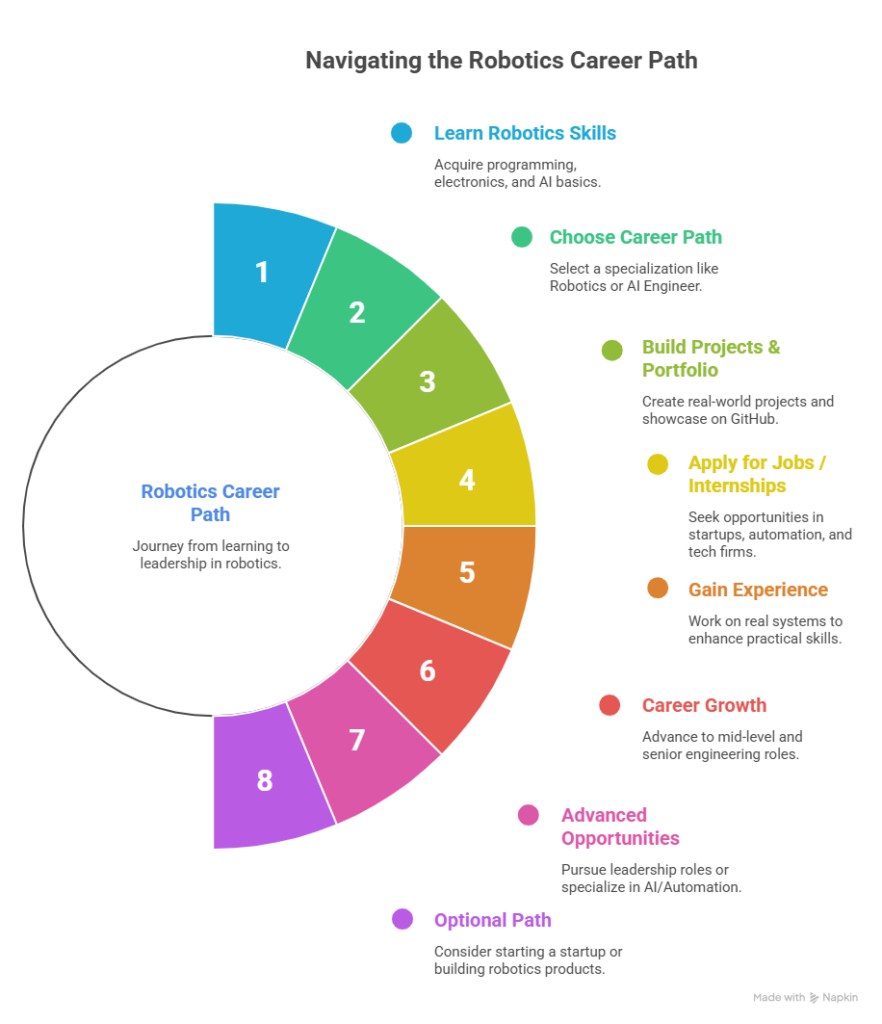
The career landscape in Robotics Engineering is diverse, dynamic, and full of opportunities, making it an attractive field for students and professionals alike. With roles ranging from robotics engineers to AI specialists and embedded system developers, individuals can choose career paths based on their interests and strengths. This flexibility, combined with the interdisciplinary nature of robotics, allows for continuous growth and specialization in various domains.
Salaries in robotics reflect the demand for skilled professionals, with strong growth potential as individuals gain experience and expertise. The presence of numerous hiring companies, including startups, manufacturing firms, and global tech organizations, ensures a wide range of opportunities for both beginners and experienced professionals. As industries continue to adopt automation and intelligent systems, the need for robotics engineers will only increase.
The future of robotics is highly promising, with significant demand expected in the coming decades due to advancements in AI, automation, and smart technologies. This makes robotics one of the most future-proof career options, offering stability and long-term growth. Engineers in this field will play a crucial role in shaping the future of industries and technology.
Finally, robotics also opens doors to entrepreneurship, allowing individuals to innovate and create solutions that address real-world challenges. From developing robotic products to launching automation services, the possibilities are vast. Overall, Robotics Engineering not only offers strong career prospects but also provides a platform for innovation, creativity, and technological advancement.