

🔹 What are the current industry trends?
The robotics industry is evolving at an extremely rapid pace, driven by advancements in artificial intelligence, automation, and smart technologies. One of the most significant trends is the development of AI-powered robots that can learn from data, adapt to changing environments, and make intelligent decisions. Unlike traditional robots that follow fixed instructions, modern robots are becoming capable of handling complex tasks with minimal human intervention. This shift is transforming robotics from simple automation tools into intelligent systems that can operate in dynamic environments.
Another important trend is the rise of collaborative robots (cobots), which are designed to work safely alongside humans. These robots are widely used in industries where human-robot interaction is necessary, such as manufacturing and healthcare. Additionally, autonomous systems like self-driving vehicles and drones are gaining popularity, as they can operate independently without human control. The concept of Industry 4.0 is also playing a major role, where factories are becoming smarter through interconnected machines, real-time data analysis, and automation.
Robotics is also expanding into service sectors such as healthcare, delivery, and cleaning, making it more visible in everyday life. At a beginner level, robots are typically seen performing fixed and repetitive tasks. However, at an expert level, robots are becoming intelligent, adaptive, and self-learning systems capable of handling complex real-world challenges. For example, in modern factories, robots equipped with cameras and AI can detect defects in products automatically, improving quality and efficiency without human intervention.
Subpoints:
- AI-powered robots (learning and adaptability)
- Collaborative robots (cobots) working with humans
- Autonomous systems (self-driving vehicles, drones)
- Industry 4.0 and smart factories
- Expansion into service sectors (healthcare, delivery, cleaning)
- Shift from fixed automation to intelligent systems
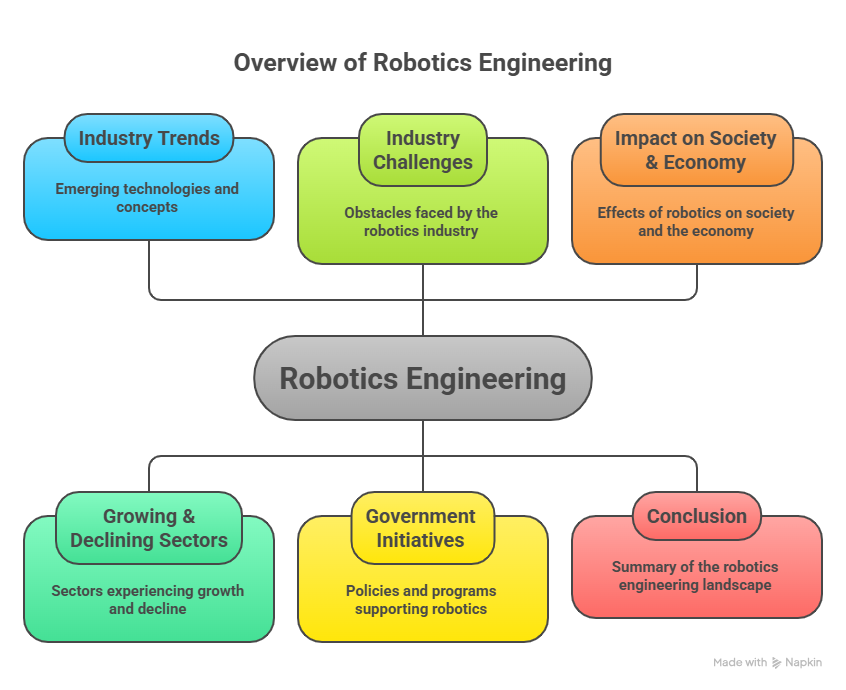
🔹 Which sectors are growing or declining?
Understanding which sectors are growing or declining in robotics is essential for making informed career decisions. Several industries are experiencing rapid growth due to the increasing demand for automation and efficiency. Manufacturing automation continues to be one of the largest sectors, as companies aim to improve productivity and reduce costs. Healthcare robotics is also expanding, with applications in surgery, rehabilitation, and patient care. Similarly, logistics and warehouse automation is growing due to the rise of e-commerce, where robots are used for sorting, transporting, and managing goods.
Other growing sectors include agriculture technology, where robots are used for tasks such as harvesting and irrigation, and defense and surveillance, where robotic systems are used for monitoring and security purposes. These sectors are benefiting from advancements in AI and robotics, leading to increased demand for skilled professionals. At a beginner level, robotics may appear to be limited to factory applications, but at an expert level, it is clear that robotics is expanding into almost every industry.
On the other hand, some sectors are declining or undergoing transformation due to automation. Manual labor-intensive industries and repetitive, low-skill jobs are being gradually replaced by robotic systems. This does not eliminate jobs entirely but shifts the focus toward more skilled roles that involve managing, designing, and maintaining these systems. For example, warehouse robots are increasingly used to sort and transport goods, reducing the need for manual labor while increasing efficiency.
Subpoints:
- Growing sectors:
- Manufacturing automation
- Healthcare robotics
- Logistics and warehouse automation
- Agriculture technology
- Defense and surveillance
- Declining/transforming sectors:
- Manual labor-intensive industries
- Repetitive, low-skill jobs
- Expansion of robotics across industries
🔹 What are the major challenges faced in this field?
Despite its rapid growth, Robotics Engineering faces several significant challenges that must be addressed for wider adoption and effectiveness. One of the primary challenges is the high cost of development and implementation, which can make robotics solutions inaccessible for smaller organizations. Building advanced robotic systems requires significant investment in hardware, software, and research, which can limit their use in certain industries.
Another major challenge is complex system integration, as robotics involves combining multiple components such as sensors, actuators, control systems, and software into a single functioning unit. Ensuring that all these components work together seamlessly is a difficult task. Additionally, reliability and safety concerns are critical, especially in applications where robots interact with humans or operate in hazardous environments. Any failure in the system can lead to serious consequences.
Handling unpredictable environments is another challenge, as robots often struggle to adapt to situations that were not anticipated during design. This is particularly relevant in real-world applications where conditions can vary significantly. At a beginner level, robotic systems are usually simple and operate in controlled environments. However, at an expert level, systems must perform reliably in complex and dynamic conditions. For example, a robot that works perfectly in a lab may fail in a real-world environment due to unexpected obstacles or changes in conditions.
Subpoints:
- High development and implementation costs
- Complex system integration
- Reliability and safety concerns
- Difficulty in handling unpredictable environments
- Continuous updates and maintenance requirements
- Real-world performance challenges
🔹 Are there government initiatives supporting this branch?
Yes, governments around the world are actively supporting the growth of robotics and automation through various initiatives and policies. In India, programs such as Make in India aim to boost manufacturing by encouraging the adoption of automation and advanced technologies, including robotics. These initiatives create opportunities for engineers by increasing demand for automated systems in industries.
Governments are also investing in defense and space robotics programs, where robotic systems are used for surveillance, exploration, and mission-critical operations. Additionally, smart city initiatives and digital transformation programs are driving the use of robotics in areas such as infrastructure management, transportation, and public services. Funding for AI and robotics research is another key area, supporting innovation and development in advanced technologies.
At a beginner level, being aware of these initiatives helps students understand the opportunities available in the field. At an expert level, professionals can align their work with these initiatives to take advantage of funding, research opportunities, and industry demand. For example, government investments in defense robotics increase the need for engineers specializing in surveillance systems and unmanned technologies, creating new career opportunities.
Subpoints:
- Make in India (manufacturing automation)
- Defense and space robotics programs
- Smart city and digital initiatives
- Funding for AI and robotics research
- Policy support for automation and innovation
- Increased job opportunities through government projects
🔹 How does this field contribute to society and the economy?
Robotics Engineering has a profound impact on both society and the economy by improving efficiency, safety, and innovation across multiple industries. One of its key contributions is increasing productivity, as robots can perform tasks faster and more accurately than humans, especially in repetitive or high-precision operations. This leads to improved output and reduced costs for businesses, contributing to economic growth.
Another important contribution is reducing human effort and risk, particularly in hazardous environments such as mining, nuclear plants, and disaster response. Robots can perform dangerous tasks that would otherwise put human lives at risk. Additionally, robotics improves accuracy and quality, as automated systems are less prone to errors compared to manual processes. This is especially important in industries such as manufacturing and healthcare.
At a broader level, robotics drives innovation by enabling new technologies and applications that were previously not possible. At a beginner level, the impact of robotics may seem limited to machines performing tasks. However, at an expert level, robotics is seen as a transformative force that reshapes entire industries and improves quality of life. For example, in healthcare, surgical robots assist doctors in performing precise operations, leading to better patient outcomes and faster recovery times.
Subpoints:
- Increased productivity and efficiency
- Reduction of human effort and risk
- Improved accuracy and quality
- Innovation across industries
- Economic growth and technological advancement
- Transformation of industries and daily life
Conclusion
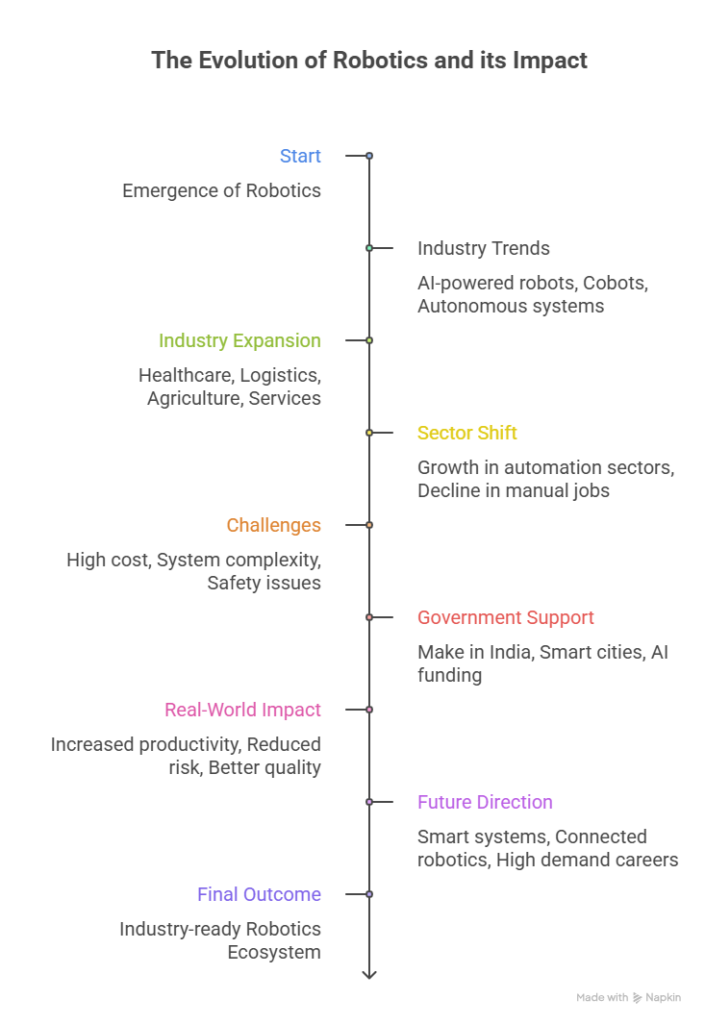
The robotics industry is undergoing rapid transformation, driven by advancements in AI, automation, and interconnected systems. Current trends such as AI-powered robots, collaborative systems, and autonomous technologies are redefining how robots are used across industries. This evolution is expanding the role of robotics beyond traditional manufacturing into areas such as healthcare, logistics, and everyday services.
At the same time, the growth of robotics is reshaping industries by creating new opportunities while transforming existing roles. While some low-skill jobs are being replaced by automation, new roles are emerging that require advanced technical skills and expertise. This shift highlights the importance of adapting to technological changes and focusing on skill development to remain relevant in the job market.
Despite its potential, the field faces several challenges, including high costs, system complexity, and reliability issues. Addressing these challenges requires continuous innovation, research, and collaboration between industry, academia, and government. Government initiatives and support programs play a crucial role in promoting the adoption of robotics and creating opportunities for professionals in this field.
Overall, Robotics Engineering has a significant impact on both society and the economy, driving productivity, improving safety, and enabling technological advancements. As the field continues to evolve, it will play a key role in shaping the future of industries and improving the quality of life, making it one of the most important and impactful areas of modern engineering.