

Fundamental Understanding of Marine Engineering
🔹What is the core problem domain this branch solves?
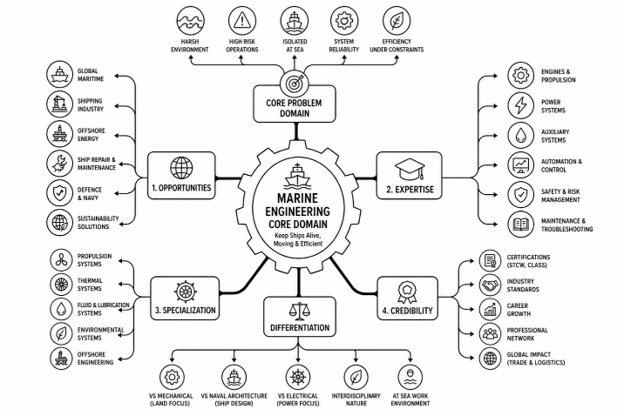
Marine Engineering is fundamentally about solving one of the toughest engineering challenges:
How to operate complex machinery reliably in one of the harshest environments on Earth—the ocean.
Unlike land-based systems, ships operate in isolated, unpredictable, and high-risk conditions, where failure is not just inconvenient—it can be catastrophic. The core problem domain revolves around ensuring that all mechanical, electrical, and thermal systems onboard a vessel function continuously, safely, and efficiently without external support.
At its heart, marine engineering deals with energy conversion, propulsion, and system reliability. A ship must generate its own power, propel itself across thousands of kilometers, and sustain operations for weeks or months. This involves managing engines, boilers, turbines, pumps, compressors, and auxiliary systems in a synchronized manner.
For example, consider a large cargo vessel crossing the Indian Ocean. The main engine must run continuously for weeks, often under varying loads and weather conditions. If the engine fails mid-sea, there is no immediate roadside assistance. Marine engineers must diagnose and fix problems using onboard resources. This makes self-reliance and technical mastery essential.
Another key problem is efficiency under constraints. Ships consume massive amounts of fuel, so even small improvements in efficiency can save millions. Engineers must optimize combustion, reduce friction losses, and maintain systems to ensure peak performance.
Environmental challenges also form a major part of the problem domain. Oceans expose machinery to saltwater corrosion, humidity, temperature fluctuations, and mechanical stress due to waves. Engineers must design systems that can withstand these conditions for long durations.
Additionally, marine engineering addresses safety and risk management. Fires, flooding, engine failure, or oil leaks can have severe consequences. Engineers must ensure systems are fail-safe and comply with strict international regulations.
Finally, the field plays a crucial role in global trade and logistics. Around 80–90% of world trade is carried by sea. Without reliable marine systems, global supply chains would collapse.
In simple terms:
Marine engineering solves the problem of keeping floating cities (ships) alive, moving, and efficient in the middle of nowhere.
🔹What are the primary outputs of this field?
The outputs of marine engineering are not just machines—they are complete functional systems that enable ships and offshore structures to operate independently in extreme environments.
The most critical output is the marine propulsion system. This includes large diesel engines, gas turbines, or hybrid systems that generate power to move the ship. These engines are designed for high efficiency, durability, and continuous operation.
For example, modern cargo ships use slow-speed two-stroke diesel engines that can run non-stop for weeks while maintaining fuel efficiency. Designing and maintaining such engines is a core output of the field.
Another major output is power generation systems onboard ships. Ships act like self-contained power plants, generating electricity for lighting, navigation systems, communication, and living quarters. Marine engineers design generators and distribution systems that ensure uninterrupted power supply.
Auxiliary systems are equally important. These include:
- Cooling systems to prevent engine overheating
- Lubrication systems to reduce wear and tear
- Fuel systems for storage, purification, and supply
- Pumping systems for water, oil, and ballast control
For instance, maintaining proper lubrication ensures engine longevity and prevents catastrophic failure.
Marine engineering also produces automation and control systems. Modern ships use sensors and software to monitor performance, detect faults, and optimize operations. These systems reduce manual workload and improve safety.
Another significant output is offshore engineering systems, such as oil rigs and floating platforms. These structures require complex machinery for drilling, extraction, and processing under ocean conditions.
Environmental protection systems are becoming increasingly important outputs. These include:
- Ballast water treatment systems
- Emission control technologies
- Oil-water separation systems
These systems ensure compliance with global environmental standards.
Finally, maintenance strategies and operational protocols are key outputs. Marine engineers develop procedures for inspection, repair, and troubleshooting to ensure long-term reliability.
In summary:
Marine engineering produces complete, self-sustaining mechanical ecosystems that keep ships running safely and efficiently.
🔹How is this branch different from closely related branches?
Marine Engineering is often confused with mechanical or naval architecture, but it has a distinct identity shaped by its environment and responsibilities.
Mechanical engineering is broad and deals with machines in general. Marine engineering applies these principles specifically to ships and offshore systems, where conditions are far more challenging.
For example, a mechanical engineer may design an engine for a factory, but a marine engineer must design an engine that can:
- Run continuously for weeks
- Operate under rolling and pitching motion
- Resist corrosion from saltwater
- Be repaired without external support
Naval architecture, on the other hand, focuses on the design and structure of the ship, including its shape, stability, and hydrodynamics. Marine engineering focuses on what happens inside the ship—engines, power systems, and machinery.
Think of it this way:
- Naval Architect → Designs the ship’s body
- Marine Engineer → Keeps the ship alive and running
Marine engineering also overlaps with electrical and environmental engineering. Ships require complex electrical systems and must comply with environmental regulations, making the field highly interdisciplinary.
Another key difference is the work environment. Most engineering branches are land-based, but marine engineers often work at sea, away from immediate support systems. This requires independence, adaptability, and resilience.
What makes marine engineering unique is not just what it studies—but where and how it is applied.
🔹What are the real-world applications of this field?
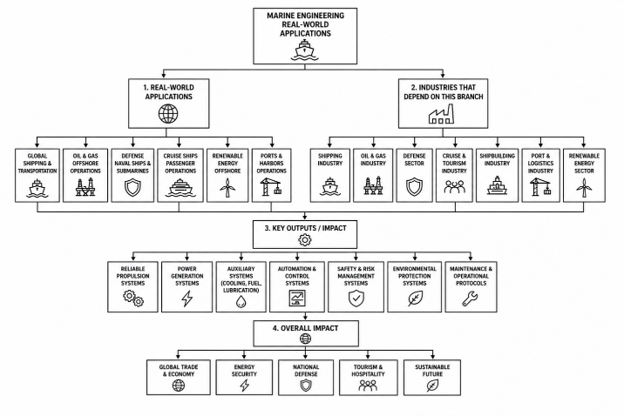
Marine engineering is deeply embedded in real-world operations that impact global economies and daily life.
The most obvious application is in global shipping and transportation. Cargo ships transport goods such as oil, food, electronics, and machinery across continents. Marine engineers ensure these ships operate efficiently and safely.
For example, when you order a product online, there’s a high chance it traveled thousands of kilometers by sea, powered by systems maintained by marine engineers.
Another major application is in the oil and gas industry. Offshore platforms rely on marine engineering for drilling, extraction, and processing. These platforms operate in extreme conditions and require highly reliable systems.
The defense sector is another critical area. Naval ships, submarines, and aircraft carriers depend on advanced marine engineering systems for propulsion, power, and safety.
Cruise ships represent a different application, focusing on passenger comfort and safety. Marine engineers ensure smooth operation of air conditioning, water supply, and entertainment systems.
The field is also expanding into renewable energy, particularly offshore wind farms and tidal energy systems. These require robust engineering solutions to operate in marine environments.
Ports and harbors also rely on marine engineering for operations such as docking systems, cargo handling, and maintenance.
In essence, marine engineering supports:
- Trade
- Energy
- Defense
- Tourism
- Sustainability
🔹What industries heavily depend on this branch?
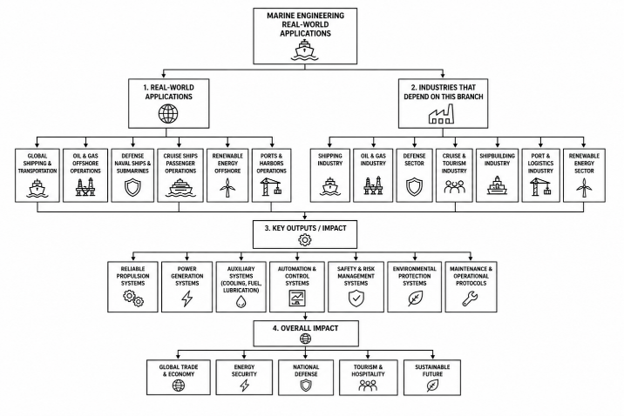
Marine engineering is essential to several major industries that drive the global economy.
The shipping industry is the largest and most important. Companies like Maersk operate massive fleets that rely on marine engineers for operation and maintenance.
The oil and gas industry depends on offshore platforms and vessels for exploration and extraction. Companies like Shell rely heavily on marine systems.
The defense sector, including organizations like Indian Navy, uses advanced marine engineering for warships and submarines.
The cruise and tourism industry depends on safe and efficient vessels to transport passengers worldwide.
Shipbuilding companies design and manufacture vessels, requiring marine engineers for system integration.
Port and logistics industries depend on marine expertise for cargo handling and operations.
The renewable energy sector, especially offshore wind farms, is an emerging area where marine engineering plays a crucial role.
These industries collectively ensure that marine engineering remains a high-demand and globally relevant field.