

Q1. What is the core problem domain this branch solves?
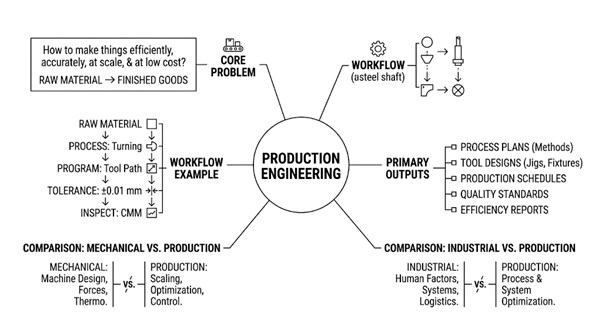
Production Engineering exists to answer one fundamental question: “How do we make things — efficiently, accurately, at scale, and at the lowest possible cost?” Every industrial product you see around you — your mobile phone, your bicycle, the car you ride, the medicines you take — passed through a production engineering system at some point.
The core problem domain is the transformation of raw materials into finished goods through a set of controlled, optimised, and economically viable manufacturing processes. Think of it this way: a mechanical engineer might design an engine component, but the production engineer figures out how to make ten thousand identical copies of it per day, with zero defects, using the least amount of material, energy, and time.
Step-by-Step Example: A steel shaft must be machined. Step 1 — Choose raw material (bar stock). Step 2 — Select the process (turning on CNC lathe). Step 3 — Design the tool path (G-code programming). Step 4 — Set tolerances (e.g., ±0.01 mm). Step 5 — Inspect using CMM. This entire workflow is production engineering.
Q2. What are the primary outputs of this field?
The primary outputs of Production Engineering are not just physical products. They include: process plans (documents defining each manufacturing step), tool designs (jigs, fixtures, cutting tools), production schedules (who does what and when), quality standards (acceptance criteria for every part), and efficiency reports (OEE, cycle time, yield rates). In essence, production engineers create the “recipe” that a factory follows to turn raw material into a saleable product.
Q3. How is this branch different from closely related branches?
This is one of the most common points of confusion for beginners. Let me clarify the boundaries clearly. Mechanical Engineering deals with the physics and design of machines — forces, thermodynamics, fluid mechanics. Production Engineering focuses on using those machines to manufacture goods at scale. Industrial Engineering broadens the scope to include human factors, systems, logistics, and supply chains. Manufacturing Engineering is often used interchangeably with Production Engineering, but in academic contexts, manufacturing engineering tends to focus more on materials and process science, while production engineering emphasises planning, control, and optimisation of the entire production system.
Example: If a company wants to build a gear, the mechanical engineer designs it, the materials engineer selects the alloy, the production engineer determines whether to mill it or hobble it, sets the cutting speed, plans the sequence, and ensures the output rate matches market demand.
Q4. What are the real-world applications of this field?
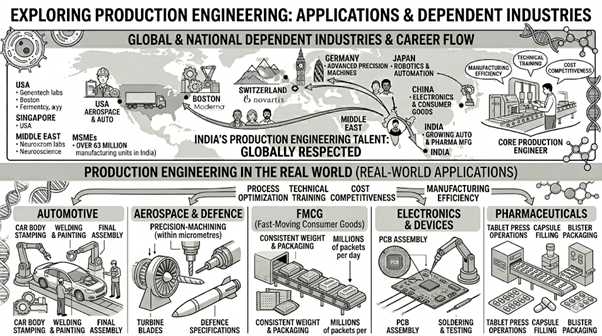
Production Engineering touches virtually every manufactured good in existence. In the automotive industry, it governs how car bodies are stamped, welded, painted, and assembled. In aerospace, it controls how turbine blades are precision-machined to within micrometres. In FMCG (Fast-Moving Consumer Goods), it manages how millions of soap bars or biscuit packets are produced each day with consistent weight and packaging. In defence, it ensures that rifle barrels and missile casings meet exact specifications. In electronics, it controls the PCB assembly, soldering, and testing of devices. Even in the pharmaceutical industry, production engineering principles govern tablet press operations, capsule filling, and blister packaging lines.
Q5. What industries heavily depend on this branch?
The industries that are most dependent on Production Engineering include: Automotive (Tata, Mahindra, Maruti, Hyundai, Toyota), Aerospace and Defence (HAL, DRDO, Hindustan Aeronautics, BEL), Heavy Engineering (L&T, BHEL, Thermax), FMCG (HUL, ITC, P&G, Nestle), Steel and Metals (SAIL, Tata Steel, JSW), Tool and Die Manufacturing (Bharat Forge, UCAL), and Electronics Manufacturing (Dixon, Samsung India, Foxconn India). India alone has over 63 million MSMEs (Micro, Small & Medium Enterprises), most of which are manufacturing units that run on production engineering principles.
Conclusion:
Production Engineering focuses on designing, managing, and improving manufacturing processes. It plays a key role in industries by increasing efficiency, reducing costs, and ensuring product quality.
CTA:
If you’re interested in machines, manufacturing, and problem-solving, this field is worth exploring. Continue to Day 2 to understand the core subjects required in production engineering.