
Q1. What are the key subjects I must master in this branch?
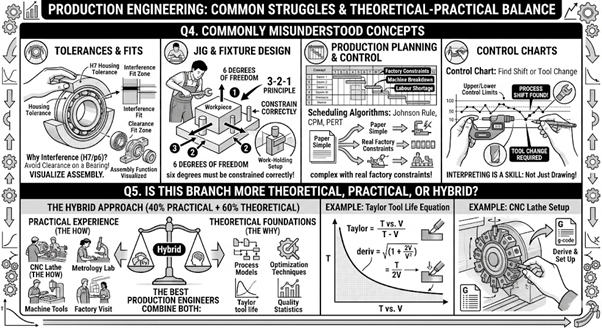
Let me list the subjects in logical learning order, the way a well-structured curriculum should present them. In your first two years, you will study Engineering Mathematics (essential for process modelling), Engineering Mechanics (forces, equilibrium), Engineering Drawing and CAD (how to read and create blueprints), Material Science (properties of metals, polymers, ceramics), and Basic Manufacturing Processes (casting, forging, welding, machining basics). In your third and fourth years, the core production engineering subjects take over: Theory of Metal Cutting (how tools remove material), Machine Tool Design, Metrology and Quality Control, Production Planning and Control (PPC), Industrial Engineering and Operations Research, Jig and Fixture Design, and Computer-Aided Manufacturing (CAM).
Real-world relevance example: Metrology teaches you to use a micrometer, Vernier caliper, CMM, and go/no-go gauges. On the factory floor on Day 1, a quality manager will hand you one of these tools and expect you to know exactly what to do.
Q2. What level of mathematics is required?
Production Engineering requires a strong foundation in applied mathematics. You will need calculus for understanding tool wear curves and thermal models. Differential equations appear in vibration analysis of machine tools. Linear algebra and matrix methods are used in operations research problems like linear programming for production scheduling. Statistics — especially normal distribution, control charts, hypothesis testing — is central to Statistical Process Control (SPC) and Six Sigma. Numerical methods are used in simulation of manufacturing systems. The good news: you do not need to become a pure mathematician. The math is always applied to a physical or industrial problem, which makes it far more intuitive.
Beginner Tip: Start practicing statistics early. Tools like Minitab, SPSS, and Excel are used daily in quality departments. Even a basic knowledge of mean, standard deviation, and Cp/Cpk values will set you apart from peers.
Q3. Which scientific principles are fundamental here?
The foundational sciences are Physics (mechanics, thermodynamics, tribology — friction and wear between surfaces), Chemistry (metallurgy, heat treatment, surface finishing), and Materials Science (understanding how steel behaves differently from aluminium or titanium under machining). Thermodynamics governs heat generation in cutting zones. The Taylor Tool Life Equation (VT^n = C) — a fundamental formula in production engineering — directly models how cutting speed affects how long a tool lasts before it wears out.
Q4. What are the most difficult concepts students struggle with?
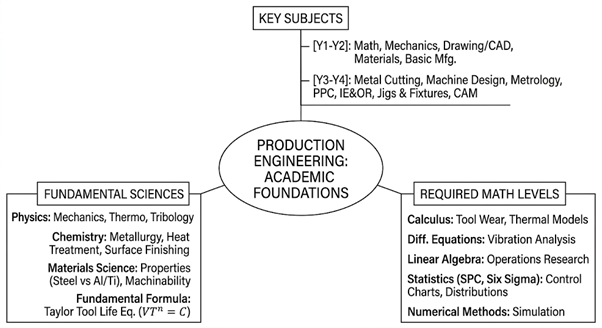
In my 50 years of industry and interaction with fresh graduates, the four most commonly misunderstood areas are: First, Tolerances and Fits — students memorise definitions but cannot apply them. Example: Why is an H7/p6 interference fit used for a bearing housing and not a clearance fit? Understanding this requires visualising assembly function, not just charts. Second, Jig and Fixture Design — students struggle with the 3-2-1 principle of work-holding, i.e., six degrees of freedom must be constrained correctly. Third, Production Planning and Control — scheduling algorithms like Johnson Rule, Critical Path Method (CPM), and PERT look simple on paper but become complex with real factory constraints. Fourth, Control Charts — drawing a chart is easy; interpreting it to find a process shift or a tool change requirement is a skill that takes deliberate practice.
Q5. Is this branch more theoretical, practical, or hybrid?
Production Engineering is unarguably the most practical branch of engineering. At least 40% of your learning should happen in workshops, on machine tools, in metrology labs, and in factory visits. However, the theoretical foundations — process models, optimisation techniques, quality statistics — are equally important because they allow you to understand WHY a process works, not just HOW to run it. The best production engineers combine both: they can derive the Taylor tool life equation AND set up a CNC lathe.
Conclusion:
Subjects like mechanics, material science, and manufacturing processes form the foundation of production engineering. These concepts are essential for understanding how products are made efficiently.
CTA:
Focus on building strong fundamentals from the beginning. Save this guide and move to Day 3 to explore important tools and software used in production engineering.