
Q1. What software tools are essential?
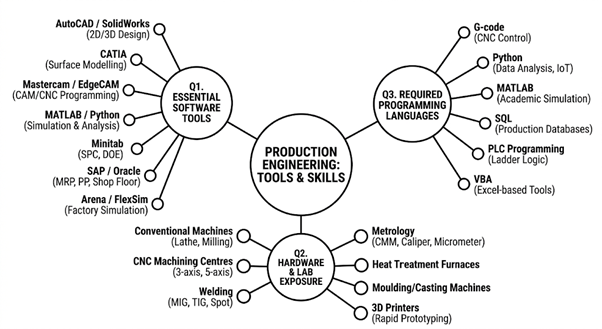
Every production engineer must be proficient in a set of software tools. AutoCAD or SolidWorks is used for 2D and 3D design and engineering drawing. CATIA is the gold standard in aerospace and automotive for complex surface modelling. Mastercam or EdgeCAM is used for generating CNC programs (G-code and M-code) from 3D models — this is called Computer-Aided Manufacturing (CAM). MATLAB or Python is used for process simulation, data analysis, and automating quality calculations. Minitab is the industry standard for statistical process control, Cp/Cpk analysis, regression, and DOE (Design of Experiments). SAP or Oracle Manufacturing Cloud handles Production Planning (PP) modules, material requirements planning (MRP), and shop floor control. Arena or FlexSim are discrete-event simulation tools used to model factory workflows and find bottlenecks before spending on physical changes.
Real Industry Example: An automotive plant in Pune uses SolidWorks to design a fixture → Mastercam to generate CNC code → MATLAB to simulate thermal behaviour of the cutting process → Minitab to run SPC on the output dimensions → SAP to schedule production. You may be expected to use ALL of these in one week.
Q2. What hardware or lab exposure is required?
You must get hands-on experience with the following: Conventional machine tools — lathe, milling machine, drilling machine, grinding machine. These are the basics. CNC Machining Centres — both 3-axis and 5-axis. You should be able to write, edit, and simulate a simple G-code program. Welding equipment — MIG, TIG, spot welding. Metrology instruments — Vernier caliper, micrometer, dial gauge, CMM (Coordinate Measuring Machine), surface roughness tester, hardness tester. Heat treatment furnaces — for understanding annealing, hardening, tempering. Injection moulding and die-casting machines — for polymer and casting process understanding. 3D Printers (FDM, SLA, SLS) — increasingly relevant in rapid prototyping and additive manufacturing.
Q3. Which programming languages (if any) are needed?
G-code is the CNC programming language you must know — it controls every movement of a CNC machine. Python is rapidly becoming the most valuable programming language for production engineers, used in data analysis, machine learning for quality prediction, and IoT integration on the shop floor. MATLAB is important for academic simulation and control system design. SQL is useful for querying production databases. PLC programming (Ladder Logic, Structured Text) is essential if you work in automation. VBA (Visual Basic for Applications) is still widely used in Excel-based production planning tools in mid-sized Indian manufacturing companies.
Q4. What are the must-have technical skills for freshers?
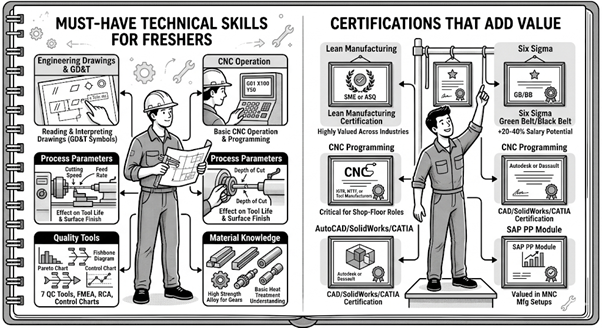
Hiring managers in top manufacturing companies look for freshers who can demonstrate the following: Reading and interpreting engineering drawings, including GD&T (Geometric Dimensioning and Tolerancing) symbols. Basic CNC operation and programming. Understanding of process parameters — cutting speed, feed rate, depth of cut and their effect on tool life and surface finish. Knowledge of quality tools — 7 QC tools, control charts, FMEA, root cause analysis. Material knowledge — which alloy for which application, basic heat treatment understanding. Production planning concepts — capacity planning, scheduling, OEE calculation.
Q5. What certifications add value in this domain?
Certifications that directly increase your employability and salary: Lean Manufacturing Certification (from SME or ASQ) — highly valued across industries. Six Sigma Green Belt (or Black Belt) — adds 20–40% to your salary potential. CNC Programming Certification (offered by IGTR, NTTF, or tool manufacturers) — critical for shop-floor roles. AutoCAD/SolidWorks/CATIA Certification — from Autodesk or Dassault. SAP PP (Production Planning) Module Certification — valued in MNC manufacturing setups. Industry 4.0 / IoT in Manufacturing certification — forward-looking and increasingly asked for. Project Management Professional (PMP) — for senior and managerial roles.
Conclusion:
Tools like AutoCAD, SolidWorks, and CNC programming are essential for modern production engineers. These technologies help in designing and optimizing manufacturing processes.
CTA:
Start learning one tool at a time and practice regularly. Follow this series and check out Day 4 to begin working on practical projects.