
Tools, Technologies & Skills
🔹What software tools are essential?
Modern marine engineering is heavily supported by digital tools that improve design, analysis, and operation.
AutoCAD is widely used for designing ship components and layouts. Engineers use it to create precise technical drawings.
ANSYS is used for simulation and analysis. It helps engineers understand stress, vibration, and thermal behavior of components before actual production.
MATLAB is used for numerical analysis and system modeling. It is especially useful in control systems and performance optimization.
Specialized marine software like NAPA and Tribon are used for ship design and stability analysis.
These tools allow engineers to simulate real-world conditions virtually, reducing the need for expensive physical testing.
For example, instead of physically testing engine performance under different loads, simulations can predict outcomes accurately.
Software tools enhance efficiency, accuracy, and decision-making.
🔹What hardware or lab exposure is required?
Marine engineering is incomplete without hands-on experience with real machinery.
Students work with:
- Marine engines
- Boilers
- Pumps and compressors
- Heat exchangers
- Fuel systems
Engine room simulators provide a realistic ship environment, allowing students to practice operations safely.
For example, students learn how to start an engine, monitor parameters, and handle emergency situations.
Workshops teach machining, welding, and maintenance skills, which are essential for onboard repairs.
Onboard training is the most critical exposure. It teaches engineers how to work under real conditions—limited resources, high pressure, and continuous operation.
Practical exposure builds confidence, skill, and decision-making ability.
🔹Which programming languages (if any) are needed?
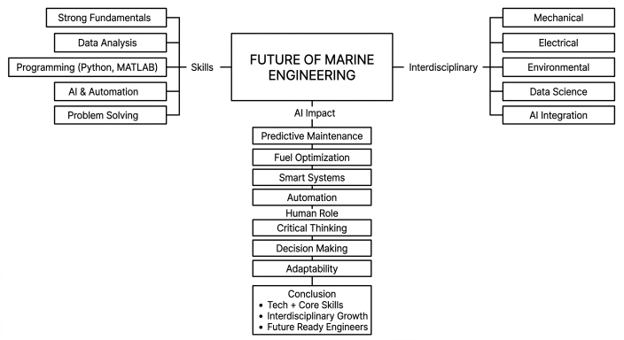
Programming is not mandatory, but it is becoming a strong advantage in modern marine engineering.
Python is widely used for data analysis, automation, and predictive maintenance. Engineers can analyze engine data to detect early signs of failure.
MATLAB is used for simulation and control system design.
Programming helps in handling large datasets, improving efficiency, and supporting AI-based systems.
For example, predictive maintenance systems use data to identify when a component might fail, reducing downtime.
Engineers with coding skills have better career flexibility and future opportunities.
🔹What are the must-have technical skills for freshers?
Freshers must focus on building a strong core skill set that combines theory and practice.
Key skills include:
- Understanding of marine engines and propulsion systems
- Knowledge of electrical and control systems
- Troubleshooting and maintenance ability
- Safety awareness and emergency handling
- Basic workshop and repair skills
For example, identifying the cause of engine overheating quickly is a critical skill.
Soft skills like communication and teamwork are also important because ship operations require coordination among crew members.
👉 Employers look for engineers who can think, act, and solve problems under pressure.
🔹What certifications add value in this domain?
Certifications are not optional in marine engineering—they are mandatory for career progression.
The most important certification is STCW (Standards of Training, Certification, and Watchkeeping), regulated by the International Maritime Organization.
Engineers must also obtain Certificates of Competency (CoC) to move up in ranks.
Safety certifications such as:
- Firefighting
- First aid
- Survival training
are essential for working onboard ships.
These certifications ensure that engineers meet international safety and operational standards.
Without certifications, you cannot legally work as a marine engineer.

Conclusion
Marine engineering today is a skill-driven field supported by advanced software, real machinery exposure, and mandatory certifications. Tools like AutoCAD, ANSYS, and MATLAB improve design and analysis, while hands-on training with engines and simulators builds real-world confidence. Programming is becoming an added advantage, but core technical and troubleshooting skills remain the most important. Certifications are essential, as they define your eligibility and career growth in this field.
Call to Action
Start building practical skills early. Learn basic software tools, get comfortable with machinery through labs or workshops, and understand how real ship systems work. If possible, begin learning Python for future advantage. Most importantly, stay aware of required certifications and plan your path accordingly. Skills plus certification is what makes you industry-ready.