
Q1. What are some beginner-level projects in this branch?
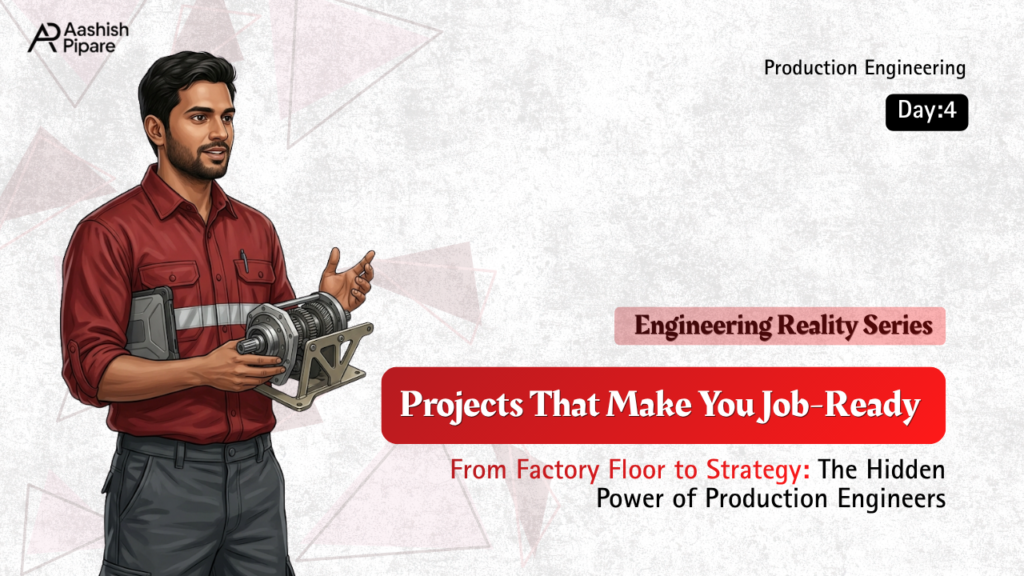
Beginner projects are designed to build hands-on confidence and understanding of individual manufacturing processes. At this stage, focus on one process at a time. A highly recommended first project is designing and fabricating a simple component — say, a stepped shaft — on a conventional lathe, then measuring it with a micrometer to check whether your dimensions match the drawing. This single project teaches you process planning, tool selection, machine operation, measurement technique, and quality inspection all at once.
Other beginner projects include: 5S implementation in your college workshop (Sort, Set in Order, Shine, Standardise, Sustain — this is the foundation of Lean manufacturing). Manual process mapping of a college canteen or small factory. A simple jig design for drilling equally spaced holes on a circular plate. Basic motion study using a stopwatch to calculate the standard time for a manual assembly task. A small time-study project measuring the cycle time for packing T-shirts in a garment factory.
Q2. What are industry-level projects I should aim for?
Industry-level projects demonstrate that you can solve real business problems. As you advance to your third and fourth year, target projects like: Reducing setup time on a CNC machine using SMED (Single Minute Exchange of Die) methodology — a classic lean project. Improving Overall Equipment Effectiveness (OEE) from, say, 65% to 80% in a machining centre by reducing downtime and scrap. Designing a welding fixture to improve repeatability and reduce cycle time in an automotive subframe assembly line. Implementing a Statistical Process Control (SPC) system on a high-volume turning line, with real-time monitoring of critical dimensions. A Value Stream Mapping (VSM) exercise on an entire production line — mapping every step, every wait time, every inventory buffer, and then designing a future-state map that eliminates waste.
Gold Standard Project: Combine VSM + SPC + OEE improvement in a single project with measurable before/after data. This type of project will stand out in any interview, because it shows you understand the entire production system, not just one tool.
Q3. How can I build a portfolio in this domain?
A portfolio for a production engineer is different from a software developer’s GitHub repository, but equally powerful when done right. Document every project with a problem statement, methodology, tools used, data collected, analysis performed, results achieved, and lessons learned. Use photographs, SolidWorks models, CAD drawings, control charts, and VSM diagrams. Create a professional PDF portfolio. Set up a LinkedIn profile and upload project summaries. If you have access, upload drawings and analysis files to GitHub or Google Drive and share links. A well-documented portfolio of even three good projects will put you ahead of 90% of candidates who only have marks and certificates.
Q4. What kind of internships should I target?
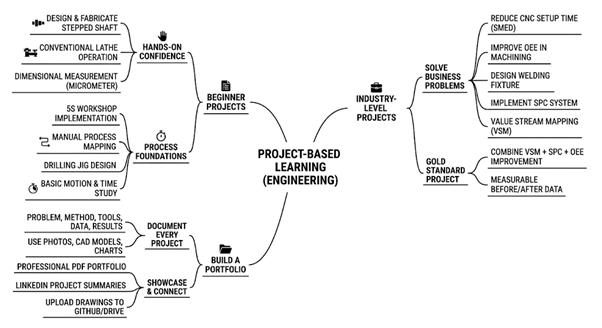
Target internships in manufacturing companies, specifically in their Production, Quality, or Industrial Engineering departments. The best internships are in automotive plants, aerospace MRO (Maintenance, Repair and Overhaul) facilities, FMCG production lines, defence manufacturing units, and precision engineering MSMEs. During an internship, volunteer for project work beyond your assigned task. Observe every process. Ask questions. Take notes. A student who interned at Bosch Nashik and contributed to a changeover time reduction project is more valuable to employers than one who spent eight weeks only filing reports.
Q5. Are there open-source or real-world problems I can work on?
Yes. The National Manufacturing Competitiveness Programme (NMCP) of the Indian government regularly publishes industrial problems. The Quality Council of India (QCI) publishes case studies. NITI Aayog’s Make in India portal lists sector-specific challenges. Internationally, the Society of Manufacturing Engineers (SME) and the American Society for Quality (ASQ) publish case study competitions. Open-source simulation tools like SimPy (Python-based discrete event simulation) allow you to model real production problems. You can also approach local MSMEs and offer to do a free process improvement study — this is a win-win, and many students who have done this have been hired directly by the same company.
Conclusion:
Hands-on projects help you understand production engineering concepts better. Working on real-life problems improves your technical and problem-solving skills.
CTA:
Choose a simple project and start today. Continue to Day 5 to explore career opportunities in production engineering.